

If you play live, the short answer is this: custom musician earplugs can cut stage noise by about 9–25 dB without ruining the sound - but only if the fit and filter are right.
From what I see in the research, the main point is simple. Standard foam plugs often dull high frequencies and make music sound muffled. Custom plugs with flat filters tend to keep pitch, tone, and cues much closer to normal, while still lowering risky sound levels such as 95–115 dB SPL.
Here’s the quick take:
- Custom plugs usually sound clearer than foam plugs
- Flat attenuation matters more than raw dB numbers
- Fit is a big deal; a poor seal can hurt both clarity and protection
- 15–17 dB filters are often the middle-ground choice for amplified gigs
- 9 dB filters suit quieter acoustic settings
- 25 dB filters suit very loud stages, such as drummers or heavy bands
- If you still get ringing after a show, your setup may not be enough
Why Custom Earplugs Are a Game Changer
sbb-itb-80b2a19
Quick comparison
| Type | Sound clarity | Tonal balance | Noise reduction | Best use |
|---|---|---|---|---|
| Custom musician earplugs | Better overall | Flat across frequencies | 9–25 dB | Stage, rehearsal, teaching |
| Pre-moulded high-fidelity plugs | Decent | Fairly even | Around 20 dB | Lower-cost music use |
| Foam earplugs | Poorer for music | Highs cut more than lows | Often high, but uneven | Loud non-music settings |
I’d sum it up this way: the best earplug for musicians is the one that protects your hearing, keeps the mix usable, and stays in for the whole set.
How Studies Measure Clarity and Attenuation
These studies look at two core issues: whether custom earplugs vs. foam earplugs keep musical detail intact, and how much sound they cut. To do that, researchers use a mix of lab work and live rehearsal or performance settings. That matters, because testing in a silent room is one thing; testing while musicians are playing in an ensemble is another.
Participant Groups and Study Designs
Most studies involve university-level student musicians or professional orchestral musicians, sometimes with small listener panels added in. The samples are usually small - between 5 and 36 participants - and the study periods are short, often 7 to 14 days. So while the early results are useful, they don't tell us much about how players adjust over months or years.
How Sound Clarity and Musical Perception Are Tested
Researchers often ask musicians to score their own experience using Likert-scale surveys, usually on a 1–5 scale. These surveys cover things like the clarity of their own sound, the clarity of the orchestra, pitch accuracy, timbre, and overall playing ability. To limit recall bias, the ratings are usually taken straight after the performance.
Some studies also try to check what listeners hear, not just what performers feel. A common method is ABX discrimination testing. Listeners hear two recordings - one with performers wearing hearing protection and one without - and then try to work out which is which. In one study, listeners could not reliably tell the two apart, which points to no clear drop in perceived sound quality.
How Hearing Protection Is Measured
Protection is usually measured with REAT or HATS. Some studies also track temporary threshold shift before and after a performance, and use real-ear measurement to check fit. Each method tests a different part of the puzzle, which is why researchers often combine them.
There is a catch, though. These methods do not always line up neatly. The biggest gaps tend to show up at 250 Hz and 4,000 Hz.
The table below shows the main study designs and what each one measures.
| Study Setting | Participants | Clarity Measures | Protection Measures |
|---|---|---|---|
| Orchestral Recording Session | 36 student musicians (strings, brass, woodwinds, percussion) | 12-item Likert scale survey (clarity of self/orchestra, pitch, playing ability); ABX listener discrimination | Peak sound levels near the conductor's podium |
| Anechoic Lab Chamber | 5 normal-hearing subjects + Artificial Head and Torso Simulator (HATS) | REAT; insertion loss across frequency bands | |
| ABX Listening Lab | 10 experienced (music majors) + 10 untrained listeners | Identification of recordings made with and without earplugs |
What the Evidence Shows About Sound Clarity
Naturalness, Tonal Balance and Reduced Muffling
These listening tests matter because flatter attenuation tends to line up with better perceived clarity.
Standard foam plugs reduce sound unevenly. They cut high frequencies more than low ones, by about 20–33 dB in the upper range, which is why music often sounds muffled. Custom musician earplugs work differently. They preserve the ear's natural boost of about 17 dB around 2,700 Hz and keep attenuation flatter across frequencies. High-fidelity plugs are built to keep attenuation flat, so timbre stays closer to what you'd hear with an open ear.
Real-ear measurements of ER-15 custom plugs found an average flat attenuation of 15 dB across frequencies. Musicians wearing high-fidelity earplugs also did better on pitch discrimination tasks than those using standard protection.
The table below sums up how each type performs on the clarity outcomes that matter most to musicians.
| Clarity Outcome | Custom Musician Earplugs | Pre-moulded High-Fidelity | Foam Earplugs |
|---|---|---|---|
| Naturalness | Excellent; replicates open-ear resonance | Fair to good | Poor; muffled |
| Tonal Balance | Very flat; filter options of 9, 15, 17 or 25 dB | Relatively flat; ~20 dB | Unbalanced; loses highs |
| Ensemble Awareness | High | Moderate | Low |
| Communication | Excellent; vented designs reduce occlusion | Good | Difficult |
Communication, Ensemble Awareness and Adaptation
Clarity matters most when musicians still need to hear cues, balance and dynamics as they happen.
In loud ensemble settings, overload distortion is a real problem. The ear itself can start to distort sound when input levels get too high. High-fidelity plugs lower that input, which can make separate instruments easier to pick out. Many musicians adjust after a short period of regular use, though balance and dynamics can feel different at first.
Where the Evidence Falls Short
A lot of the remaining variation in results comes down to fit, canal shape and bore size.
Ear shape and bore size can change high-frequency response, so fit has a big effect on clarity. Poor fit is the main reason some custom plugs lose high-frequency detail. So when studies report weaker clarity results, part of that may come from fit problems, not from the tech itself.
What the Evidence Shows About Noise Reduction and Safe Use
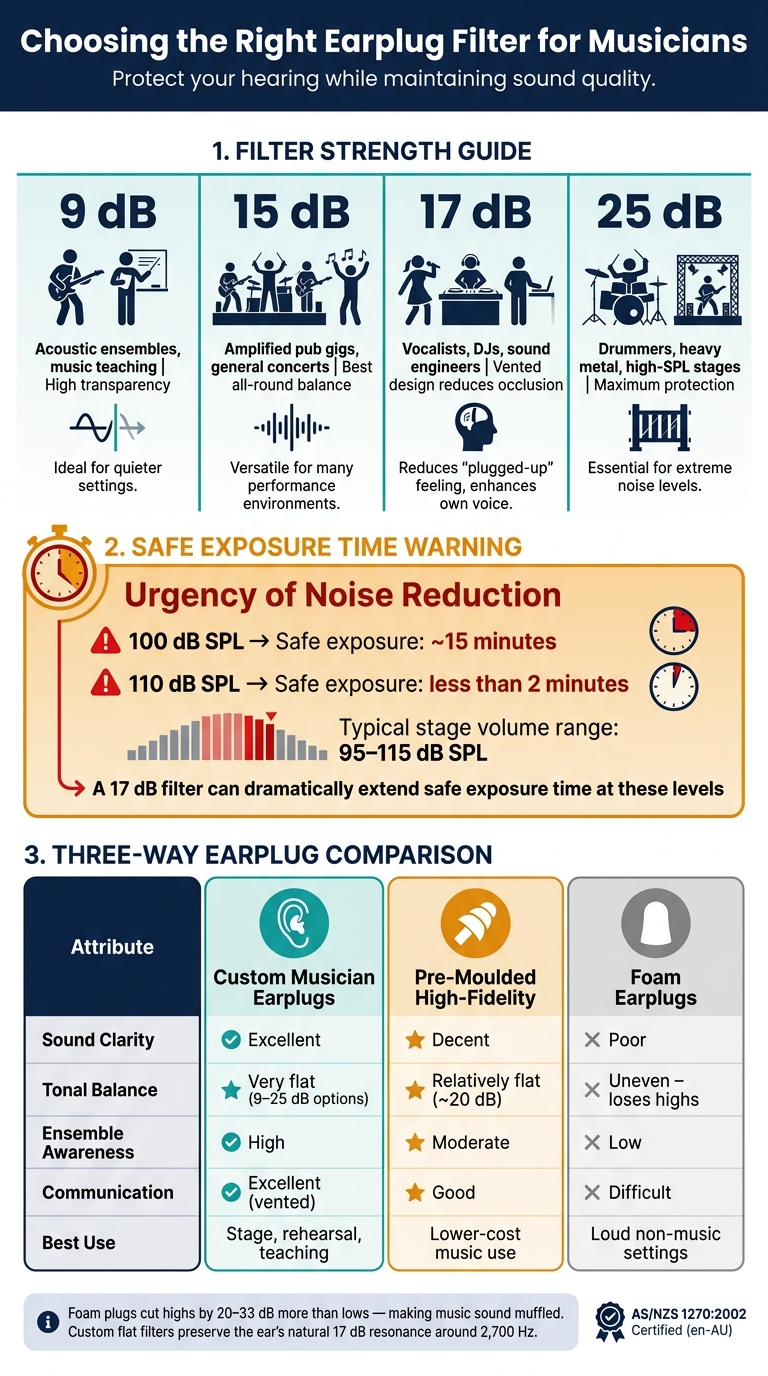
Musician Earplugs Compared: Custom vs Pre-Moulded vs Foam
Measured Attenuation in Live and Test Conditions
Once clarity is in place, the next step is simple: is the filter strong enough to keep sound exposure in a safe range?
Custom musician earplugs usually cut sound by 9 to 25 dB, depending on the filter installed. Just as important, that reduction tends to stay fairly even across frequencies from 125 Hz to 8,000 Hz. That matters because the main safety gain isn't just lower volume. It's steady reduction across the spectrum, so music still sounds balanced instead of oddly muffled.
The numbers get serious fast. At 100 dB SPL, safe exposure time drops to about 15 minutes. At 110 dB SPL, it falls to less than two minutes. So a 17 dB filter can make a big difference when stage volume starts pushing into that range.
There is one catch, though. Lab ratings don't always line up with what happens in daily use. Fit, ear canal shape, and how the plug sits in the ear can all change the result. That's why Real-Ear Measurement (REM) is recommended to check whether a custom earplug is delivering its stated protection in a given person's ear canal.
Effects on Temporary Hearing Changes
Temporary threshold shift and that familiar post-gig ringing are signs that the sound level got past the protection in use. If ringing sticks around after a show, that's a stronger warning that the filter may be too light for the stage level.
In plain terms, if your ears are still buzzing on the way home, something isn't working well enough. That is why filter strength can't be judged on paper alone. It also has to be judged by what happens after hours of actual wear.
Choosing Filter Strength Without Losing Compliance
The best filter is the one musicians will keep in for the whole set.
That's where the trade-off comes in. Too little attenuation, and protection may fall short. Too much, and some players pull the plugs out halfway through because the sound feels distant or off. A six-month study of 24 musicians found that wear rates still dropped over time, which shows that comfort by itself does not keep people using earplugs consistently.
| Filter Strength | Typical Setting | Attenuation | Suitability Note |
|---|---|---|---|
| 9 dB | Acoustic ensembles, music teaching | 9 dB | High transparency; suited to low-volume settings |
| 15 dB | Amplified gigs, general concerts | 15 dB | Good middle ground; balances protection with audibility |
| 17 dB | Vocalists, DJs, amplified performers | 17 dB | Vented design reduces occlusion for singers |
| 25 dB | Drummers, heavy metal, high-SPL stages | 25 dB | Maximum protection; can reduce awareness of cues and room sound |
For most amplified band work, 15–17 dB filters are the usual pick. For quieter acoustic settings, 9 dB filters make more sense when transparency matters more than maximum reduction.
What This Means for Australian Musicians
Design Features Linked to Better Clarity and Predictable Protection
The research points to a simple takeaway: clear sound comes down to fit and filter design, not just the dB rating. Three features stand out most often: flat filters, a stable custom seal, and vented shells.
A custom mould helps keep the seal steady when your jaw moves. That matters a lot if you sing or play a wind instrument. In those cases, ear impressions should be taken with the mouth slightly open. Vented filter designs can also cut the occlusion effect for vocalists and wind players, because they let sound move in both directions. Medical-grade silicone can make long sessions easier on the ears, with less fatigue.
Put simply, each feature does a different job:
- Flat filters help with pitch accuracy
- Custom shells keep the seal more stable
- Vented designs cut down occlusion
- Interchangeable filters help you match your protection to the gig
If a product is certified to AS/NZS 1270:2002, that gives you a recognised local benchmark for attenuation.
Matching Earplugs to Different Performance Settings
Once the design is sorted, the next step is picking the right attenuation for the room. And that matters, because Australia’s live music scene runs from quiet teaching spaces to loud pub stages.
A 9 dB filter suits music teachers and acoustic ensembles, where sound transparency matters most. For amplified pub gigs, 15 dB is often the best all-round pick. Vocalists, DJs, and sound engineers may lean toward 17 dB, while drummers and performers standing close to a high-output PA should look at 25 dB.
One of the handiest parts of interchangeable filters is that one mould can work across different settings. So you’re not starting from scratch every time the venue changes.
If the fit starts to feel loose, or you notice muffled hearing or new tinnitus after use, book a hearing check.
Conclusion: Key Research Takeaways
For live performance, the big factors are fit, filter choice, and wearing them every time. For Australian musicians moving between rehearsal rooms and loud stages, the evidence points to custom-moulded earplugs with interchangeable filters matched to the setting.
FAQs
How do I know which filter strength I need?
The right filter strength comes down to where you play and how much noise you're around.
- 9 dB: music teachers, acoustic performers, and rehearsals
- 15 dB: a solid all-round pick for many musicians and concert-goers
- 17–25 dB: rock or metal performers, drummers, and anyone standing near high-output PA systems
With ACS Custom’s user-swappable filters, you can use the same custom-moulded shell in different settings and just change the filter to suit the job.
Can custom earplugs affect singing or wind playing?
Yes. Custom earplugs can affect singing and wind playing because they change how you hear sound through the occlusion effect.
When the ear canal is sealed, your own voice or instrument can sound louder, boomier, or a bit unnatural. That can be a headache for wind and brass players, especially horn players, because the sound inside your head shifts in a way that feels off. Some singers, though, may like a slight occlusion effect because it helps them monitor their own voice more easily.
How often should custom earplugs be checked for fit?
The research doesn’t set out a fixed timetable for checking the fit of custom earplugs. What it does make clear is that professional fit verification matters during the initial manufacturing process.
Even small fit problems can affect how well the earplugs work. That’s why proper care helps custom-moulded earplugs stay consistent and effective across their expected lifespan.


