

If you need the short answer: custom IEMs suit regular stage or studio use, while universal IEMs suit fast purchase, lower upfront spend, and shared use.
I’d boil it down to this:
- Choose custom IEMs if you want the most stable fit, stronger noise blocking, and the same sound each time
- Choose universal IEMs if you need them now, want to spend less up front, or may share them with other people
- Custom models can block about 26–28 dB of outside noise, while universal models often block around 8–9 dB
- Custom models usually take 4–8 weeks after impressions are received
- Custom pricing often sits around $500–$2,100 AUD, plus audiologist and impression costs
Before I decide, I’d check four things:
- Use case: stage, studio, commuting, casual listening
- Fit and comfort: long sessions, movement, talking, singing
- Sound consistency: bass, seal, repeatable monitoring
- Ownership: lead time, cleaning, tip changes, one-user vs shared use
Universal fit vs Custom In-Ear Monitors!
sbb-itb-80b2a19
Quick Comparison
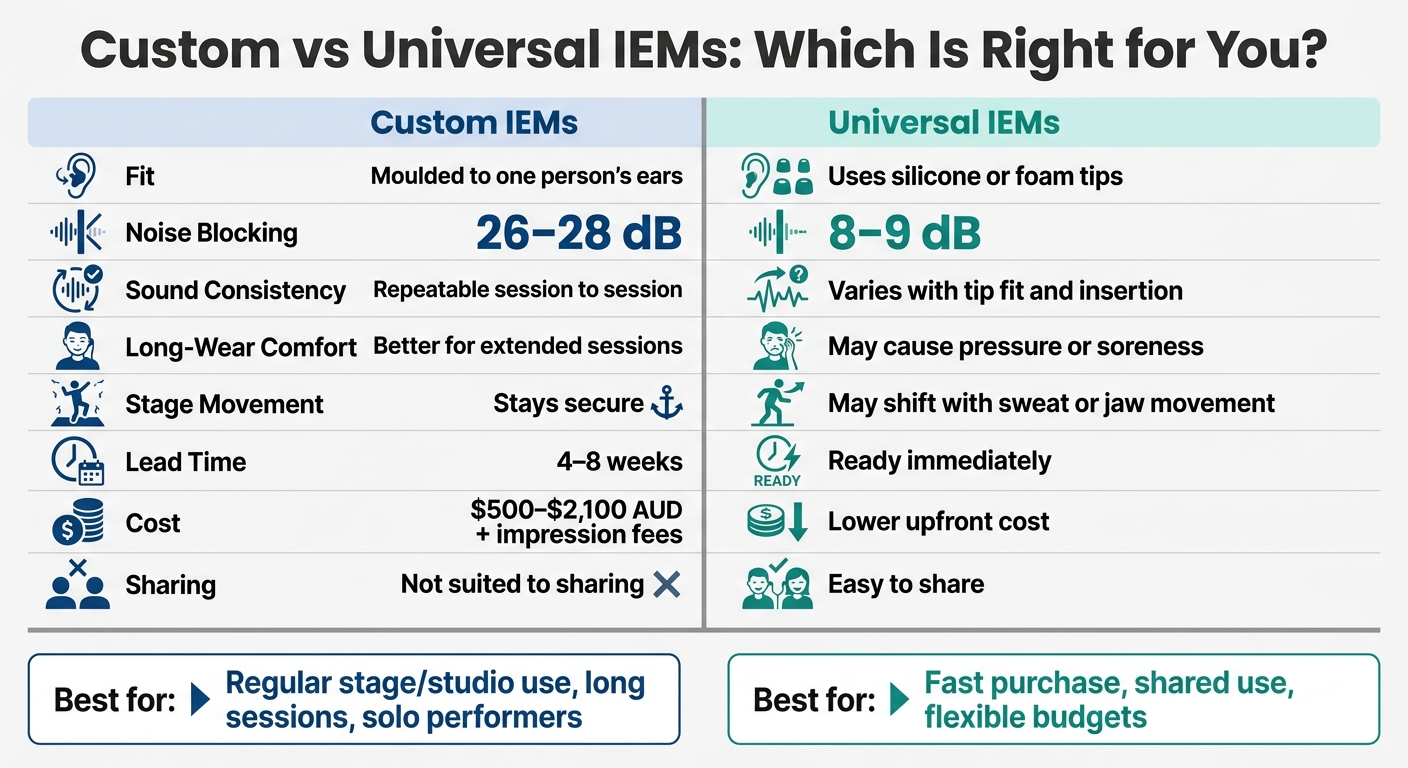
Custom vs Universal IEMs: Side-by-Side Comparison
| Checkpoint | Custom IEMs | Universal IEMs |
|---|---|---|
| Fit | Custom earplugs vs. foam earplugs differ in fit; custom versions are moulded to one person’s ears while universal ones use silicone or foam tips | |
| Noise blocking | About 26–28 dB | About 8–9 dB |
| Sound consistency | More repeatable session to session | Can change with tip fit and insertion |
| Comfort over time | Often better for long wear | Can cause pressure or soreness |
| Movement on stage | More secure | May shift with sweat or jaw movement |
| Lead time | Usually 4–8 weeks | Ready to use straight away |
| Cost | Higher upfront; extra impression fees | Lower upfront in most cases |
| Sharing | Not suited to sharing | Easy to share |
If I were buying for live work, recording, or long sessions, I’d look hard at custom. If I needed a fast, lower-cost option with more flexibility, I’d go universal.
What to check before you decide
Before you go any further, run through these three questions. The answers usually point you in the right direction faster than staring at a long spec sheet.
How often and why you will use them
Start with how you'll use them day to day.
If you're a gigging musician playing loud stages on a regular basis, custom IEMs make a lot of practical sense. The shell stays secure in your ear even when you're moving around hard on stage. And if you're recording in the studio, a custom fit can also help cut audio bleed during recording.
On the other hand, if the gear needs to be shared with engineers or bandmates, universals are the easier option. A custom shell is moulded for one person, so it can't simply be handed to someone else.
That one answer tends to shape both your budget and your timeline.
Budget and lead time
Custom IEMs cost more upfront, and that's before you add audiologist fees. You'll also need to factor in ear impression fees and any wax removal charge.
If you've got an upcoming show or a fixed deadline, work backwards from that date now. It saves a lot of stress later.
And once you've got your spending limit and timing sorted, the next thing to check is fit consistency.
Need for consistent performance
Ask yourself this: do you need the same seal and sound every single time you put them in?
With universal IEMs, fit can shift a bit from one insertion to the next. A tip that seals well one day might sit a little differently the next time, and that can change the sound profile, especially in the low end. For a live performer or a recording engineer who depends on accurate monitoring, that kind of variation can be a headache. With a custom shell, the seal comes from the shape of your ear, so the fit and sound are more repeatable from session to session.
If you're fine with making a quick tip adjustment each time, universals can still work well. But if you need to put them in and trust them straight away in a live setting, the steadier seal of a custom fit can justify the extra spend and the wait.
Next, compare fit and isolation.
Fit, comfort, and isolation
Seal stability during long sessions
Fit matters just as much as sound. If you're choosing between custom and universal IEMs, the main test is simple: which one holds up during the way you actually use them?
Universal tips seal by pressing against the ear canal. That can work fine at first, but over long sessions it may lead to soreness. Custom shells sit in the shape of your ear instead, so they avoid those pressure points.
Movement changes things too. Sweat and motion can loosen universal tips. A custom shell, moulded to your ear anatomy, stays secure during energetic movement.
The same goes for jaw movement. If you sing or talk a lot, a universal seal can shift. Custom shells tend to stay put.
How much outside noise you need to block
Passive isolation is the amount of noise blocked by the seal alone. This is where the gap can get pretty big.
Well-fitted custom IEMs can isolate up to 26–28 dB. Universal IEMs often deliver 8–9 dB. In a loud room or on stage, that extra isolation means you can monitor at a lower volume, which is a big deal over time.
Fit and isolation comparison table
| Feature | Custom IEMs | Universal IEMs |
|---|---|---|
| Seal reliability | High; locked into your ear anatomy | Variable; depends on tip fit and ear shape |
| Long-wear comfort | Better for extended sessions; no pressure points | Can cause soreness or fatigue over extended sessions |
| Passive isolation | Up to 26–28 dB | Often 8–9 dB without an optimal tip seal |
| Seal stability in motion | Secure during movement and jaw changes | Can shift with sweat or jaw changes |
Next, check how fit affects sound and day-to-day upkeep.
Sound consistency and day-to-day ownership
How fit affects bass, clarity, and monitoring accuracy
Once you’ve sorted the fit, the next thing to watch is whether the sound stays the same every time you use your IEMs.
The seal has a direct effect on what you hear. If the seal is poor, bass is usually the first thing to drop away. After that, detail and clarity can suffer too. A tighter seal also blocks more stage noise, which makes it easier to hear fine detail without pushing your monitoring volume as high.
With universal IEMs, that seal can move during a session, especially if you’re singing or talking. Custom IEMs sit in one fixed position in the ear, so the distance from the nozzle to the eardrum stays the same. That matters more than it might seem. With universals, the sound can shift from one session to the next, especially if you’ve changed tips or inserted them a bit deeper or shallower than usual.
Cleaning, storage and replacement parts
Both types need regular care, but the day-to-day jobs aren’t exactly the same.
After each use, clear earwax from the sound exits with a dedicated cleaning tool. Left alone, wax build-up will wear down performance over time. It also helps to keep your IEMs in a hard case with silica gel pouches, which can protect them from sweat and moisture.
If you use universal IEMs, tip replacement is part of the deal. Silicone and foam tips don’t last forever, so you’ll need to swap them out now and then. It’s also worth trying different tip sizes and materials if you’re chasing a steadier seal and more even sound.
For custom IEMs, the main thing to keep an eye on is fit over time. Big body-weight changes can affect how the acrylic shell sits in the ear canal. That kind of upkeep helps keep the sound dependable.
Sound and ownership comparison table
Use the table below to compare what changes in day-to-day use.
| Feature | Custom IEMs | Universal IEMs |
|---|---|---|
| Sound consistency | High; fixed seal and driver position session to session | Variable; depends on tip choice and insertion depth |
| Bass response | Deep and consistent due to a permanent seal | Can thin out if the seal shifts |
| Maintenance | Wax cleaning; fit may change with significant body-weight fluctuations | Wax cleaning; periodic tip replacement |
Final decision checklist
Use this checklist to line up the right option with your routine, budget and timeline.
Match your answers from the earlier checks to the option that fits how you'll use them day to day.
Choose custom IEMs if:
- You listen for long sessions, need a stable seal, and want strong passive isolation
- You're fine waiting 4–8 weeks for production after your ear impressions are taken
- Your budget is about $500–$2,100 AUD
- You want a one-user fit
Choose universal IEMs if speed, flexibility and a lower upfront cost matter more than a fixed fit:
- You need them now and want a lower upfront cost
- You're happy to test different tip sizes and materials to find a seal that works
- You want a ready-to-use option
- You work in a setting where monitors need to be shared between users
If custom fits your checklist, book an audiologist appointment and start the impression process.
FAQs
How do I know if I need custom IEMs?
You’ll likely need custom in-ear monitors if you need a secure fit that stays put during active movement on stage or long hours of pro use.
Because they’re moulded to your ears, they tend to feel more comfortable over time, with less pressure on sore spots. They also create a tight seal for strong noise isolation. That can help you monitor at lower volumes while still hearing vocal clarity and fine detail in the mix.
Are universal IEMs good enough for live gigs?
Universal IEMs can work for live gigs, but they often bring a few headaches that custom models sidestep. Because the fit is generic, they can become uncomfortable during long sets. And if the seal shifts even a little, noise isolation can drop off and what you hear on stage can change with it.
There’s also the fit issue during active performances. Since universal IEMs rely on interchangeable tips, they can move or slip when you’re in the middle of a set.
ACS Custom monitors are built to match your ears. That means a more secure fit, better isolation, and more consistent clarity on stage.
What extra costs come with custom IEMs?
Beyond the main purchase price of A$500 to A$2,500, custom IEMs can come with extra costs.
You’ll also need to pay for professional ear impressions so the custom moulds can be made properly. On top of that, you might choose add-ons like ambient filters or more advanced multi-driver setups.


