

Ignoring hearing protection isn't just bad for your ears - it can hurt your health, safety, and wallet. Noise-induced hearing loss (NIHL) is permanent and affects millions of Australians, especially in noisy industries like construction, mining, and agriculture. Without proper protection, you're at risk of:
- Hearing Loss: Once the damage is done, it’s irreversible.
- Health Risks: Linked to dementia, depression, and anxiety.
- Workplace Hazards: Missed warnings increase accident risks.
- Financial Costs: Hearing aids cost thousands, plus lost productivity impacts both workers and businesses.
Custom hearing protection offers a practical solution. Unlike custom earplugs vs. foam earplugs, custom options fit better, last longer, and reduce noise without blocking important sounds. Prevention is cheaper and safer than managing long-term damage. Protect your hearing now to avoid costly consequences later.
Understanding Noise-Induced Hearing Loss (NIHL)
What is Noise-Induced Hearing Loss?
Noise-induced hearing loss (NIHL) happens when exposure to loud noise over time damages the tiny hair cells in the inner ear. These cells are responsible for converting sound into signals that the brain can process. Unfortunately, once these cells are damaged or lost, they cannot regenerate, and no medical treatment currently exists to restore them.
"Unlike a cut or a broken bone, there is no recovery... Once a worker's hearing is gone, it is gone." - Compliance Council
The damage from noise exposure builds up over time, with every instance of exposure adding to the overall risk. In Australia, the legal threshold for workplace noise exposure is set at 85 dB(A), averaged over an eight-hour workday. It's important to note that the decibel scale is logarithmic, meaning a 3 dB increase doubles the noise energy absorbed. For example, at 100 dB(A) - a noise level often associated with heavy machinery - the safe exposure time drops to just 15 minutes. This helps explain the high rates of hearing loss in some of Australia's most noise-intensive industries.
Hearing Loss Rates in Australia
The cumulative nature of NIHL means even small exposures can add up over time, leading to alarming rates of hearing loss in certain Australian industries. For instance, 65% of Australian farmers aged 15 to 75+ report some level of hearing loss, with younger farmers being about seven times more likely to experience hearing problems compared to others in their age group. Additionally, nearly half of all farmers report dealing with tinnitus, a condition marked by persistent ringing or buzzing in the ears.
Construction and mining workers face similarly high risks. A rock drill, which operates at 121 dB(A), can exceed the safe daily noise limit in just 7.2 seconds. Workers' compensation data in Australia reveals that most claims for occupational NIHL come from men aged 55–59, highlighting how early exposure can result in hearing issues decades later.
"Occupational noise-induced hearing loss is one of the most common yet preventable occupational diseases." - Karen Hirschausen, Principal Audiologist, Hearing Australia
Early Warning Signs to Watch For
NIHL often develops so gradually that it can go unnoticed until significant damage has occurred. Two common early warning signs include tinnitus - a persistent ringing, buzzing, or whistling sound in the ears, often more noticeable at night - and temporary threshold shifts, where hearing seems muffled after exposure to loud noise. These symptoms, while sometimes dismissed as harmless, are clear indicators that damage is already taking place.
Other early signs might include frequently asking others to repeat themselves, finding it difficult to follow conversations in noisy settings, or needing to turn up the volume on the TV. Regular audiometric testing is key to catching these changes early. Experts recommend starting with a baseline audiogram within three months of noise exposure and following up with tests every two years to monitor any shifts in hearing ability.
sbb-itb-80b2a19
What Are The Costs After A Hearing Loss Diagnosis? - Everyday Hearing Help
Health Consequences of Skipping Hearing Protection
The early signs of hearing damage - like tinnitus, muffled hearing, and trouble following conversations - are just the tip of the iceberg. Ignoring these issues can lead to a cascade of health problems that stretch far beyond your ears.
Cognitive Decline and Dementia Risk
Hearing loss forces the brain to work overtime, which can lead to mental fatigue and difficulty concentrating. This constant strain doesn't just sap energy - it can also accelerate cognitive decline. Adding to this, social isolation caused by communication challenges deprives the brain of vital stimulation, speeding up its deterioration . Over time, these effects create a ripple effect, increasing the risk of more serious health concerns like dementia.
Mental Health Effects
Leaving hearing loss unaddressed can take a serious toll on mental health. Struggles with daily communication often lead to heightened levels of depression and anxiety. The frustration of not being able to hear clearly can chip away at confidence, making social interactions feel like a burden rather than a joy.
"Noise-induced hearing loss is permanent, painless as it develops, and entirely preventable." - AIMS Industrial
It’s not just mental health at stake - physical safety is also compromised when hearing protection is ignored.
Falls and Accident Risk
Hearing plays a critical role in staying aware of your surroundings. Missing important auditory cues - like the hum of machinery or a shouted warning - can significantly increase the chance of accidents, particularly in workplaces . Interestingly, there’s also a risk in over-protection: lowering noise levels at the ear below 70 dB(A) can make it harder to hear important safety signals, leaving workers disconnected from their environment. The key is finding a balance - reducing harmful noise without completely cutting off awareness.
Failing to protect your hearing doesn’t just affect your ears. It can lead to cognitive strain, mental health challenges, and even physical danger, underscoring the importance of taking proactive steps to safeguard your hearing.
The Financial Cost of Untreated Hearing Loss
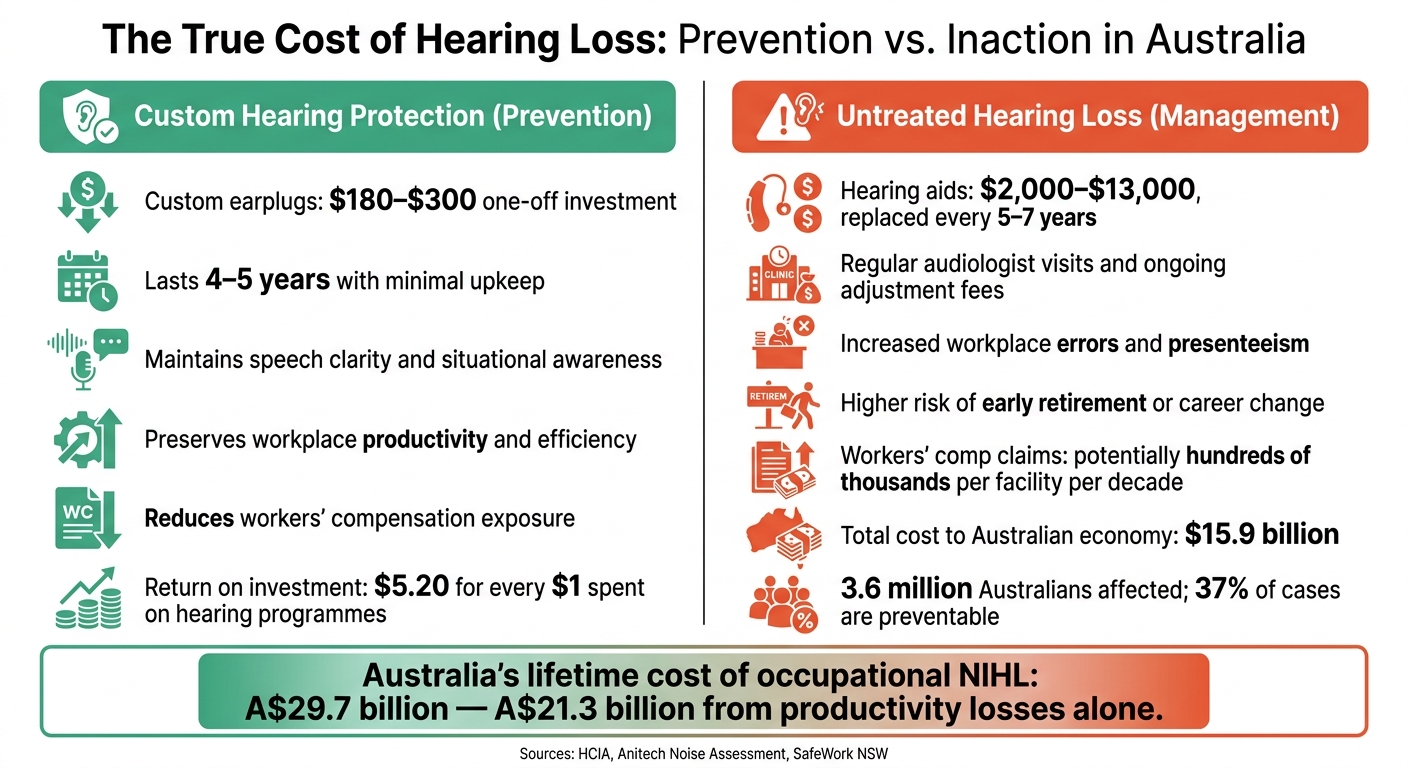
Cost of Preventing vs. Ignoring Hearing Loss in Australia
Untreated hearing loss doesn’t just affect your health - it also comes with a hefty price tag. The financial burden can be felt both personally and within the wider economy.
Direct Healthcare Expenses
In Australia, hearing aids are a significant expense, often costing thousands of dollars and needing replacement every 5–7 years. On top of that, there are ongoing audiologist fees and administrative costs to consider. For employers, workers' compensation claims and medical assessments add further strain to their budgets.
Lost Productivity at Work
Hearing loss can severely impact productivity in the workplace. Employees with untreated hearing issues often experience presenteeism, where they are physically present but unable to perform at their best. Tasks take longer as instructions need repeating, errors increase, and managers spend extra time clarifying details. Over time, the difficulties and frustrations can lead workers to opt for early retirement or switch to quieter jobs that might not align with their skills or earning potential.
"The real cost of noise-induced hearing loss to Australian business extends far beyond workers' compensation payments." - Anitech Noise Assessment
For businesses, these challenges quickly add up. For instance, a manufacturing facility with 100 noise-exposed employees could face hearing loss claims amounting to hundreds of thousands of dollars over a decade. This underscores the financial wisdom of prioritising prevention over reactive solutions.
Lifetime Cost Comparison
The difference between prevention and long-term management becomes clear when you break down the numbers:
| Category | Custom Hearing Protection (Prevention) | Untreated Hearing Loss (Management) |
|---|---|---|
| Equipment Costs | One-off investment, replaced periodically | Hearing aids costing thousands every 5–7 years |
| Professional Fees | Initial fitting and occasional noise assessments | Regular audiologist visits and adjustments |
| Productivity Impact | Preserves efficiency and focus | Increased errors and reduced output |
| Employment Longevity | Supports a full career | Higher risk of early retirement or career change |
| Business Risk | Lowers workers' compensation exposure | Claims possibly reaching hundreds of thousands |
Untreated hearing loss costs the Australian economy an estimated $15.9 billion, with around 3.6 million Australians affected. What’s more, 37% of these cases are preventable. Research highlights that every dollar spent on hearing intervention programmes yields a return of $5.20, making early action a smart financial move.
"Interventions are needed to minimise the impact of hearing loss... [this] would result in a cost benefit ratio of 5.2, which is equivalent to a return on investment of $5.20 for every $1 invested in the program." - Ashley Wilson, Chairman, HCIA
Opting for custom hearing protection, like those offered by ACS Custom, can help avoid these escalating financial costs while preserving both health and productivity.
How Custom Hearing Protection Reduces Risk
With the rising health and financial toll of untreated hearing loss, taking preventive measures is more important than ever. Custom hearing protection offers a practical way to address these challenges effectively.
Why Choose Custom Hearing Protection?
Generic foam earplugs often fall short when it comes to comfort, leading to inconsistent use. Did you know that even a brief 10-minute lapse in wearing protection in a noisy setting can reduce its effectiveness by 40%?. That’s a significant gap.
Custom-moulded earplugs, on the other hand, are designed to fit the unique shape of your ear, ensuring a snug, comfortable seal. Many of these plugs are vented to allow airflow, which prevents the occlusion effect - a common discomfort with generic plugs. They also feature acoustic filters that reduce noise to safer levels, around 85dB, while maintaining speech clarity and environmental awareness. This is critical in workplaces where hearing instructions or warnings could prevent accidents.
Durability is another win for custom plugs. Made from soft silicone, they can last 4 to 5 years with minimal upkeep, making them a more economical choice compared to disposable foam plugs.
A great example of these benefits in action is ACS Custom, a company that's been at the forefront of custom hearing protection since 1994.
ACS Custom: Leading the Way in Hearing Protection
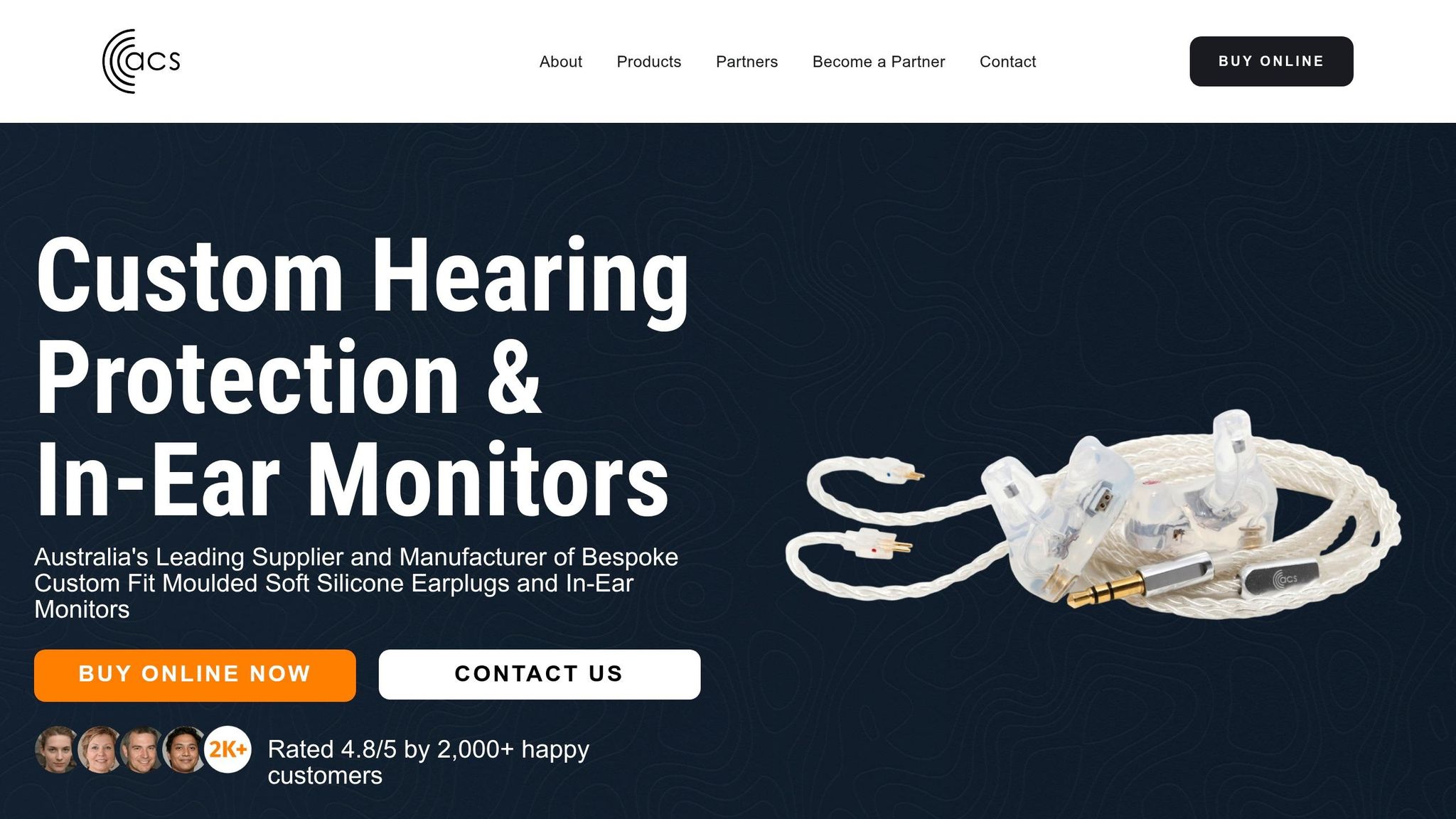
Since its founding in 1994, ACS Custom has specialised in delivering custom hearing protection and in-ear monitors. Their products are crafted from soft medical-grade silicone, using precise moulds of the wearer’s ears for a perfect fit.
Their PRO Series filters are designed to offer tailored noise reduction, with attenuation levels ranging from 10dB to 27dB. This means you can choose protection suited to your specific environment, rather than defaulting to maximum noise blocking. ACS Custom also holds Class 3 and Class 5 certification under AS/NZS 1270:2002, the recognised standard for hearing protectors in Australia and New Zealand. They are one of the few manufacturers in the region to meet both certifications.
With a customer rating of 4.8 out of 5 stars from over 2,000 reviews, and endorsements from outlets like The Telegraph and TechRadar, ACS Custom has built a strong reputation for both professional and everyday use.
"ACS Custom products are precision-engineered to provide unrivalled comfort, sound quality and hearing protection." - ACS Custom
Matching ACS Custom Products to Everyday Needs
ACS Custom offers a range of solutions tailored to different environments and activities. Here’s a breakdown of their products and features:
| Use Case | ACS Custom Product | Key Features |
|---|---|---|
| Construction & Mining | PRO Series (e.g., PRO 27) | Class 5 attenuation; durable silicone; preserves speech clarity |
| Music & Live Performances | Musicians' Earplugs / Custom IEMs | Linear attenuation filters; reduces volume without distortion |
| Shooting & Hunting | Shooting Plugs | Allows ambient sound; reacts instantly to high-impulse noise up to 140dB |
| Swimming & Water Sports | Swim Plugs | Watertight custom seal; buoyant medical-grade silicone; prevents swimmer's ear |
| Motorsports | Pro Drivercom 26 | Hearing protection with integrated helmet intercom communication |
| Sleep | SleepSound | Low-profile, ultra-soft design; comfortable for side-sleepers |
While custom earplugs may cost between $180 and $300, this investment pales in comparison to the $2,000–$13,000 needed for hearing aids, which also require replacement every 5–7 years. Choosing the right product for your specific needs ensures you get the most out of this investment.
Steps to Avoid Long-Term Hearing Costs
Noise Assessment and Monitoring
The first step in protecting workers' hearing is to assess noise exposure accurately. Using professional tools like calibrated sound level metres and dosimeters, a noise survey identifies tasks and areas where workers face potential risks. Without precise data, any protective measures are essentially guesswork.
In Australia, the legal threshold for initiating a formal hearing conservation programme is 85 dB LAeq,8h, with an absolute exposure limit of 90 dB LAeq,8h. For workers wearing hearing protection, the in-ear noise exposure should ideally stay below 80 dB(A). This target accounts for real-world factors like imperfect fit or inconsistent use. Additionally, peak noise levels must never exceed 140 dB(C) under any circumstances.
Noise assessments should be conducted every 2–3 years in stable environments, or annually if there are changes to equipment or processes. Areas with hazardous noise levels should be clearly marked as "hearing protector areas", ensuring no one enters without proper protection, even for a moment.
Once the noise risks are clearly understood, the next step is implementing a hearing conservation programme to manage exposure systematically.
Setting Up a Hearing Conservation Programme
A Hearing Conservation Programme (HCP) is a structured approach that combines engineering controls, administrative strategies, and personal protective equipment (PPE). The hierarchy of controls is important: engineering solutions should always come first. This might include enclosing noisy equipment or replacing it with quieter alternatives. PPE should only be used to address risks that cannot be eliminated.
A well-executed HCP includes baseline audiometric testing within the first six months of a worker's exposure to noise levels at or above 85 dB(A). This baseline is followed by annual tests to detect any early signs of hearing damage. Training is another vital component, ensuring workers understand how noise affects hearing, how to properly use and maintain their PPE, and how to interpret their audiometric results. All records, including assessments and audiometric data, should be kept for at least five years.
"If the hearing PPE is removed, even for a short time, the protection provided to the worker will be substantially reduced." - SafeWork NSW
After establishing the programme, the final piece of the puzzle is selecting the right hearing protection.
Choosing Quality Hearing Protection
Once noise levels are measured, selecting the appropriate class of hearing protection becomes much simpler. Australian standards (AS/NZS 1270:2002) provide a clear guide to match noise exposure levels with the necessary PPE class:
| Measured Exposure dB(A) | Required PPE Class |
|---|---|
| Less than 90 | Class 1 |
| 90 to less than 95 | Class 2 |
| 95 to less than 100 | Class 3 |
| 100 to less than 105 | Class 4 |
| 105 to less than 110 | Class 5 |
Source: SafeWork NSW / AS/NZS 1270:2002 [11]
One key consideration is avoiding over-protection. Using PPE with a rating much higher than required can make it difficult for workers to hear verbal instructions or safety alerts, introducing new risks. The goal is to select protection that reduces noise to safe levels without isolating the user.
For optimal results, consider custom-moulded options like the PRO Series from ACS Custom. These products offer attenuation ranging from 10dB to 27dB and are Class 5 certified under AS/NZS 1270:2002, meeting the highest standards for demanding environments. Custom-moulded hearing protection also allows for fit-testing, which ensures the chosen device delivers its rated attenuation for the individual wearer - something generic disposables often struggle to achieve.
"Investment in hearing conservation programs... typically costs a fraction of workers' compensation and indirect costs avoided through prevention." - Anitech Noise Assessment
For example, a manufacturing facility with 100 workers could face hearing loss compensation claims that total hundreds of thousands of dollars over a decade. This doesn't even account for losses in productivity or recruitment costs. By comparison, investing in a structured programme and high-quality protection is a much smaller expense.
Conclusion: The Case for Prevention
The health risks and financial costs of noise-induced hearing loss (NIHL) make a strong argument for prioritising prevention.
NIHL is permanent - once the hair cells in the inner ear are damaged, they cannot regenerate. Each day without proper hearing protection adds to the cumulative damage, leaving no chance for recovery.
The financial impact is just as alarming. For Australia's workforce, the lifetime cost of occupational NIHL is estimated at A$29.7 billion, with A$21.3 billion attributed to productivity losses alone. Preventative measures, like hearing conservation programmes, are far less costly than the expenses tied to workers' compensation and other indirect costs.
This stark difference in costs makes it clear: prevention is not only better for health, but also for your wallet. The steps are straightforward: measure noise levels accurately, establish a structured hearing conservation plan, and ensure the use of properly fitting protection. Disposable earplugs, for instance, often provide only 6–9 dB of real-world noise reduction, far below their advertised ratings.
Custom-moulded hearing protection offers a more dependable solution. Companies like ACS Custom create tailored hearing protection using medical-grade materials, certified to Class 5 under AS/NZS 1270:2002. These custom solutions ensure a proper acoustic seal, delivering consistent protection every time they’re used.
Investing in high-quality, custom-moulded hearing protection is a proactive step toward reducing both health risks and financial burdens. Preventing NIHL doesn’t just protect your hearing - it also secures your career and financial stability. Taking action now is far more cost-effective than dealing with the long-term consequences of inaction.
FAQs
How can I tell if I’m starting to get noise-induced hearing loss?
Noise-induced hearing loss tends to creep up slowly, making the early symptoms easy to miss. You might find that speech sounds unclear or distorted, particularly higher-pitched tones like birdsong or consonants such as s, f, sh, and th. Other clues include tinnitus - a constant ringing or buzzing in your ears - and struggling to hear conversations in noisy environments. If your hearing feels muffled after work, it could be a temporary threshold shift, which is your body's way of warning you about potential long-term damage. Keep an eye on these changes and consider seeing an audiologist if you notice any of these signs.
How do I choose the right earplug class for my workplace noise level?
Begin with a professional workplace noise assessment to understand your exposure levels and determine the necessary noise reduction measures. This is a critical step in ensuring compliance and safeguarding hearing health.
In Australia, any hearing protection you use must comply with the AS/NZS 1270:2002 standard. To minimise risk, aim for an in-ear noise level of 80 dB(A), ensuring it remains below the 85 dB(A) limit over an eight-hour workday.
When selecting earplugs, think beyond just noise reduction. Consider their comfort, how they perform in your specific environment, and whether they are compatible with other gear you may need to wear. These factors play a big role in ensuring both safety and usability.
Are custom earplugs worth the cost compared with disposable plugs?
Custom earplugs can be a smart investment for the long haul. While disposable earplugs might seem cheaper upfront, they can cost anywhere from AU$50 to AU$365 per year, depending on how often you replace them. On the other hand, custom earplugs start at around AU$200 and can last 3 to 5 years or more, bringing their annual cost down to just AU$33 to AU$50.
Beyond the savings, custom earplugs deliver other perks. They’re designed for a snug, personalised fit, ensuring greater comfort during extended use. They also provide consistent noise reduction and are easier to keep clean, making them a better option for those who rely on earplugs regularly.


