

When choosing earplugs for noisy workplaces, you’re balancing cost, comfort, and compliance with Australian standards. Here’s the key takeaway: comparing custom earplugs vs standard earplugs shows that custom options are a better long-term investment for regular users, while standard plugs are a cheaper, short-term solution.
- Custom Earplugs: Made to fit your ears perfectly, they’re comfortable for extended wear and provide consistent noise reduction (10–27dB). They cost AU$200+ upfront, but last 3–5+ years, averaging AU$50 per year.
- Standard Earplugs: Mass-produced and disposable, they’re affordable (AU$0.50–AU$20 per pair) but require frequent replacement, costing about AU$50 annually for regular use. They can be less effective if not inserted correctly.
Quick Comparison:
| Feature | Custom Earplugs | Standard Earplugs |
|---|---|---|
| Cost (Initial) | AU$100–AU$200+ | AU$0.50–AU$20 per pair |
| Lifespan | 3–5+ years | Disposable or short-term |
| Cost Per Year | AU$33–AU$50 | ~AU$50 |
| Comfort | High | Varies |
| Noise Reduction | Predictable, tailored | Dependent on fit |
Verdict: If you need daily protection in high-noise environments, custom earplugs offer better comfort, durability, and compliance with Australian standards (AS/NZS 1270:2002). For occasional use or lower noise levels, standard earplugs are a practical option.
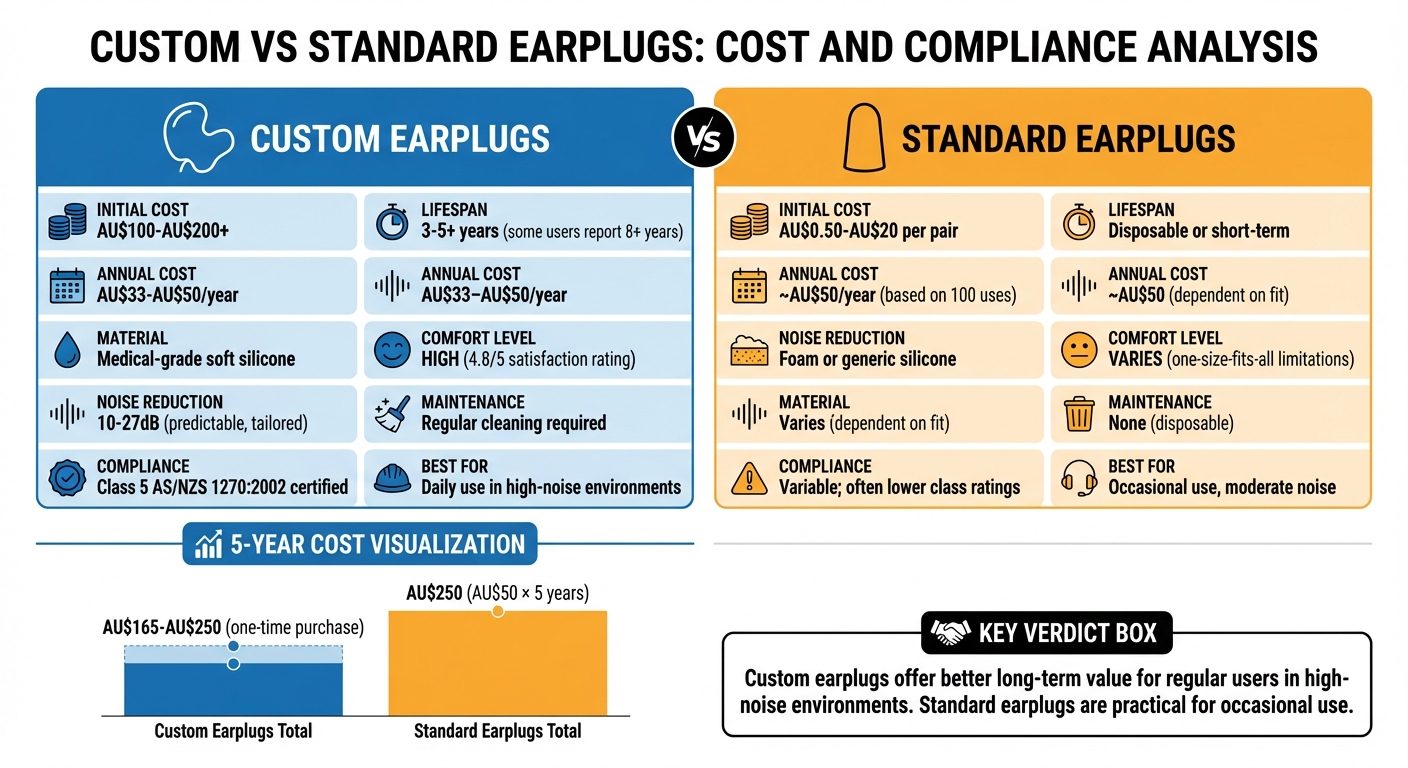
Custom vs Standard Earplugs Cost Comparison Over 5 Years
Custom Earplugs Custom Hearing Protection VS and Generic Ear Plugs Generic Hearing Protection Why?
sbb-itb-80b2a19
Initial and Long-Term Cost Comparison
Understanding both immediate and ongoing costs is key to ensuring compliance with Australian hearing protection standards.
Upfront Costs: Custom vs Standard
Standard foam earplugs typically range from AU$0.50 to AU$20 per pair. On the other hand, custom earplugs require a more substantial initial outlay, costing AU$200+. This higher price reflects the inclusion of professional ear impressions and manufacturing with medical-grade silicone. Custom options, such as the ACS PRO Series, also feature specialised attenuating filters (10dB to 27dB), which are not commonly available in basic, off-the-shelf earplugs. Now, let’s see how these upfront costs compare when looking at the bigger picture.
Long-Term Cost Benefits of Custom Earplugs
Custom earplugs are a long-term solution. According to Dr. Jonathan Javid, Au.D., a licensed clinical audiologist, "with proper care, custom earplugs typically last 3–5 years". Some users even report using them for up to 8 years. By contrast, disposable foam earplugs, used 100 times annually at AU$0.50 each, can cost around AU$50 per year. Meanwhile, a custom pair costing approximately AU$150 and lasting three years averages out to AU$50 per year - but with better comfort and protection.
Cost Comparison Table
Here’s a breakdown of the key cost factors for standard and custom earplugs:
| Feature | Standard Earplugs | Custom Earplugs (e.g., ACS PRO Series) |
|---|---|---|
| Initial Cost (AU$) | AU$0.50 – AU$20 per pair | AU$200+ |
| Lifespan | Disposable or short-term use | 3–5+ years |
| Cost Per Year | ~AU$50 (based on 100 uses/year) | ~AU$33–AU$50 (amortised over 3–5 years) |
| Maintenance | None (disposable) or basic washing | Regular cleaning |
| Material | Foam or generic silicone | Medical-grade soft silicone |
Custom earplugs do require routine cleaning to ensure hygiene. Dr. Javid notes, "custom plugs, when cleaned properly, are not only more hygienic but also safer for the ear canal over long-term use". For frequent users, this durability makes custom earplugs an economical choice rather than an indulgence. These cost considerations provide a solid foundation for assessing how each option aligns with strict hearing protection requirements.
Compliance with Hearing Protection Standards
In Australia, adhering to hearing protection standards ensures reliable noise reduction in everyday situations. The Australian Standard AS/NZS 1270:2002, which classifies hearing protection devices into Classes 1 through 5, alongside the European Standard BS EN352-2, provides a framework for evaluating noise attenuation effectiveness [2]. Let’s examine how custom and standard earplugs measure up to these standards.
Custom Earplugs and Attenuation Precision
Custom earplugs stand out for their precision in noise reduction, thanks to the exact fit achieved through personalised ear impressions. For example, the ACS PRO Series offers SNR ratings ranging from 12dB to 27dB, with the PRO 27 meeting the stringent requirements of Class 5 under AS/NZS 1270:2002. These earplugs are crafted from soft, medical-grade silicone, moulded to match the user's ear canal, ensuring consistent and predictable attenuation. As ACS Custom describes:
"Our PRO Series custom fit earplug range provides you with a perfect seal and comfortable fit, and offers the correct level of noise reduction regardless of the application."
This tailored approach ensures that the earplugs maintain their effectiveness over time and across various applications.
Challenges with Standard Earplugs Compliance
Standard foam earplugs often struggle to deliver their certified attenuation levels in practical use. Their effectiveness depends heavily on proper insertion, which involves careful rolling, insertion, and expansion. Workers with uniquely shaped ear canals may find it difficult to achieve the necessary seal, leading to protection levels that fall short of their laboratory-certified ratings. This variability makes it harder to ensure consistent compliance in real-world conditions.
Testing and Compliance Insights
Attenuation testing under AS/NZS 1270:2002 and BS EN352-2 highlights the reliability of custom earplugs. These tests evaluate how well earplugs reduce noise across different frequencies, determining their SNR and Class ratings. Custom designs consistently meet their rated performance due to their tailored fit and durable silicone construction, which resists the wear and tear that can degrade foam plugs. For workplaces that require documented compliance, custom earplugs provide a dependable and verifiable noise reduction solution. This reliability underscores their value in maintaining hearing protection standards effectively.
Comfort, Fit, and Usage Compliance Factors
When it comes to hearing protection, the best solution is the one that workers are willing to wear consistently. Discomfort or poor fit can lead to reduced usage, which directly impacts effectiveness. This is where custom earplugs and standard earplugs differ the most.
Comfort and Retention of Custom Earplugs
Custom earplugs are tailored to create a snug, secure seal that stays in place, even during movement. Whether you're operating heavy machinery, performing on stage, or tackling an eight-hour workday, these earplugs are designed to stay put while minimising irritation. Their ergonomic shape makes them ideal for extended wear, unlike standard options that may cause discomfort over time.
ACS Custom boasts a 4.8/5 satisfaction rating from over 2,000 customers, with comfort being a standout feature. SleepSound Earplugs user Rhianna K shared:
"Most comfortable and effective ear plugs I have tried. (And I have tried many.)"
Similarly, Sammy, an IEM Earplugs user, noted:
"The result is the best on stage sound & unrivalled comfort & fit when wearing for long periods of time."
These testimonials highlight how comfort plays a key role in ensuring users stick to wearing their earplugs, reinforcing the value of custom solutions.
Fit and Comfort Limitations of Standard Earplugs
Standard earplugs often fall short due to anatomical differences. Their one-size-fits-all design doesn't always create a proper seal for every ear canal, leading to inconsistent noise reduction and discomfort during prolonged use. For individuals with uniquely shaped ear canals, standard plugs can shift, slip, or even fall out, compromising their effectiveness and potentially creating unsafe noise exposure. Additionally, the materials used in standard earplugs are typically less soft than the medical-grade silicone found in custom options.
These drawbacks become evident in practical use, where standard earplugs often fail to provide the comfort and reliability needed for all-day wear.
Field Data on Usage and Compliance
Real-world data confirms that comfort is a key factor in ensuring hearing protection is effective. Custom earplugs, thanks to their superior fit and ergonomic design, are particularly suited for extended use. Unlike standard earplugs, which can lose their effectiveness over time, custom options maintain consistent protection throughout long shifts.
One long-time user from the music industry shared their experience of using custom filtered plugs for over 20 years, showcasing the durability and compliance that a secure, comfortable fit can encourage. Keith W, a SleepSound Earplugs user, also noted:
"The earplugs fit perfectly and provide comfort through the night, markedly improving sleep quality."
Such testimonials underline the importance of comfort in driving long-term usage, a critical factor for workplace hearing conservation programmes - something standard earplugs often struggle to achieve.
Cost-Benefit Analysis for Compliance Outcomes
Return on Investment for Custom Earplugs
Investing in custom earplugs may feel like a bigger upfront expense, but the long-term benefits are hard to ignore. These earplugs save money over time by cutting down on replacement costs and improving compliance with safety regulations. When workers consistently wear their hearing protection, employers are less likely to face workers' compensation claims or penalties for failing to meet occupational health and safety standards. In Australia, these regulations require hearing conservation measures if noise levels exceed 85 dB during an 8-hour shift.
Custom earplugs are built to last, with many users reporting a lifespan of 8 years or more. Compare that to disposable earplugs, which need frequent replacing - an ongoing cost that adds up fast. Additionally, custom earplugs provide certified noise reduction, with attenuation levels ranging from 10 dB to 27 dB when using ACS PRO Series filters. This ensures workers get the protection they need without the guesswork.
Comfort is another major advantage. Custom earplugs are designed for extended wear, making workers more likely to keep them in, which reduces the risk of unsafe noise exposure. This consistent use not only protects workers but also helps employers avoid fines and compensation claims. The table below highlights the cost and compliance differences between custom and standard earplugs over five years.
Comparison Table: Custom vs Standard Earplugs
| Factor | Custom Earplugs | Standard Earplugs |
|---|---|---|
| 5-Year Total Cost | Higher initial investment; minimal replacement costs | Lower upfront cost; ongoing replacement expenses |
| Compliance Rate | High; comfort drives consistent usage | Lower; discomfort leads to removal |
| Risk Reduction | Perfect seal reduces injury and compensation costs | Variable protection; poor fit increases risk |
| Lifespan | 8–20 years with proper care | Often disposable or short-term use |
| Regulatory Compliance | Certified to AS/NZS1270:2002 (Class 3 & 5) | Varies; often lower class or uncertified |
Key Takeaways from Cost-Benefit Analysis
While custom earplugs may require a larger initial investment, they deliver long-term savings and better compliance results. Their tailored fit ensures workers receive the proper level of noise reduction, while the comfort factor encourages consistent use throughout the workday. This combination helps prevent hearing damage and reduces the risk of compensation claims or regulatory penalties.
For industries like manufacturing, construction, mining, and defence - where hearing protection is non-negotiable - custom earplugs are a smart investment. They also offer flexibility with attenuation filters, avoiding over-protection that might otherwise tempt workers to remove their earplugs for better communication, which could compromise safety and compliance.
Conclusion: Choosing the Right Earplugs
Benefits of Custom Earplugs
Custom earplugs offer reliable protection, specifically designed for prolonged use in noisy environments like construction, mining, and manufacturing. Made from soft, medical-grade silicone, they create a snug seal that provides consistent noise reduction far superior to standard earplugs. Many users find the custom fit so comfortable that they can wear them for extended periods without discomfort, making it easier to stick to proper hearing protection habits[2].
The PRO Series filters are a standout feature, allowing essential sounds - like conversations or safety signals - to remain clear while harmful noise is reduced. While the upfront cost ranges from AU$150 to AU$300, their durability makes them an economical choice over time.
When to Use Standard Earplugs
Standard earplugs are a good option for occasional use or when you need a quick and accessible solution. With prices ranging from AU$23 to AU$50, they’re budget-friendly and don’t require professional customisation or waiting for manufacturing. These are especially practical for younger users, as growing ears mean frequent remoulding would be necessary with custom options. In settings with moderate noise or infrequent exposure, properly fitted standard earplugs can still offer sufficient protection.
Cost vs Compliance Summary
Choosing between custom and standard earplugs depends on your exposure and needs. For those in high-noise environments requiring daily protection, custom earplugs from ACS Custom provide superior comfort and long-term value. They also meet the AS/NZS1270:2002 standards, which are critical for safety and compliance in Australia. However, for occasional use or moderate noise exposure, standard earplugs remain a practical and affordable choice.
FAQs
How do I know what dB rating I need?
To determine the right dB rating for earplugs, think about the noise levels you'll be exposed to and the level of protection required. Custom earplugs, such as those from ACS Custom, can provide noise reduction ranging from 10dB to 31dB, depending on the filters you choose. If you're dealing with noise levels above 85dB, it's important to opt for earplugs that bring your exposure down to safer levels. For tailored advice, consider consulting safety standards or speaking with a hearing professional.
What does AS/NZS 1270:2002 Class 1–5 mean?
The AS/NZS 1270:2002 standard outlines the noise reduction levels of hearing protectors. Class 1 represents the lowest level of noise reduction, while Class 5 provides the highest level of protection, reflecting performance under testing. These classifications are designed to ensure that hearing protection meets the safety standards required in Australia and New Zealand.
How can I tell if my earplugs are sealing properly?
To make sure your earplugs are sealing correctly, they should fit snugly and comfortably without leaving any gaps. You can test the seal by gently tugging on the earplug - if the noise reduction stays consistent, you’ve got a good seal. For a more reliable and comfortable fit, custom-moulded earplugs are often the best option, as they are shaped specifically for your ears to ensure maximum noise reduction.


