

If I want the short answer: BA is better for detail and isolation, while dynamic is better for bass punch and a more natural tone. There isn’t one winner for everyone. The better pick depends on detail, bass impact, timbre, soundstage, comfort, isolation, source matching, and long-session use.
Here’s the simple version:
- Balanced armature (BA) IEMs usually give me cleaner separation, sharper treble detail, and better passive isolation than foam earplugs
- Dynamic driver (DD) IEMs usually give me more bass weight, more slam, and a tone that many listeners find more lifelike
- Fit and seal matter just as much as driver type
- A poor seal can cut bass hard in both, and BA sets can sound especially thin when the fit shifts
- BA models are often more sensitive to output impedance and can show hiss more easily
- DD models are often easier to live with day to day, but venting can let in more outside noise
A few points stand out fast. Dynamic drivers move more air, so bass often feels stronger and more physical. Balanced armatures use very small moving parts, which helps with speed and fine detail. And for many people, the difference that matters most is not the driver at all - it’s whether the IEM seals well and stays comfortable after 1 to 2 hours of listening.
Balanced Armature vs. Dynamic Drivers ft. Audio Technica ATH-IM0 series
sbb-itb-80b2a19
Quick Comparison
| Criteria | Balanced Armature | Dynamic Driver |
|---|---|---|
| Clarity | Higher | Good, but softer |
| Detail retrieval | Higher micro-detail | Less sharp |
| Bass impact | Tighter, lighter | Stronger slam |
| Bass control | Clean and controlled | Warmer and weightier |
| Timbre | More analytical | More natural |
| Soundstage | More focused | Often more open |
| Imaging | Precise placement | Good, but less exact |
| Isolation | Usually higher | Usually lower with vents |
| Comfort | Small shells can help | Venting can ease pressure |
| Source matching | More picky | Usually easier |
| Daily upkeep | Small bores can clog | Often less fussy |
My take: if I listen on trains, in the office, or at lower volume, I’d lean BA. If I care more about hip-hop, pop, rock, EDM, bass feel, and body, I’d lean dynamic. If I get the fit wrong, though, neither will sound the way they should.
That’s the whole argument in plain English: BA for precision, DD for punch, fit for everything.
Balanced armature drivers in IEMs
Balanced armature drivers use a tiny armature and diaphragm to deliver fast, precise sound. When electrical current passes through the driver, it moves the armature, which then pushes the diaphragm with a small connecting pin. That quick movement and tight control help explain why BA IEMs often appeal to people who care more about separation than heavy low-end punch.
Where balanced armatures perform best
BA drivers tend to do well with busy, layered recordings. Jazz and classical, for example, often sound cleaner and more organised because these drivers separate instruments well across the mix. Their low moving mass also helps with fast transient response, fine detail, and low distortion.
Another plus is sensitivity. Fine details can stay audible even at lower listening levels, which makes BA IEMs a good match for longer sessions. The flip side is pretty simple: the same sort of tuning that brings out detail can also sound a bit lean if you want more bass presence.
Where balanced armatures fall short
The main trade-off is weaker sub-bass and less physical weight unless the IEM is tuned to make up for it. Some listeners also feel that heavily analytical BA tuning sounds a little clinical.
Why shell size, fit and custom moulding matter
Because BA drivers are so small, they can fit into compact shells and sit deeper in the ear canal. That can help passive isolation. But the fit has to be stable. If the seal breaks, even slightly, bass drops off and the sound becomes less consistent.
In practice, driver type matters less than fit when the seal is poor.
That clarity comes with trade-offs in bass and body, which is where dynamic drivers differ most.
Dynamic drivers in IEMs
Dynamic drivers give up a bit of precision in exchange for bass weight, warmth, and a more natural tone. If BA drivers lean toward accuracy, dynamic drivers lean toward body and punch.
Where dynamic drivers perform best
Their clearest strength is bass. Dynamic drivers can deliver strong bass impact with a physical, tactile feel that’s hard to miss. As Andrew Bellavia, Director of Market Development at Knowles Electronics, puts it:
"To me, the dynamic sounds softer, warmer, fuller, but a little less precise. People who want that maximum bass impact will go for dynamic every time."
Vocals and instruments also tend to sound fuller, which gives music a more natural, full-bodied character. For genres like electronic, hip-hop, pop and rock, that extra punch and tonal body can matter more than razor-sharp separation. In that sense, dynamic drivers sit at the other end of the spectrum from BA: less surgical, more physical.
Where dynamic drivers fall short
In busy mixes, dynamic drivers usually separate instruments less cleanly than a well-tuned BA IEM. Fine detail, like note decay or soft breath cues, can come through with less definition. They can also use larger housings, which may be harder to fit well, especially if you’ve got smaller ears.
How fit and seal affect dynamic sound
Fit matters a lot with dynamic drivers. Without a proper seal, sub-bass and impact fall off fast. If the ear tip doesn’t seal well, the warm, rich sound that makes dynamic drivers appealing can start to feel thinner.
Vented housings can help reduce ear pressure, which is nice for comfort. The catch is that they also reduce passive isolation, so that’s worth weighing up if you listen while commuting or walking around.
Those trade-offs lead straight into the comparison of detail, timbre, bass, and soundstage.
Balanced armature vs dynamic: a direct comparison
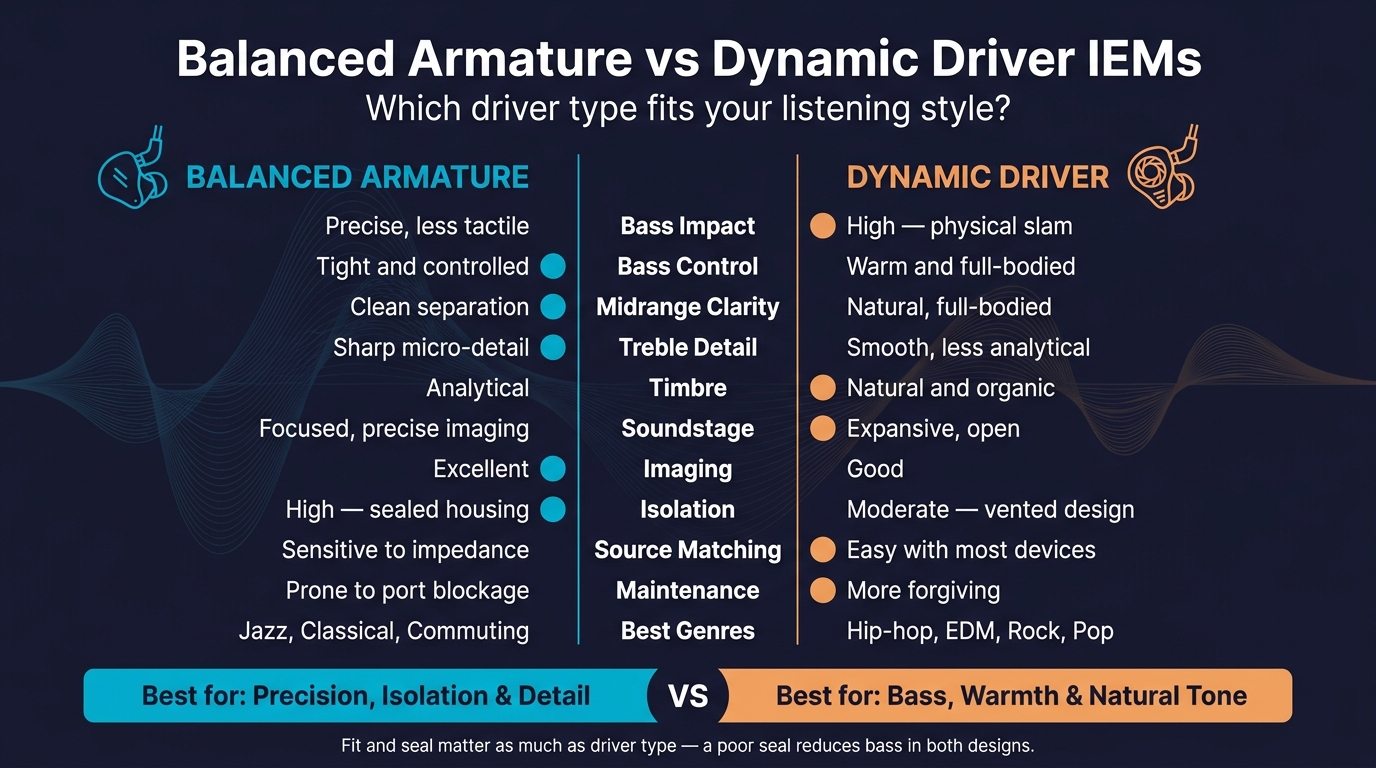
Balanced Armature vs Dynamic Driver IEMs: Full Comparison
Neither driver type wins outright. Each one has clear strengths, and the better pick comes down to what you want from your listening.
Once you know the basics, the main gap is in how each driver handles detail, tone, bass, and isolation.
| Criterion | Dynamic Driver | Balanced Armature |
|---|---|---|
| Bass Impact | High - physical air displacement creates tactile slam | Moderate - precise but less tactile |
| Bass Control | Warm and full-bodied | Tight and controlled |
| Midrange Clarity | Natural, full-bodied mids | Clean separation |
| Treble Detail | Smooth, less analytical | More micro-detail and sharper transients |
| Timbre | Natural and organic | More analytical |
| Soundstage | Expansive, especially in vented designs | Focused imaging, precise placement |
| Imaging | Good | Excellent, particularly in multi-driver arrays |
| Ease of Driving | Easy to drive from most sources | Very efficient, but sensitive to output impedance |
| Isolation | Moderate - venting reduces passive isolation | High - sealed housing blocks more ambient noise |
Detail, timbre, bass and soundstage
BAs tend to lead on micro-detail and imaging. DDs tend to lead on body and bass weight.
"BAs achieve remarkable precision because the moving mass is almost zero. They can resolve fine treble micro-detail with low distortion." - GK AudioLab
That lines up with what many listeners hear in practice. Balanced armatures often sound cleaner and more exact, especially in the treble, where small cues and sharp transients stand out more clearly.
Dynamic drivers push back in a different way. They usually sound more natural and full-bodied, with bass that feels more physical. Because they move more air, low-end notes often have more slam and a stronger sense of impact.
The trade-off is that this kind of precision can be more dependent on fit, which can affect comfort over long sessions.
Comfort, isolation and safe long-term listening
Balanced armature IEMs usually isolate better because their sealed housings block more outside noise. That matters for comfort, but also for hearing. If less noise gets in, you can often listen at lower, safer volume levels in busy places.
Custom-moulded IEMs, like those from ACS Custom, take that a step further. They create a close acoustic seal shaped to your ear canal, which helps maximise isolation.
"Because the balanced armature is a sealed metal can, it can give better isolation than a dynamic driver, which has to have a space behind it." - Andrew Bellavia, Knowles Electronics
Those fit gains become even more important when you look at how your source behaves day to day.
Source matching, maintenance and daily use
Driver type matters, but it won't save a poor source match or the wrong ear tips. A badly matched setup can throw off the sound fast.
Dynamic drivers are usually easy to pair with everyday devices like smartphones. Balanced armatures are very efficient, but they're also more sensitive to output impedance, which can shift tuning or bring out hiss.
Daily wear tells a similar story. Dynamic drivers are less likely to suffer from port blockage, so they tend to be more forgiving over time. Balanced armatures are more prone to acoustic port occlusion, where earwax or moisture blocks the tiny sound bores and changes performance.
At that point, the choice comes back to what you care about more: cleaner detail and stronger isolation, or a fuller tone with more physical bass.
Which driver type suits your listening priorities
The better pick depends on what you care about most. If you know your listening habits, the choice gets a lot easier.
| Priority | Balanced Armature | Dynamic Driver |
|---|---|---|
| Detail retrieval | Most detail | Coherent, but less resolving |
| Bass impact | Precise, less tactile | Superior; natural, tactile slam |
| Natural timbre | More analytical | Natural, full-bodied |
| Isolation | High - sealed design | Moderate - often requires venting |
| Comfort (long sessions) | Excellent - smaller, lighter shells | Good - venting can reduce ear pressure |
Choose balanced armature if clarity and isolation come first
BA drivers make sense for listeners who want clean separation, crisp treble detail, and strong passive isolation. That makes them a good match for commuting or office use, where background noise can fight for your attention. Their smaller shells can also feel better during long listening sessions.
Choose dynamic if bass feel and natural tone matter more
Dynamic drivers suit listeners who want more bass weight and a warmer, fuller sound. That more organic presentation also works well with acoustic music, where timbre plays a big part in how lifelike everything feels.
Final take: fit and seal matter as much as driver type
In day-to-day use, fit and seal matter just as much as driver type. If the seal breaks, bass drops off in both designs, and balanced armatures are extra sensitive to seal loss. Custom-moulded IEMs from ACS Custom can improve isolation and comfort during long sessions.
FAQs
Are hybrid IEMs a better middle ground?
Yes, for many audiophiles, hybrid IEMs hit a sweet spot.
They pair dynamic drivers for punchy bass with balanced armatures for clear mids and treble. The result is a more flexible, full-range sound that can work well across different genres.
That balance is a big reason they’re so popular. But tuning matters a lot. If the drivers don’t blend well, the sound can feel disjointed instead of smooth.
Which driver type is better for gaming and movies?
For gaming and movies, dynamic drivers are usually the better pick. They tend to deliver deeper, stronger bass and a sound that feels more immersive.
Balanced armature drivers are known for precise, detailed audio, especially in the higher frequencies. But they often have less bass extension and move less air. So if you want fuller sound effects, harder-hitting impact, and a more cinematic feel, dynamic drivers are usually the better fit.
Do ear tips matter more than driver type?
It depends on what you prioritise. Driver type sets the main sound character: dynamic drivers often sound warmer and more natural, with stronger bass. Balanced armatures, on the other hand, are known for clarity, detail, and speed.
Ear tips matter too. Fit and passive noise isolation can change comfort, bass, and clarity more than many people expect. Put simply, driver type shapes the sound, while ear tips help you get the most out of it.


