

Orchestral musicians face a serious risk: hearing loss. With noise levels often exceeding safe limits, 43% of professional musicians report hearing loss, and 35% show signs of noise-induced damage. Even solo practice can hit peaks of 130 dB, putting ears in danger. Despite this, only 40% use hearing protection during private practice.
To protect your hearing without sacrificing sound quality, consider these strategies:
- Take sound breaks: Rest your ears for 5–10 minutes every hour.
- Monitor noise levels: Use real-time decibel tracking in rehearsals.
- Adjust stage setups: Use acoustic barriers and reposition instruments to reduce exposure.
- Use custom earplugs: High-fidelity options like ACS PRO15 earplugs preserve sound clarity while reducing harmful noise.
Routine hearing tests and recovery periods are just as crucial. With proper care, you can protect your hearing and maintain your performance quality.
How to Choose Earplugs for Professional Musicians
sbb-itb-80b2a19
Hearing Risks in Orchestras
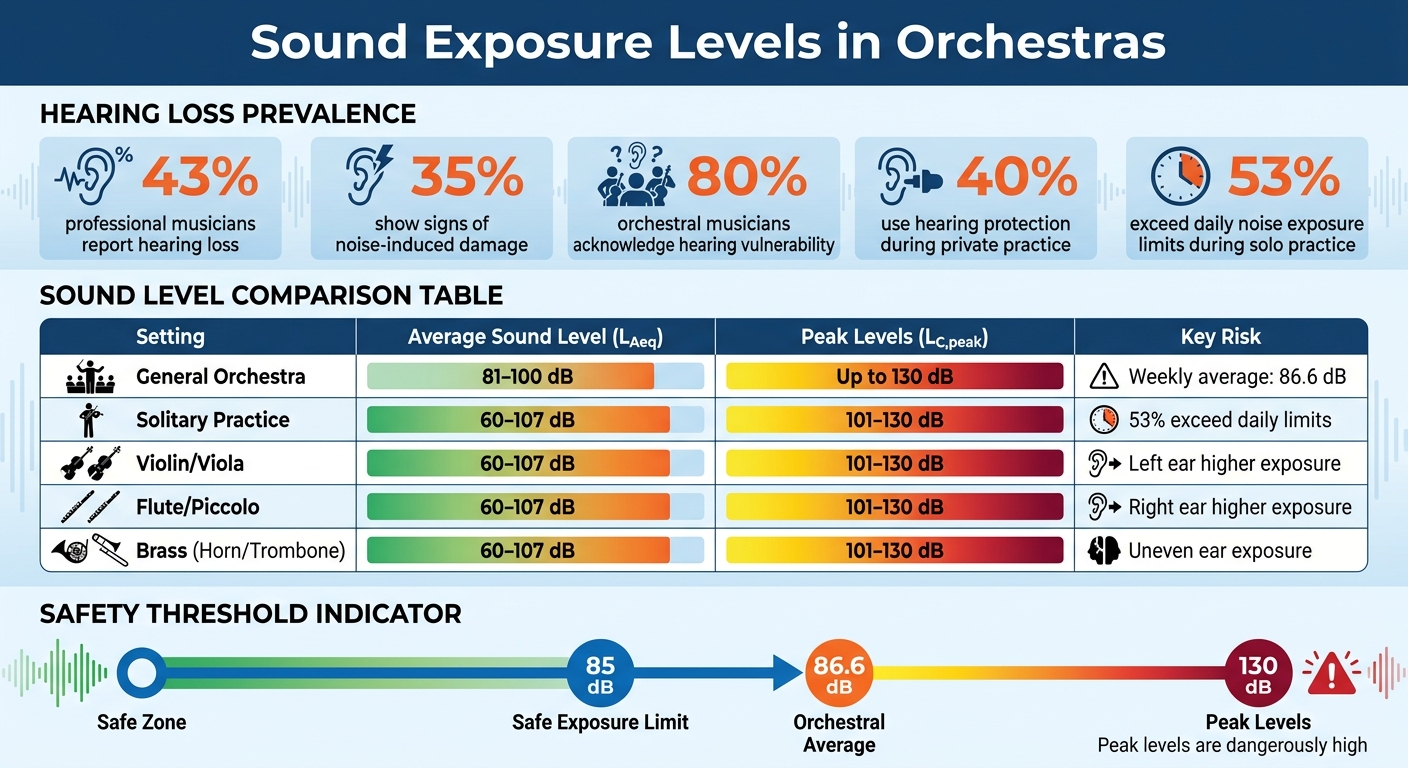
Orchestral Musicians Hearing Loss Statistics and Sound Exposure Levels
Sound Levels in Orchestral Settings
The noise levels in orchestras often surpass what’s considered safe for hearing. Professional orchestral musicians face weekly sound exposure ranging from 81 to 100 dB, with an average of 86.6 dB. Since exposure above 85 dB can lead to permanent hearing damage, this puts musicians at significant risk.
The danger is even greater during solitary practice. In practice rooms, sound levels range from 60 to 107 dB LAeq, with peak levels hitting 101 to 130 dB LC,peak. A study conducted between 2009 and 2014 by the University of Sydney's "Sound Practice" project, led by Dr Bronwen Ackermann, examined 377 professional musicians from Australia’s eight major symphony orchestras. The findings revealed that 53% of these musicians exceeded the permissible daily noise exposure limits during solo practice sessions alone.
| Instrument Group | Typical Sound Level (LAeq) | Peak Levels (LC,peak) | Notable Risks |
|---|---|---|---|
| General Orchestra | 81–100 dB | Up to 130 dB | Weekly average exposure of 86.6 dB |
| Solitary Practice | 60–107 dB | 101–130 dB | 53% exceed daily limits during solo practice |
| Violin/Viola | 60–107 dB | 101–130 dB | Left ear faces higher exposure levels |
| Flute/Piccolo | 60–107 dB | 101–130 dB | Right ear faces higher exposure levels |
| Brass (Horn/Trombone) | 60–107 dB | 101–130 dB | Uneven exposure between ears |
Different instruments also create uneven sound exposure between ears. For instance, violin and viola players often experience higher noise levels in their left ear, while flute and piccolo players are more affected in their right ear. This uneven exposure can lead to varying degrees of hearing loss between ears.
The consistently high sound levels highlight the pressing need for hearing protection measures in orchestras. These risks pave the way for the hearing issues discussed in the next section.
Common Hearing Problems Among Musicians
Musicians are more prone to hearing issues like tinnitus, hyperacusis, and permanent threshold shifts compared to the general population. Noise-induced damage to the inner ear’s delicate hair cells, often revealed by audiometric "notches", can significantly impact their ability to perform with precision. Beyond the physical challenges, hearing problems often lead to increased stress, worsened mental health, and a reduced sense of well-being at work. For musicians, whose careers depend on perfect pitch and tonal clarity, even slight hearing loss can be devastating.
"The risk of NIHL in the orchestra is highly variable dependent upon instrument type, venue, repertoire, and duration of exposure, and that the greatest exposure is generally from a musicians' own instrument." – Bronwen J. Ackermann, University of Sydney
Hearing Conservation Strategies
Protecting musicians' hearing in orchestra settings requires thoughtful adjustments to both rehearsal practices and stage sound management. By adopting these strategies, orchestras can minimise noise risks while maintaining musical excellence.
Safe Rehearsal Techniques
Incorporating sound breaks during rehearsals is a simple yet effective method to protect hearing. Musicians should aim for 5 to 10 minutes of quiet rest every hour, giving their ears time to recover from high noise levels. For individual practice sessions, the 60/60 rule is a helpful guideline: keep the volume at 60% and limit practice to 60 minutes at a time.
Real-time sound monitoring during rehearsals is another valuable tool, enabling musicians and conductors to track decibel levels and make necessary adjustments. This is particularly critical given that a collegiate trumpet player, for example, can exceed their daily noise limit in just 38 minutes of practice. Beyond rehearsal techniques, optimising stage and venue acoustics plays a significant role in reducing noise exposure.
Sound Management and Acoustic Adjustments
Physical adjustments to the stage can greatly reduce harmful sound exposure. For instance, seating arrangements can be modified to position high-frequency instruments like trumpets on risers, directing sound upwards and away from fellow musicians. Similarly, placing musicians slightly back from the stage edge allows high-frequency sounds to reflect off the front, rather than directly impacting others.
Acoustic barriers such as shields, screens, and baffles are another effective measure. These transparent tools absorb or deflect sound while maintaining a clear line of sight for the conductor. String players, often seated in front of loud brass sections, benefit significantly from these barriers. Additionally, improving venue acoustics by reducing reverberation in practice rooms and performance halls can lower overall noise exposure, as echo-heavy environments amplify sound levels.
"Improved strategic approaches, acoustic screens and recently developed active earplugs were found to provide effective new options for hearing protection." – Bronwen J. Ackermann et al., University of Sydney
Since hearing risks vary depending on factors like instrument type, venue acoustics, and repertoire demands, tailoring these strategies to fit specific contexts is essential. Combining controlled rehearsal practices with thoughtful acoustic management ensures musicians can safeguard their hearing without compromising their artistry or performance quality.
Ear Protection Options for Musicians
For orchestral musicians, picking the right hearing protection is a big deal. It’s not just about reducing harmful noise levels; it’s also about keeping the sound quality intact. There are several options out there, each with its own benefits and drawbacks, depending on what you need and your budget. These solutions aim to protect your ears while letting you enjoy the music as it’s meant to be heard.
Types of Earplugs
Universal reusable earplugs are a budget-friendly choice for musicians looking for basic protection. For example, options like the Pacato 16 and 19, available for AUD $23.00, are ready-to-use and made from reusable materials. However, since they come in standard sizes, the fit might not be perfect for everyone. This can lead to an imperfect seal and an occlusion effect, which may affect sound clarity and make communication harder.
Custom-Moulded Earplugs for Musicians
For a better fit and improved performance, many musicians compare custom earplugs vs. foam earplugs before opting for custom-moulded options. These are made specifically for each individual using soft, medical-grade silicone and impressions of their ears. This ensures a snug fit and excellent comfort, even during long sessions.
ACS Custom, a company specialising in hearing protection since 1994, offers its PRO series earplugs, which provide attenuation levels from 10 dB to 27 dB. These earplugs use high-fidelity filters to deliver a flat reduction across all frequencies, preserving the clarity of the music. One standout model, the PRO15, provides subtle 12 dB protection at lower frequencies and ramps up to 15 dB at higher frequencies. This design is especially useful for shielding against sharp peaks from loud wind instruments while adhering to EN352-2 European Standards.
"The PRO15 provides more subtle attenuation which is perfect for use in acoustic or orchestral environments, sloping up in the higher frequencies for protection against heavily played wind instruments." – ACS Custom
Advanced vented filter technology helps tackle the occlusion effect by letting sound pass both ways through the filter. Combined with a deep fit that extends past the cartilage of the ear canal, this design reduces the "booming" sensation often associated with standard earplugs. With a 4.8/5 rating based on over 2,000 reviews, users frequently praise these earplugs for their comfort during long use and their ability to maintain clear sound quality. Custom-moulded earplugs are priced between AUD $150.00 and $300.00. For those looking to personalise their earplugs further, extras like custom colours or laser etching are available for an additional AUD $20.00 each.
Investing in the right ear protection is essential for safeguarding your hearing while performing in orchestras or other musical settings.
Long-Term Hearing Care and Monitoring
Caring for your hearing is an ongoing process that requires both regular monitoring and periods of recovery. With 43% of professional orchestral musicians in Australia experiencing hearing loss, and that number rising to 54% among pit orchestra musicians, the importance of consistent hearing care cannot be overstated. Regular check-ups give musicians the tools they need to protect their auditory health over the long term, bridging the gap between daily routines and sustained well-being.
Regular Hearing Assessments
Routine hearing tests are key to spotting early signs of issues like noise-induced hearing loss, tinnitus, or hyperacusis. Catching these problems early can make a significant difference. Start with a baseline test, then schedule follow-ups to monitor changes - especially if you’re a brass player or part of a pit orchestra. Interestingly, brass players under 50 are the least likely to wear earplugs but the most likely to report hearing loss, putting them at heightened risk.
"Developing and maintaining a successful hearing conservation strategy within a professional orchestra is a complex task involving a fine balance of legislative requirements, control measures, exposure assessment, audiological monitoring, and educational programs." – Ian O'Brien, School of Medical Sciences, The University of Sydney
Ear Recovery and Rest
Giving your ears time to recover is just as important as monitoring them. Reducing noise exposure off stage is crucial, as many musicians underestimate the risks during private practice, where sound levels can still be dangerously high and earplug use is often neglected. Recovery periods complement regular assessments and are essential for well-rounded hearing care. Incorporate breaks into your practice sessions, and consider using solid silicone or SleepSound earplugs at night to aid recovery after performances. Orchestral management can also help by planning schedules and rotating repertoires to include "quiet time" between demanding pieces.
ACS Custom Solutions for Orchestral Hearing Protection

ACS Custom offers hearing protection solutions specifically designed to meet the unique needs of orchestral musicians. Their PRO15 custom-moulded earplugs are crafted to handle the demands of orchestral acoustics, providing 12 dB attenuation in the mid-range and up to 15 dB at higher frequencies - key areas where wind instruments often produce their loudest sounds. These earplugs, priced between $299.00 and $300.00 AUD per pair, are made from soft, medical-grade silicone and are customised based on individual ear impressions. This ensures a snug fit and all-day comfort, even during extended rehearsals or performances.
ACS Custom doesn't just focus on protection - they prioritise comfort and sound clarity, too. The earplugs feature a vented design that extends beyond the ear cartilage, reducing the occlusion effect and delivering more natural sound. As music teacher and violinist Michael Patton shares, "As a music teacher and violinist in orchestras I've been searching for a comfortable set of earplugs that don't make me sound like I'm under water! These fit the bill...".
The PRO series also includes interchangeable filters, offering protection levels ranging from 10 dB to 27 dB, making it adaptable to different environments. These filters comply with EN352-2 standards, and ACS stores ear impressions for two to three years, simplifying future reorders. For musicians who need both high-fidelity sound and effective hearing protection, the Ambient series of in-ear monitors integrates precision drivers with ambient ports, allowing players to remain aware of their surroundings while keeping sound levels safe.
User feedback highlights the practicality of these solutions. Professional musician Akash Aujla notes, "I have found the PRO15 ear plugs to do a wonderful job of balancing safety and practicality, allowing me to protect my hearing without compromising my ability to communicate effectively...". With an impressive 4.8/5 rating from over 2,000 customer reviews, ACS Custom has proven itself as a trusted provider for hearing conservation in orchestral settings. For an extra $20.00, customers can add personal touches like laser etching or custom colours.
Conclusion
Orchestral musicians face considerable risks when it comes to hearing damage. With 80% of professional orchestral musicians acknowledging their vulnerability and 43% already experiencing hearing loss, protecting hearing is critical for sustaining their careers. Self-reported hearing loss among musicians ranges from 25% to 31%, nearly double the 13% average found in the general population.
Finding a way to safeguard hearing while preserving sound quality is no small feat. Standard foam earplugs often distort sound and cause the occlusion effect, making them impractical for musicians. It's no wonder that 83% of musicians who try earplugs report difficulty using them during performances. Custom solutions, like ACS Custom's PRO15 earplugs, tackle these issues head-on. Priced at $300.00 AUD per pair, these earplugs use vented filter technology and medical-grade silicone that extends deeper into the ear canal, offering a tailored fit and improved sound clarity.
"Protecting an orchestral musician's hearing without interfering with the balance, acoustics or the acuity they require is a vexing issue for researchers and musicians alike." - Ian O'Brien, Bronwen J. Ackermann, and Tim Driscoll
This highlights the need for solutions designed with musicians in mind. Australia's five-year Sound Practice Project has proven that targeted interventions can effectively protect hearing. Beyond just physical health, hearing protection contributes to a better work environment, with musicians reporting reduced stress and improved psychosocial conditions when their hearing is safeguarded.
Investing in high-quality hearing protection is an investment in a musician's future. Custom-moulded earplugs, which offer 12 dB to 15 dB attenuation in critical frequency ranges, allow musicians to preserve their hearing without compromising the sound quality they've worked so hard to perfect. These tools are essential for maintaining both performance excellence and long-term well-being in the demanding world of orchestral music.
FAQs
How loud is “too loud” in orchestra rehearsals?
Excessive noise during orchestra rehearsals is defined as levels exceeding 85 dBA over an 8-hour period. Being exposed to such high volumes for extended periods can heighten the risk of hearing loss. To protect your ears, consider using hearing protection like custom-moulded earplugs, which can help minimise the impact of prolonged noise exposure.
What’s the easiest way to reduce exposure without affecting sound quality?
Custom-moulded earplugs are an excellent way to protect your hearing while keeping sound quality intact. Designed to fit your ears perfectly, these earplugs offer consistent noise reduction without distorting the clarity of the audio. They allow you to enjoy your favourite sounds at safer levels, ensuring your ears stay protected without sacrificing the listening experience.
Do custom earplugs affect tuning and balance on stage?
Custom earplugs can affect tuning and balance if they're not designed correctly. However, well-made custom-moulded earplugs are tailored to preserve sound clarity and maintain a natural balance, all while safeguarding your hearing. These earplugs are specifically crafted to allow musicians to perform comfortably without sacrificing audio quality.


