

A crossover in in-ear monitors (IEMs) ensures each driver handles only the frequencies it’s designed for, improving sound clarity and reducing distortion. There are two main types: passive and active crossovers.
- Passive crossovers use physical components (resistors, capacitors, and inductors) to split audio signals into frequency bands. They’re compact, don’t need external power, and are common in most IEMs. However, they can introduce phase shifts, frequency ripple, and slightly less precise sound control.
- Active crossovers use digital signal processing (DSP) to divide audio signals before amplification. They offer higher precision, better phase accuracy, and tighter driver control but require more hardware, making them less common in portable IEMs.
Key takeaway: Passive crossovers suit live performances and portability, while active crossovers are better for studio use or audiophile setups. Both have distinct strengths depending on your needs.
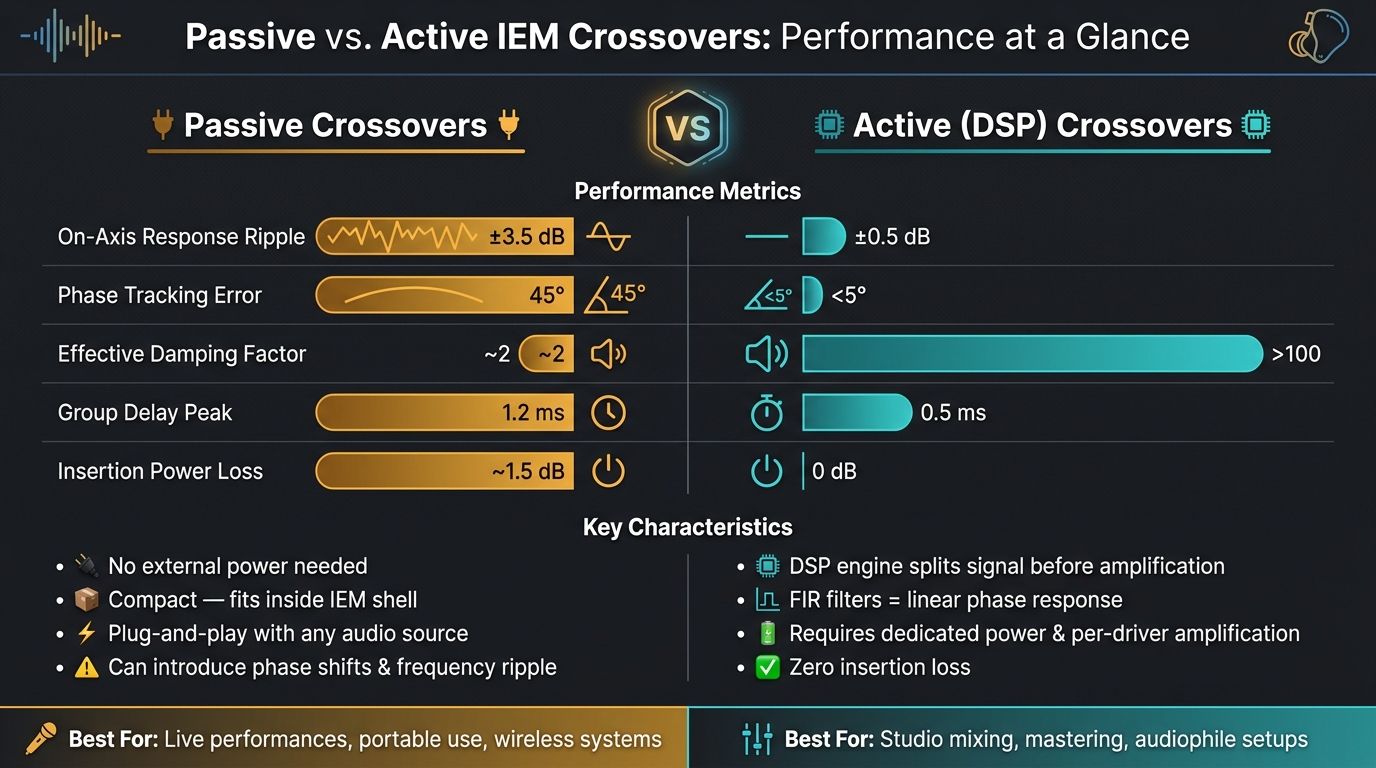
Passive vs Active IEM Crossovers: Key Performance Metrics Compared
BEGINNER'S GUIDE to Graphs & Crossovers Explained (LEVEL 2)
sbb-itb-80b2a19
1. Passive Crossovers
A passive crossover is a network of resistors, capacitors, and inductors - collectively known as an RLC circuit - integrated directly into the shell of an in-ear monitor (IEM). Positioned between the amplifier's output and the drivers, it splits the incoming audio signal into distinct frequency bands, all without requiring an external power source. In a 3-way design, the crossover takes this a step further by assigning a dedicated mid-range band to its own driver.
Design and Implementation
The "ways" of a crossover refer to the number of frequency bands it creates. A 2-way crossover divides the signal into two parts: lows and mid-highs. A 3-way crossover, on the other hand, separates the signal into low, mid, and high bands, allowing each driver to focus on a narrower range for better precision. As Andy Swanson from Alclair explains:
"The number of crossover points does not determine how good a monitor sounds. It describes the topology, which is the way frequencies are divided and routed."
However, the compact space inside an IEM shell limits the complexity of the design. First- or second-order filters are often used because of the bulkiness of components like inductors. To maintain sound quality, high-end manufacturers use automotive-grade components with low internal resistance (ESR), which helps minimise signal distortion.
These design choices play a critical role in shaping the final sound quality, as detailed in the next section.
Sound Quality Impact
The constraints of passive crossover design can present distinct sound quality challenges. For instance, these crossovers reduce the amplifier's control over driver motion, lowering the damping factor from over 100 in active systems to about 2. This can result in smeared transients and a slightly "muddy" low end. Additionally, the on-axis frequency response can fluctuate by as much as ±3.5 dB in the 1–3 kHz range, while phase tracking errors at the crossover point can reach 45 degrees.
Managing phase shifts is one of the toughest aspects of designing passive crossovers. Filters naturally introduce phase shifts at their cutoff frequencies, and poor stacking of multiple filters can lead to energy cancellations instead of additions. As Cristina Downey, Senior Electroacoustic Engineer at Knowles Corp, points out:
"Poorly executed crossovers can cause phase issues (cancellation of energy rather than addition and vice versa), frequency dips, and distortion, particularly in the midrange..."
Practical Applications
Despite these challenges, passive crossovers remain highly effective in professional settings. A well-designed 3-way passive crossover is particularly versatile, offering vocalists a dedicated mid-range driver that helps their voice stand out in complex band mixes. A prime example is the ACS Eclipse 500, updated in March 2026. This model uses a 3-way passive crossover to manage an 8mm dynamic sub-bass driver, two Knowles balanced armatures, and a Knowles Super Tweeter, all for $1,650 AUD. At the more advanced end, the Subtonic STORM employs a 7-way passive crossover (its proprietary CTRL Crossover) with automotive-grade inductors and resistors to divide sound into seven precise bands, aiming for exceptional clarity and detail.
Maintenance Tip: While passive crossovers are generally durable, the acoustic filter screens in IEM tubes can become clogged with sweat-related mineral deposits over time. This can lead to reduced volume or changes in frequency balance. Regular cleaning can help maintain optimal performance.
2. Active Crossovers
Unlike passive crossovers, which operate between the amplifier and drivers, an active crossover works earlier in the signal chain - right at the line level, before the signal reaches amplification. Instead of relying on resistors, capacitors, and inductors, active crossovers use operational amplifier (op-amp) circuits or Digital Signal Processing (DSP) engines to divide the audio signal into separate frequency bands. Each band is then routed to its own amplifier channel, which directly powers the corresponding driver.
Design and Implementation
Because active crossovers split the signal digitally before amplification, they are unaffected by the complex and variable impedance of the drivers. In passive systems, this impedance directly impacts the filter's performance, often causing it to deviate from its intended design. DSP-based crossovers, on the other hand, deliver precision by adhering strictly to their mathematical models.
DSP technology also makes it possible to implement Finite Impulse Response (FIR) filters, which cannot be achieved with passive components. FIR filters provide a perfectly linear phase response, ensuring that all frequencies arrive at the listener's ears with the same time delay. As Acoustas explains:
"The ultimate advantage of DSP lies in Finite Impulse Response (FIR) filters... the result is a dramatic improvement in transient accuracy and stereo imaging that is physically impossible for a passive crossover to achieve."
Sound Quality Impact
When it comes to sound performance, active systems demonstrate clear advantages. For example, DSP-based active systems can reduce on-axis response ripple to ±0.5 dB, a significant improvement over the ±3.5 dB seen in passive designs. Phase tracking error drops dramatically from 45 degrees to less than 5 degrees, and the effective damping factor leaps from roughly 2 in passive systems to greater than 100 in active setups. This tighter control over driver motion results in cleaner transients and a more defined low-frequency response.
| Performance Metric | Passive Crossover | Active DSP System |
|---|---|---|
| On-Axis Response Ripple | ±3.5 dB | ±0.5 dB |
| Phase Tracking Error | 45 degrees | <5 degrees |
| Effective Damping Factor | ~2 | >100 |
| Group Delay Peak | 1.2 ms | 0.5 ms |
| Insertion Power Loss | ~1.5 dB | 0 dB |
Siegfried Linkwitz from Linkwitz Lab summarises it well: "The amplifier takes maximum control over the motion of the speaker cone which gives a greater sense of clarity and dynamism compared to a passive dividing network between amplifier and driver."
These performance benefits, however, come with added complexity.
Practical Applications
While active crossovers undeniably enhance performance, their practical implementation in IEMs presents challenges. They require multiple amplifier channels and a dedicated power source for the DSP engine, making them difficult to integrate into compact IEM designs. As a result, passive crossovers remain the standard choice for most IEMs. However, some manufacturers - particularly those catering to audiophiles - are beginning to explore DSP-active architectures. By eliminating the inherent limitations of passive components, these systems aim to push the boundaries of audio accuracy and performance.
Pros and Cons
When deciding between the two types of crossovers, it all comes down to what you need from your in-ear monitors (IEMs). Each type has its strengths, and the right choice depends on your performance and practical requirements.
Passive crossovers are all about simplicity and ease of use. They fit neatly inside the IEM shell, need no external power, and work seamlessly with any standard audio source - whether it’s a wireless belt pack, a smartphone, or a portable DAC. This plug-and-play convenience makes them the go-to option for most IEMs, from entry-level models to high-end custom designs. However, they aren’t perfect when it comes to precision. As Andy Swanson points out:
"Every filter introduces a phase shift at its cutoff frequency. Stack multiple filters and those shifts can interact in ways that affect the sound negatively."
On the other hand, active DSP crossovers take a different approach. They address the limitations of passive designs by offering better phase accuracy, enhanced damping, and zero insertion loss. For example, they can improve the damping factor from roughly 2 to over 100, while also eliminating the ~1.5 dB insertion loss found in passive systems. The trade-off? Active crossovers require dedicated amplification for each driver and a DSP power source. This extra hardware makes them challenging to fit into compact IEM shells, which is why they’re more common in studio reference setups than in live stage environments.
Here’s a quick comparison of their key features:
| Feature | Passive Crossovers | Active (DSP) Crossovers |
|---|---|---|
| Design Complexity | Simple; uses RLC components inside the IEM shell | Complex; requires a DSP engine and per-driver amplification |
| Sound Quality | Can experience phase shifts and impedance-related frequency ripple | Linear phase (FIR filters), precise correction, and tighter transients |
| Damping Factor | ~2; reactive components limit amplifier control | >100; direct connection ensures maximum driver control |
| Power Efficiency | ~1.5 dB insertion loss | No insertion loss (0 dB) |
| Best Suited For | Live performances, portable use, wireless systems | Studio mixing, mastering, and audiophile setups |
For most musicians and casual listeners, a well-designed passive crossover, like those found in ACS Custom’s professional IEMs, delivers excellent sound quality without the added complexity. But when precision and control are your top priorities - think studio mixing or audiophile listening - active systems are the better option. The choice ultimately comes down to what matters most for your specific needs.
Conclusion
Crossover design plays a crucial role in shaping the sound quality of in-ear monitors (IEMs). Whether it's a passive or active design, the crossover determines how effectively frequencies are divided between drivers, directly influencing what you hear - whether you're on stage or in the studio.
This technical foundation has practical implications depending on the application. Passive crossovers are the go-to choice for most IEMs. They're compact, require no external power, and integrate seamlessly into the IEM shell. However, they can introduce challenges like phase shifts and frequency ripple. Well-engineered designs aim to minimise these issues. On the other hand, active digital signal processing (DSP) crossovers offer highly accurate frequency separation, but their reliance on additional hardware generally limits their use to studio environments.
When comparing passive and active designs, the choice ultimately hinges on the intended purpose. Musicians and audiophiles benefit from ACS Custom's dedication to crafting precise crossover architectures that enhance performance. For instance, ACS Custom employs passive 3-way crossovers across its professional IEM range. The ACS Evolve, priced at $1,100 AUD, is tailored for a flat, reference-style response. Meanwhile, the ACS Emotion Hybrid, at $2,100 AUD, combines a 9mm dynamic bass driver with balanced armatures to deliver a robust low-end, perfect for performers needing to stay in sync with the rhythm section.
FAQs
How can I tell if my IEMs use a passive or active crossover?
The type of crossover in your IEM can be determined by reviewing the technical specifications provided by the manufacturer. Typically, most IEMs - like those from ACS Custom - rely on passive crossovers. These are integrated into the earpieces to divide audio signals between the drivers. Since these components are enclosed within the custom-moulded shell, you won’t be able to see them directly. Instead, the product’s documentation will confirm the crossover type.
Do more crossover “ways” always sound better?
No, adding more crossover ways doesn’t automatically guarantee better sound quality. While having additional ways can improve frequency separation and allow drivers to focus on specific ranges, the real difference lies in the tuning. A well-crafted 2-way system can provide impressive clarity, whereas a 3-way system might offer better control and a broader soundstage, especially for intricate audio mixes. Ultimately, the system's performance depends on how well it’s designed and engineered.
Can I upgrade an IEM from passive to active DSP?
ACS Custom’s in-ear monitors (IEMs) come equipped with passive crossovers, such as the 'Passive 3-way crossover'. Based on the available information, it doesn't appear that these passive-crossover IEMs can be upgraded to include active DSP functionality. If you're looking to use active DSP, you'll need to choose a model that’s built specifically for that purpose.


