

Custom earpieces vs. foam earplugs are designed to solve communication challenges in noisy workplaces like construction sites, live events, and emergency services. These earpieces, made from medical-grade silicone and tailored to your ear's shape, offer a secure fit, comfort for long shifts, and clear audio by reducing background noise.
Key Points:
- Noise Isolation: Blocks up to 31dB of noise, ideal for loud environments.
- Durability: Lasts 2-5 years with proper care.
- Workplace Safety: Certified to meet Australian standards (AS/NZS 1270:2002).
- Custom Fit: Made from ear impressions for maximum comfort and stability.
- Compatibility: Works with various radio connector types (e.g., Kenwood and Motorola).
For optimal performance, ensure your earpiece matches your radio model, noise level needs, and workplace safety requirements. Investing in custom earpieces enhances communication clarity and reduces fatigue in demanding environments.
Understanding Your Radio and Work Environment
Identifying Your Two-Way Radio Model and Connectors
When ordering a custom earpiece, one of the first steps is knowing the exact make and model of your two-way radio. Why? Because your radio's model determines the type of connector it uses, and the wrong connector means your earpiece simply won’t function. Common connector types include Kenwood two-pin, Motorola two-pin, and Hytera multi-pin, each requiring a precise match or, in some cases, an adapter.
To confirm the connector type, check the label on your radio or consult the manufacturer's website. Some custom earpieces come with interchangeable connectors or adapters, which can be a lifesaver if your team uses multiple radio brands on-site.
Once you’ve ensured compatibility, the next step is to consider how your work environment influences your earpiece needs.
Assessing Noise Levels and Situational Needs
Work environments vary a lot in terms of noise. In louder settings, you’ll need more noise isolation, while some roles demand a balance between hearing protection and situational awareness. For example, security personnel often need to stay alert to ambient sounds, whereas factory workers benefit from maximum noise reduction.
Many custom earpieces provide up to 31dB of noise reduction, making them ideal for noisy environments like construction sites or manufacturing plants. If your role requires adaptability, consider earpieces with adjustable or removable acoustic filters. These filters let you tweak noise attenuation as needed, without the hassle of switching out your earpiece.
Once you’ve figured out your noise isolation needs, it’s crucial to ensure your equipment adheres to Australian workplace safety standards.
Workplace Safety and Compliance
Matching your earpiece to both your radio and local safety regulations ensures you’re equipped for Australian work environments. Hearing protection in Australia must meet AS/NZS 1270:2002 standards, which classify protection levels from Class 1 (low noise) to Class 5 (very high noise). Always confirm that your earpiece is certified under this standard and that its class aligns with your workplace’s noise profile.
If you’re unsure about the correct class, consult your employer or work health and safety officer. The most reliable way to determine your workplace’s noise levels is through a formal noise assessment, which provides precise data on peak noise exposure in your specific environment.
Choosing the Right Custom Earpiece Design
Earpiece Styles for Two-Way Radios
Once you've identified your radio and noise requirements, it's time to pick the right earpiece style. The main options include in-ear moulds, acoustic tube-compatible moulds, and low-profile designs. Each style has its own strengths, so your choice should align with the noise reduction needs and working conditions you've already assessed.
- In-ear moulds: These fit snugly in the ear canal, offering excellent noise isolation. They're a great choice for loud environments where blocking external noise is crucial.
- Acoustic tube-compatible moulds: These connect to a coiled acoustic tube that delivers sound from the radio to your ear. This design keeps the radio away from your ear while maintaining clear audio, making it perfect for situations where maintaining situational awareness is important.
- Low-profile designs: These sit flush with the ear, ensuring comfort during extended use, especially under helmets or headsets. They're ideal for roles like event staff or security where discretion and comfort are key.
Material and Build Considerations
The material and construction of your earpiece play a big role in its performance and comfort. Medical-grade silicone is a top choice - it provides a snug, durable fit and has smooth edges to prevent irritation during long hours of use. For added functionality, look for moisture-resistant designs and venting features to minimise the occlusion effect (that "plugged ear" sensation).
For example, ACS Custom uses medical-grade silicone across its communication earpiece range. Their PRO Series filters can provide noise reduction levels ranging from 10dB to 27dB, tailored to your specific needs. Make sure the design you choose is not only comfortable but also compatible with your radio's accessories.
Pairing Earpieces with Radio Accessories
Choosing the right earpiece is just one part of the equation. To ensure optimal performance, it’s crucial to integrate it seamlessly with your radio accessories. As mentioned earlier, your equipment must match your work environment.
If you're using a surveillance kit - which typically includes a coiled tube and an in-line push-to-talk button - check the diameter of the tube to avoid needing bulky adapters. For roles that rely on a remote speaker microphone (often clipped to a shoulder or chest), the earpiece connects via a short cable to the microphone unit instead of directly to the radio. In this case, the connector on your earpiece must match the output jack of the microphone to avoid compatibility issues and the need for extra adapters, which can add bulk and increase the risk of failure.
When placing your order, don’t just specify your radio model - provide details about your entire accessory setup. This ensures every component works together smoothly, saving you from potential headaches in the field.
Ordering Custom Earpieces and the Fitting Process
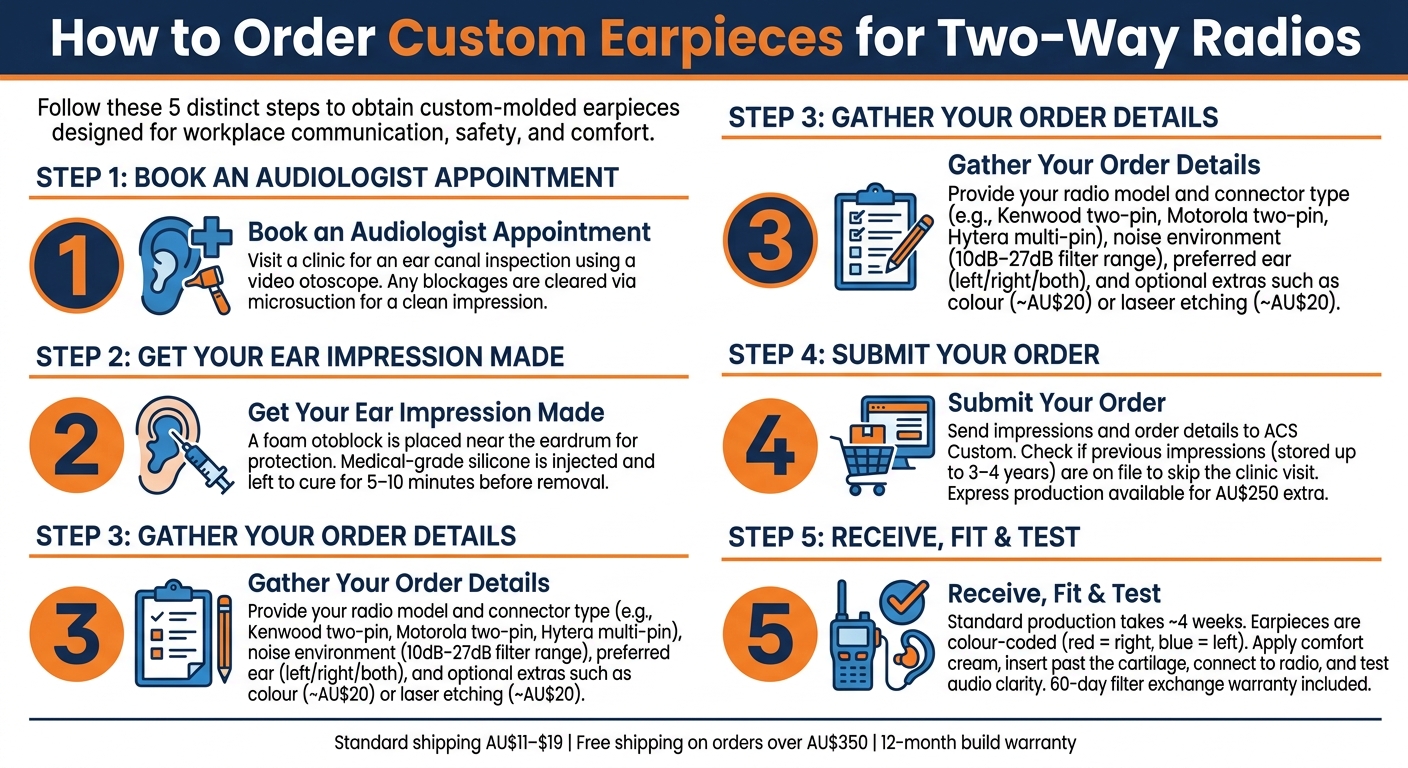
How to Order Custom Earpieces for Two-Way Radios: Step-by-Step Guide
The Ear Impression Process
The first step in ordering custom earpieces is getting an accurate ear impression. This mould captures the unique shape of your ear, ensuring a snug and effective fit. The process, which takes about 10–20 minutes, starts with an audiologist using a video otoscope to inspect your ear canal. If there’s any blockage, it’s usually cleared on the spot using microsuction, as blockages can compromise the mould’s accuracy.
Once your ear canal is clear, a small foam or cotton otoblock is carefully placed near your eardrum to protect it. Medical-grade silicone is then injected into your outer ear and canal. After curing for 5–10 minutes, the hardened impression is gently removed. The audiologist will inspect the impression to ensure it fully captures the ear’s shape. If you’re ordering from ACS Custom, let your audiologist know about their specific requirements, such as using an open-jaw technique with a bite block when necessary.
With the completed impression in hand, you’re ready to gather the details needed to place your order.
Information Needed for Your Order
To make the ordering process smooth, gather the following details:
- Radio model and connector type: Ensures the earpiece works seamlessly with your two-way radio system.
- Noise environment: Specify the type and level of noise you encounter, whether it’s steady industrial noise or sudden, sharp sounds. This helps determine the right PRO Series filter, with options ranging from 10dB to 27dB.
- Preferred side: Indicate if you need the earpiece for your left ear, right ear, or both.
- Optional extras: Choose customisations like colour (around AU$20), laser etching of up to 10 characters (around AU$20), removal grips, or a detachable neck cord.
If you’ve ordered from ACS Custom before, check if your ear impressions are still on file. They typically keep digital records for 3 to 4 years, which can save you a trip to the clinic when reordering.
Production and Delivery by ACS Custom
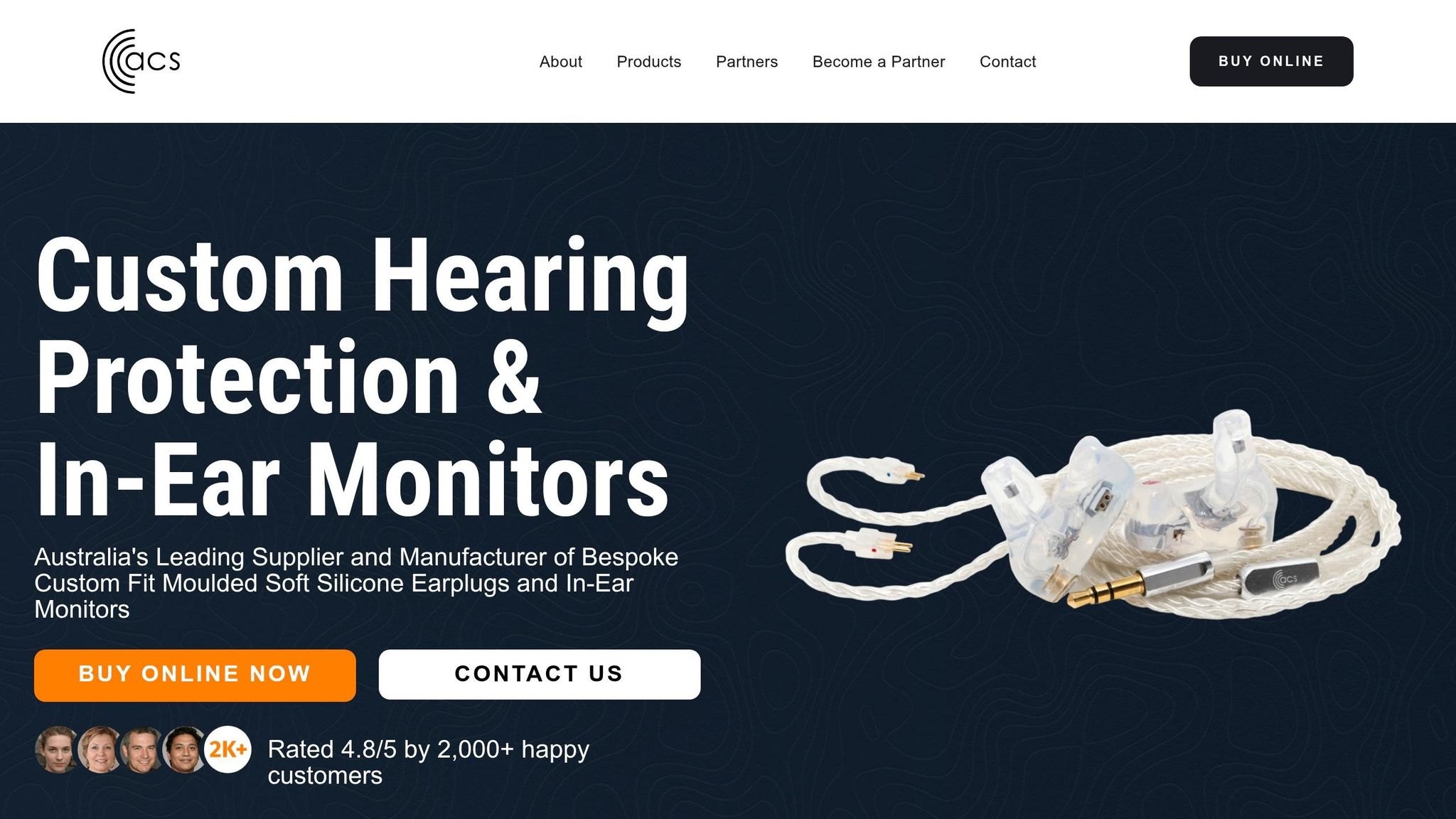
ACS Custom creates their earpieces in the United Kingdom using 40 Shore medical-grade silicone, which balances comfort with durability. Your ear impressions are 3D scanned and modelled with precision, ensuring a perfect fit.
Standard production takes about 4 weeks for PRO Series earplugs. If you’re in a hurry, express production is available for an extra AU$250, pushing your order to the top of the queue. Standard shipping within Australia costs between AU$11 and AU$15, while express shipping ranges from AU$15 to AU$19. Orders over AU$350 qualify for free shipping.
Each ACS Custom earpiece comes with a 12-month build warranty and a 60-day fit and filter exchange warranty. If the noise reduction doesn’t meet your needs, you can swap the filter without starting over.
sbb-itb-80b2a19
Fitting, Testing, and Maintaining Custom Earpieces
How to Fit and Connect Your Earpieces
Your earpieces are colour-coded to simplify identification - red logo for the right ear and blue for the left. Before inserting them, apply a thin layer of comfort cream. This helps the silicone slide in smoothly and ensures a proper seal.
To insert, gently twist the earpiece while pushing it in until it sits securely. The correct depth is crucial - it should extend just past the cartilage to block incoming sound before it enters the ear canal. If you’ve added optional grips, these can make the process faster, particularly when wearing gloves. Once inserted, connect the acoustic tube or cable to your radio accessory.
"A large amount of occlusion can be eliminated by ensuring that the earplug sits deep enough into the ear canal to extend past the cartilage. This ensures that the sound hits the plug and is deadened rather than entering the canal at all." - ACS Custom
Take time to practise until you can achieve a consistent, snug fit. Once that’s mastered, move on to testing the earpiece to confirm both comfort and performance.
Testing for Clarity and Fit
After fitting your earpiece, run a quick sound test to ensure it’s working properly. Speak aloud - your voice should sound natural, not hollow or overly amplified. If it sounds boomy, the earpiece isn’t seated deeply enough. Adjust its position and try again.
Next, test audio clarity by transmitting a signal. The sound should be clear across all frequencies, without muffled highs or distorted lows. A well-fitted earpiece ensures you hear transmissions as intended. Then, test it in your actual work environment. The filters should reduce harmful noise peaks while keeping radio communications sharp and audible. If the noise reduction feels too strong or too weak for your specific conditions, ACS Custom offers a 60-day filter exchange warranty, allowing you to switch to a different PRO Series filter without having to start over.
"Amazing fit, no occlusion effect, clear tight sound." - Tom C., Verified Buyer
Cleaning and Storage Tips
Proper maintenance keeps your earpieces in top condition. Follow these steps after each use:
- Surface wipe: Use a moist cloth or sterile wipe to clean the surface. Clear any debris from the sound channels with the included wax pick.
- Deep clean: Remove the filters and wash the silicone moulds in warm, soapy water. Avoid immersing the filters in liquid unless you’re using the PRO Impulse model, which is fully washable. Allow the moulds to dry completely before reinserting the filters.
- Visual inspection: Check for any tears, cracks, or blockages before each use. Damage to the silicone can affect both the seal and your hearing protection.
Australia’s diverse climate presents unique challenges. Whether you’re working in the humid conditions of Far North Queensland or the dry heat of the Pilbara, the PRO Series filters are water-resistant and designed to handle perspiration effectively. Store your earpieces in the provided carry pouch when not in use, keeping them away from direct sunlight and extreme temperatures. Both can degrade the silicone over time. Additionally, plan to replace your moulds every four years, as the shape of your ear canal changes gradually with age.
| Maintenance Task | Frequency | Method |
|---|---|---|
| Surface wipe | After every use | Moist cloth or sterile wipe |
| Wax removal | Daily or as needed | Provided wax pick |
| Deep clean | Periodically | Warm soapy water (moulds only; remove filters first) |
| Visual inspection | Before each use | Check for tears, cracks, or blocked tubes |
| Full replacement | Every 4 years | New impressions and new moulds |
Conclusion: Better Communication with Custom Earpieces
Custom earpieces are a game changer for on-site communication, especially in noisy Australian workplaces. Unlike generic options, these tailored solutions provide a snug fit that ensures clearer audio, less fatigue, and proper hearing protection.
Take ACS Custom's PACS Pro series, for example. These earpieces are certified to AS/NZS 1270:2002, delivering Class 5 protection. The Pro27 filter significantly boosts safe noise exposure - up to nine times more compared to unprotected ears. Meanwhile, the Pro Communicator range features high-fidelity speakers, ensuring crystal-clear communication even in environments with intense background noise.
"The investment in custom molded Pro Communicator Heavy Duty ear pieces is the best investment made. Being custom molded they are easy to wear all day without causing pain... They plug straight into the radio hand piece so calls are easy to hear and understand no matter where you are." - John Jamieson, Factory Worker
Durability is another key benefit. Custom moulds typically last three to five years, and with impressions stored for up to three years at over 350 locations across Australia, reordering is hassle-free. Pricing starts at $580.00 AUD for the standard Pro Communicator and $591.00 AUD for the Heavy Duty model, which is ideal for high-moisture, high-wear conditions . For more information, visit ACS Custom. Investing in a custom-moulded earpiece ensures you’re equipped for effective, reliable communication in any workplace setting.
FAQs
How do I confirm my radio’s connector type before ordering?
When identifying the connector type for your radio, start by checking the manual or manufacturer specifications. Common types include two-pin, 3.5 mm, or even proprietary connectors. For added clarity, you can consult industry-standard connector charts that pair specific brands and models with their compatible plugs. If you're still uncertain, reaching out to your radio equipment provider can help confirm the correct connector.
Once you've identified the right connector, ACS Custom offers tailored communication solutions that integrate effortlessly with your equipment.
What noise-reduction level should I choose for my job?
To determine the appropriate noise-reduction level, begin with a workplace noise assessment to measure the decibel levels in your environment. In Australia, the SLC80 rating is used to evaluate sound reduction. The goal is to lower noise exposure to around 75–80 dB(A) at the ear. ACS Custom’s PRO Series filters provide adjustable attenuation options, helping you maintain a balance between protecting your hearing, staying aware of your surroundings, and meeting communication needs.
Can I still hear what’s happening around me while wearing them?
ACS Custom earpieces are designed to let you stay aware of your surroundings while protecting your hearing from harmful noise. Equipped with advanced acoustic filters, they allow for clear communication and maintain situational awareness. The vented design reduces the occlusion effect - essentially, the amplified sound of your own voice - providing a more natural and comfortable listening experience. This means you can stay connected to your environment and have conversations, even in loud settings.


