

Construction workers face serious risks from prolonged noise exposure, which can lead to permanent hearing loss and other health issues. Tools like nail guns, chainsaws, and pile hammers produce dangerous noise levels, exceeding safe exposure limits in seconds. Australian regulations cap workplace noise at 85 dB(A) over an 8-hour shift, with peak limits at 140 dB. Proper hearing protection is essential to safeguard workers.
Key Points:
- Noise Risks: Tools like circular saws (105 dB) and pile hammers (125 dB) can damage hearing in seconds.
- Regulations: Safe noise exposure is capped at 85 dB(A) over 8 hours, with stricter limits for workers exposed to certain chemicals.
- Protection Options: Custom-moulded earplugs vs. foam earplugs, noise-cancelling earmuffs, and double protection (earplugs + earmuffs) help reduce risks.
- Maintenance: Replace earplugs every 4–5 years; earmuff cushions and seals every 3–6 months.
- Training: Proper fit and regular audiometric testing are critical for compliance and safety.
By using the right hearing protection, maintaining equipment, and following safety guidelines, workers can prevent noise-induced hearing loss and protect their long-term health.
Hearing Protection | Construction Safety
sbb-itb-80b2a19
Noise Levels on Construction Sites
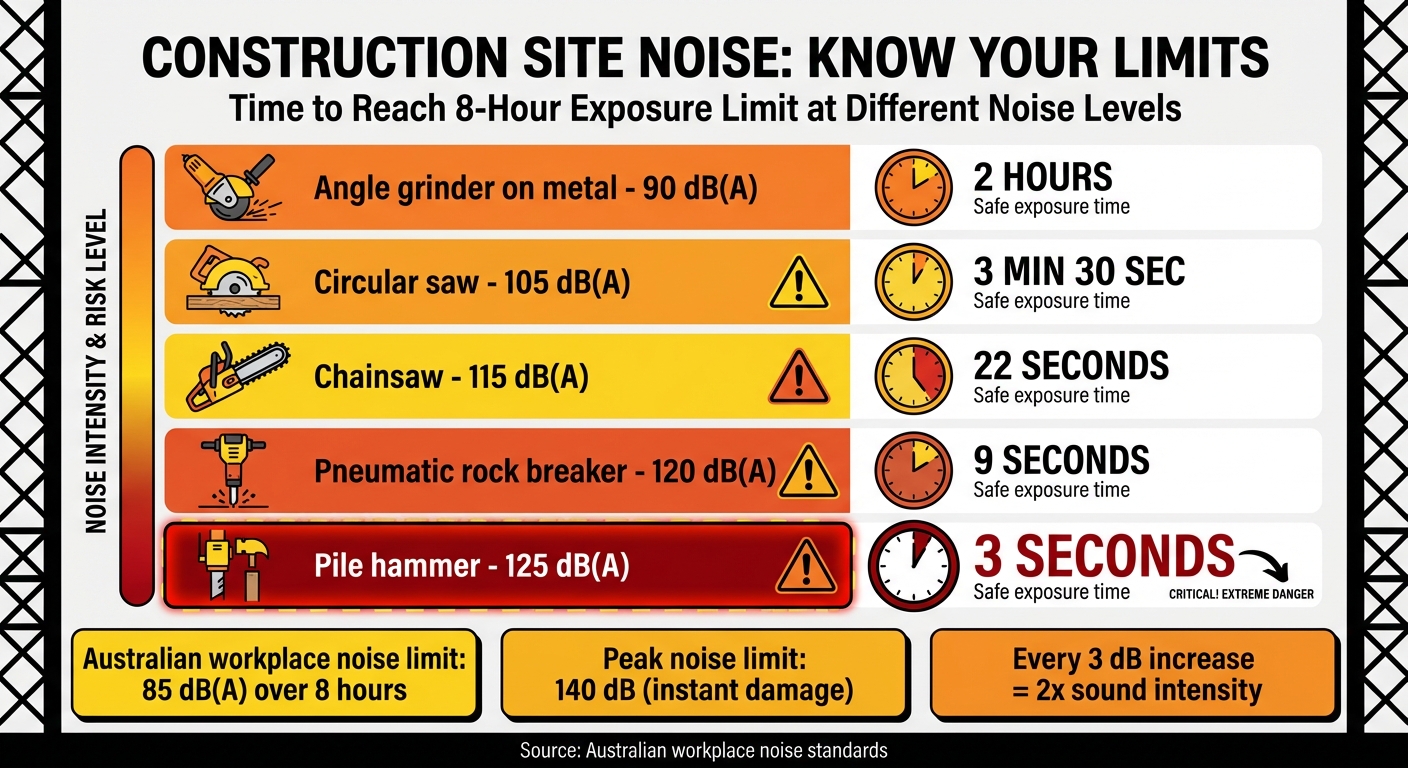
Construction Equipment Noise Levels and Safe Exposure Times
Common Sources of Loud Noise
Construction sites are notorious for their high noise levels, often reaching dangerous thresholds. For instance, a diamond rock saw can hit 120 dB(A), while chainsaws generally operate between 110 and 115 dB(A). Even routine tools like angle grinders and pneumatic hammers produce noise levels around 105 dB(A).
To put this into perspective, the safe exposure time for a circular saw at 105 dB(A) is just 3 minutes and 30 seconds. A pneumatic rock breaker at 120 dB(A) reduces this to a mere 9 seconds, and a pile hammer at 125 dB(A) cuts it down to a staggering 3 seconds.
| Equipment/Activity | Noise Level dB(A) | Time to Reach 8-Hour Limit |
|---|---|---|
| Angle grinder on metal | 90 | 2 hours |
| Circular saw | 105 | 3 minutes 30 seconds |
| Chainsaw | 115 | 22 seconds |
| Pneumatic rock breaker | 120 | 9 seconds |
| Pile hammer | 125 | 3 seconds |
Other equipment like concrete saws (about 110 dB), wacker plate compactors (around 97 dB), MIG welders (approximately 90 dB), and even hand hammering (roughly 90 dB) also contribute to the noise. When several machines operate at the same time, background noise levels rise, further reducing the safe exposure time.
These figures highlight how critical it is to follow workplace noise regulations to protect workers' hearing.
Australian Workplace Noise Standards
With such high noise outputs, Australian regulations impose strict limits to safeguard workers. The standard allows for an average noise level of 85 dB(A) over an 8-hour workday or 40-hour week. Since noise intensity doubles with every 3 dB increase, even a slight rise in decibels drastically reduces safe exposure times. For example, 88 dB(A) is twice as intense as 85 dB(A).
"Workers must not be exposed to noise of 85 decibels or higher over the course of an 8-hour day or 40-hour week." – Safe Work Australia
The peak noise limit is set at 140 dB, as exposure at or above this level can cause instant and irreversible hearing damage. Activities like sledgehammering can sometimes approach or surpass this dangerous threshold. Additionally, workers exposed to ototoxic substances (such as specific solvents or heavy metals) face a stricter noise limit of 80 dB or less.
From 29 July 2025, Queensland will introduce mandatory audiometric testing for workers required to use personal hearing protection. This will include an initial baseline test within three months of starting work, followed by regular assessments every two years.
Hearing Protection Equipment Checklist
Dealing with excessive noise levels on construction sites isn't just a challenge - it's a necessity to address for safety. This checklist outlines essential hearing protection equipment that aligns with Australian standards, ensuring compliance and safety.
Construction sites often reach noise levels far beyond safe limits, making proper hearing protection non-negotiable. In Australia, all hearing protection must meet AS/NZS 1270:2002 standards. These standards classify equipment into five classes based on their noise reduction capabilities, with Class 5 offering the highest level of protection for extremely loud environments like those involving jackhammers or pile drivers.
The goal is to choose protection that lowers noise exposure to just under 85 dB. This ensures you can still hear important cues like warning signals, radios, and conversations while staying protected.
Custom-Moulded Earplugs
Custom-moulded earplugs are designed to fit the unique shape of your ear canal, offering a snug fit and consistent noise reduction. Over a four-year period, they cost approximately $262.00 (excl. GST) compared to around $740.00 for disposable plugs. This makes them a cost-effective and environmentally friendly option, as they generate just 5 grams of waste over four years compared to the 17 kilograms created by disposable plugs.
These earplugs come with interchangeable filters, allowing you to switch between Classes 1–5 depending on noise levels throughout the day. They're comfortable for long shifts and easy to clean with water and mild soap. While the silicone material remains durable, the shape of your ear canal naturally changes over time, so replacements are needed every 4–5 years.
Noise-Cancelling Ear Muffs
For extreme noise environments, active noise-cancelling ear muffs are a solid choice. They not only block harmful noise but also allow you to hear voices and essential communication. Some models even feature built-in radios or Bluetooth, helping you coordinate with your team without compromising protection.
If you're wearing a hard hat, make sure to select ear muffs designed to attach securely to helmets. Poorly fitted muffs can significantly reduce their effectiveness, cutting noise by just 6 dB. Standard models cost about $60.00, but you'll need to replace sealing rings and cushions every 3–6 months to maintain performance and hygiene. Replacement kits typically add $30.00 per set.
Combined Earplugs and Ear Muffs
When noise levels exceed 100–105 dB(A) - common with equipment like jackhammers, chainsaws, or pile drivers - double protection becomes essential. Using both earplugs and ear muffs together can achieve a combined Noise Reduction Rating (NRR) of 65%, offering the highest level of protection for high-risk environments. This combination is crucial for tasks where safe exposure times drop to just seconds, ensuring you're shielded even during short bursts of intense noise.
| Type | NRR Achievement | Best For |
|---|---|---|
| Earplugs (below 105 dBA) | Up to 50% of rated NRR | Intermittent noise, hot climates |
| Ear Muffs (below 105 dBA) | Up to 70% of rated NRR | Easy on/off access, hard hat compatibility |
| Double Protection | Up to 65% combined NRR | Peak noise above 100–105 dBA |
Next, we'll dive into how to choose the right equipment and maintain it to ensure long-term effectiveness.
Selecting and Maintaining Hearing Protection
Getting a Proper Fit
Ensuring your hearing protection fits correctly is crucial for effectiveness. For custom earplugs, a professional ear impression guarantees a snug seal. These plugs are often colour-coded - red for the right ear and blue for the left - to help with proper placement. To insert them, gently twist the earplugs back with light pressure until they create a seal in the ear canal. If inserting them feels tricky, applying a small amount of water-based comfort cream at the ear entrance can make it easier. For earmuffs, check that the cushions are soft and pliable. If you’re wearing a hard hat, choose earmuffs designed to integrate seamlessly with your head protection. A proper fit not only makes wearing them more comfortable but also ensures they provide maximum protection.
Cleaning and Maintenance
Keeping your hearing protection clean is important for both hygiene and longevity. After each use, clean silicone earplugs and sound tubes to remove wax or debris using a cleaning tool. For a thorough cleaning, wash non-electronic silicone earplugs in warm, soapy water - just be sure to remove any filters first - and let them dry completely before reinserting the filters. Never submerge the filters in water.
Earmuffs should be wiped down after use and stored in a dedicated case, away from moisture, extreme temperatures, and direct sunlight. Keep the internal foam inserts dry. Avoid pulling custom earplugs out by tugging on neck cords or cables, as this can damage them.
When to Replace Equipment
Replacing your hearing protection regularly is key to maintaining its effectiveness. Custom earplugs should be replaced every 4–5 years to account for changes in the shape of your ear canal. PACS Hearing Protection Australia advises:
"As a guideline we recommend new ear impressions and replacement of your hearing protection earplugs every four to five years due to anatomical changes to the shape of the ear canal".
For earmuffs, replace the cushions and sealing rings every three to six months to maintain proper sound attenuation and hygiene. If the headband loses tension or can no longer hold the cups securely over your ears, it’s time to replace either the headband or the entire unit. Disposable foam plugs should be discarded as soon as they become dirty, damaged, or fail to spring back to their original shape after being rolled.
Compliance and Worker Training
Ensuring proper hearing protection on noisy construction sites requires strict adherence to regulations and ongoing worker education. According to the Model WHS Regulations, PCBUs are legally required to eliminate or minimise risks of work-related hearing loss. This involves identifying noise hazards, conducting thorough noise assessments, applying control measures, and providing workers with appropriate hearing protection.
Australian standards cap noise exposure at 85 dB(A) over an 8-hour workday, with peak noise levels over 140 dB(C) capable of causing immediate harm. Stricter limits apply when workers are exposed to ototoxic substances.
Audiometric testing is essential for workers who regularly depend on hearing protection. New employees should have their first audiometric test within three months of starting their role, followed by tests at least every two years. In Queensland, starting 29 July 2025, all workers using hearing protection will be required to undergo mandatory audiometric testing. It’s equally important to keep detailed records of noise monitoring, PPE training, and audiometric test results to ensure compliance during audits.
These measures emphasise that compliance goes beyond providing protective equipment - it also requires educating workers about their use.
Training Workers on Hearing Protection
Providing hearing protection is only part of the solution - training workers to use it correctly is just as critical. Workers should understand the Australian Class 1 to Class 5 rating system, which helps them choose protection suited to specific noise levels. For instance, Class 5 protection is recommended for noise levels between 105 and 110 dB. Studies highlight the importance of proper fitting during training, as poorly fitted earplugs may only reduce noise by 6 dB.
Training should also stress personal responsibility for adhering to safety policies and maintaining their protective gear. Workers need to be aware of the risks: at 109 dB(A), the daily exposure limit is exceeded in just 1.9 minutes. Additionally, a single use of an explosive powder-actuated tool can surpass the 140 dB(C) peak noise standard instantly.
For extremely noisy environments, such as when using jackhammers (where noise levels exceed 100–105 dBA), workers should be trained to use double protection - combining earplugs with earmuffs. Finally, it’s crucial to highlight that even a short lapse in wearing protection in high-noise areas can result in surpassing the allowable daily exposure limit.
Conclusion
This checklist highlights the essential steps construction workers need to take to safeguard their hearing. Protecting your hearing on-site isn’t just a recommendation - it’s a necessity. Noise-induced hearing loss is entirely preventable, yet it often creeps up unnoticed until the damage is permanent. That’s why using reliable hearing protection from the very start is so important.
The 85 dB(A) threshold exists for a reason: every 3 dB increase doubles the sound intensity and cuts your safe exposure time in half. Construction workers face these risks daily, with some machinery exceeding safe noise levels in mere seconds. For instance, a single use of an explosive powder-actuated tool can generate over 140 dB, causing irreversible damage instantly.
"Hearing protection only works when used, and its effectiveness is also reliant on its condition and whether it is fitted correctly." - SafeWork NSW
The fit and quality of your hearing protection matter more than you might think. Poorly fitted earplugs, for example, may only reduce noise by 6 dB, leaving you dangerously unprotected. Whether it’s custom-moulded earplugs or regular equipment checks, every step contributes to effective hearing protection. In environments where noise levels exceed 100–105 dBA, double protection - such as combining earplugs with earmuffs - is a must.
True compliance goes beyond simply wearing hearing protection. It’s about ensuring a proper fit, maintaining your gear, understanding the Class rating system, attending training, and undergoing regular audiometric testing. By committing to these practices and consistently using well-maintained hearing protection, you’re not just meeting safety standards - you’re preserving your ability to hear for years to come.
FAQs
How do I know if my site noise is over 85 dB(A)?
To determine whether noise levels on a site surpass 85 dB(A), you’ll need to conduct a thorough noise assessment. Use equipment like sound level meters or noise dosimeters to measure sound levels. Be sure to take readings at different locations and times to get a comprehensive baseline of the noise environment.
If noise levels hit or exceed 85 dB(A), it’s crucial to take action. Ensure workers have access to appropriate hearing protection and implement additional measures to manage risks effectively. These steps are essential to protect workers’ hearing health and maintain a safer work environment.
Do I need earplugs, earmuffs, or both?
In extremely noisy settings, such as construction sites, pairing earplugs with earmuffs delivers the highest level of hearing protection. This combination significantly reduces noise exposure and helps protect your hearing more efficiently.
What are the early signs of noise-induced hearing loss?
Noise-induced hearing loss can sneak up on you with subtle signs. You might notice sounds becoming muffled or distorted, a persistent feeling of fullness or pressure in your ears, or difficulty picking up high-pitched tones. Another common clue is tinnitus - those annoying ringing or buzzing sounds in your ears. Since these symptoms often develop gradually, catching them early is key to avoiding further damage.
Partnering for Your Hearing Health: earLAB & ACS Custom
At earLAB, we are proud to support the ACS Custom community by providing the clinical expertise necessary to protect and enhance your listening experience. Whether you are a musician, an audiophile, or an industry professional, your hearing health is our priority. Our Melbourne-based clinics offer a full suite of specialised services, including professional ear impression taking for a perfect ACS fit, safe microsuction earwax removal to ensure clear sound delivery, and comprehensive hearing tests to monitor your auditory health. As an independent clinic, we also provide expert hearing aid fittings and rehabilitation, offering unbiased advice on the latest technology tailored to your lifestyle. Book your appointment at locations to ensure your ears—and your ACS devices—are performing at their absolute best.
Related Blog Posts
- How to Choose Custom Earplugs for Your Industry
- 7 Signs You Need Custom Hearing Protection at Work
- How to Get Custom Moulded Earplugs: Step-by-Step Guide
- How Custom Earplugs Prevent Noise-Induced Hearing Loss


