

Custom moulded earplugs offer a personalised fit, lasting comfort, and effective noise protection for various needs - from sleep to work or music. Unlike custom earplugs vs. foam earplugs, they’re crafted from medical-grade silicone using impressions of your ears, ensuring they fit perfectly and last up to 4–5 years. Here's a quick summary of the process:
- Step 1: Choose a qualified provider who uses certified materials and follows safety standards like AS/NZS 1270.
- Step 2: Book a consultation to get impressions of your ears taken by an audiologist.
- Step 3: Impressions are used to create a precise mould, ensuring a snug fit.
- Step 4: Customise your earplugs with options like noise filters, colours, or laser etching.
- Step 5: Manufacturing takes 3–4 weeks, after which your earplugs are delivered and tested for fit.
Custom options include filters for specific environments, like Pro17 for musicians or Pro27 for motorcyclists. These earplugs provide durable, long-term hearing protection, making them a smart investment for anyone exposed to loud noise regularly.
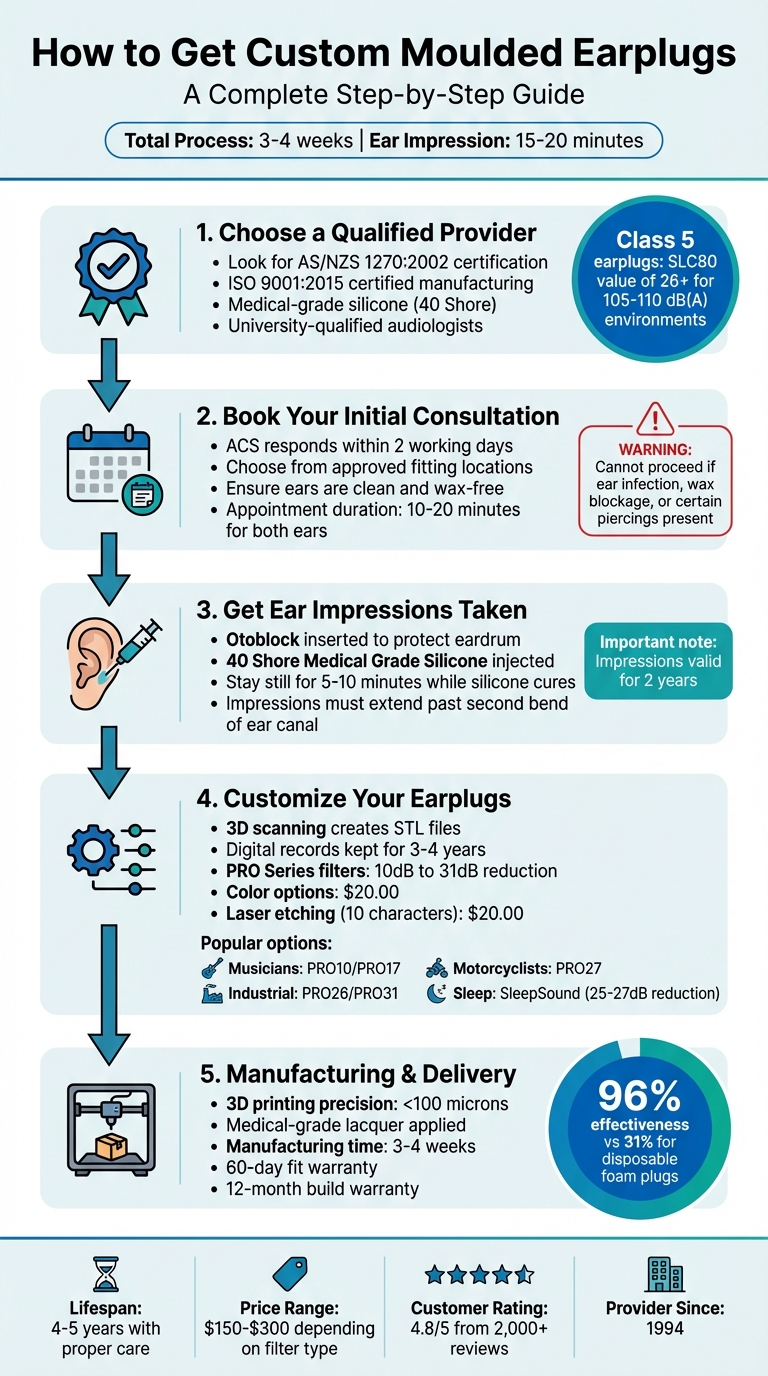
5-Step Process to Get Custom Moulded Earplugs
Step 1: Choose a Qualified Provider
The quality of your provider plays a major role in the safety, comfort, and durability of your earplugs. A provider that uses medical-grade materials and follows proper manufacturing standards ensures your earplugs are not only safe but also effective and long-lasting. For example, medical-grade silicone is hypoallergenic, gentle on the skin, and flexible enough to move naturally with your ear canal - whether you're talking or chewing - while maintaining an acoustic seal. On the other hand, lower-quality materials can lead to skin irritation and poor noise protection. While cheaper providers might save you money upfront, they often compromise on comfort, protection, and longevity. It’s worth taking the time to evaluate the key standards that ensure your custom earplugs perform as they should.
What to Look for in a Provider
Start by confirming that your provider meets the AS/NZS 1270:2002 certification, which is the standard for hearing protection in Australia and New Zealand. For noisy workplaces - like industrial settings where 8-hour noise levels reach 105–110 dB(A) - you’ll need Class 5 earplugs with an SLC80 value of 26 or higher. Also, check that the provider’s manufacturing process is ISO 9001:2015 certified, which guarantees quality management. Finally, make sure that ear impressions are taken by university-qualified audiologists or hearing health care professionals.
"It is better to select a hearing protector that is comfortable and likely to be worn during the entire exposure rather than one that provides high protection but is uncomfortable and likely to be removed for short periods." - WorkSafe Victoria
Here’s an example of why comfort matters: if a hearing protector rated at 30dB is removed for just 1.4% of the time (meaning it’s worn 98.6% of the time), its effective protection drops from 30dB to only 18dB. This highlights the importance of choosing earplugs that are not only effective but also comfortable enough to wear consistently.
About ACS Custom
ACS Custom has been a leader in custom-moulded hearing protection in Australia since 1994. The company uses 40 Shore medical-grade silicone, ensuring flexibility and durability, and holds ISO 9001:2015 certification for quality management. Their PRO31 filters also meet the Class 5 AS/NZS 1270:2002 certification, adhering to Australia’s strictest safety standards.
The ACS Custom PRO Series offers a range of options tailored to different environments, with noise reduction levels ranging from 10dB to 27dB. Using advanced 3D scanning technology, ACS ensures a precise fit for every customer. They’ve earned a 4.8/5 satisfaction rating from over 2,000 customer reviews. Prices for their custom earplugs range from $150.00 to $300.00, depending on the filter type. While the initial cost may seem high, these earplugs typically last 4 to 5 years, providing superior comfort and protection compared to disposable alternatives.
sbb-itb-80b2a19
Step 2: Book Your Initial Consultation
After selecting ACS Custom as your provider, the next step is to schedule your consultation. Once you've placed your order online, ACS Custom will reach out within two working days to provide details about the nearest approved fitting location from their extensive network across Australia. Alternatively, you can choose your own audiologist or opt for one of their recommended partners. This consultation is essential for creating the custom earplug impressions.
If you'd rather book directly, specialised clinics like earLAB in Melbourne offer the convenience of scheduling appointments via their website or phone. The entire process, including the consultation and taking impressions, typically takes just 10 to 20 minutes for both ears.
Before your appointment, it's important to ensure your ears are clean and free of wax. Audiologists cannot proceed with impressions if there’s a blockage. As ACS Custom explains, "ACS custom products require good deep impressions in order to create a seal in the ear, so it is important there is no obstruction, such as earwax, in the ear canal". If wax is present, you’ll need to visit a GP or ear-cleaning specialist and reschedule your appointment.
What Happens During the Consultation
Your audiologist will start by inspecting your ears with an otoscope to check for obstructions or infections. During this time, you’ll have the opportunity to discuss your specific needs - whether you require protection for industrial work, motorsports, music, or sleep. Be as detailed as possible about your environment; for example, a motorcyclist might need the Pro27 filter to minimise wind noise, while a DJ might prefer the Pro17 for high-fidelity sound protection.
You should also share any relevant hearing history, such as tinnitus or previous ear infections, and mention any skin sensitivities (ACS Custom products are crafted from medical-grade, hypoallergenic silicone). If you’ve already purchased your earplugs online, don’t forget to bring your order confirmation to the appointment.
When You Can't Get Ear Impressions
In certain situations, the impression process may need to be postponed. For instance, if the audiologist detects an ear infection, wax blockage, or other irregularities during the otoscope inspection, the impressions cannot be taken until the issue is resolved. Additionally, you’ll need to remove specific ear piercings - such as Daith, Rook, Conch, Snug, or Tragus - as these can interfere with the impression material or result in an incomplete mould.
For customers under 18, it’s important to confirm age policies in advance. Some clinics have restrictions or require specific qualifications to take impressions for minors. ACS Custom advises: "We recommend verifying with your chosen impression taker whether they are qualified and authorised to take impressions for minors".
Once these concerns are addressed, you’ll be ready to move forward with the ear impression process in the next step.
Step 3: Getting Your Ear Impressions Taken
After confirming your ears are ready for the procedure, the audiologist will begin crafting the physical moulds. These moulds capture the exact shape of your ear canal and outer ear, which are as unique as fingerprints. This personalised fit ensures a proper acoustic seal to block noise and keeps the earplugs comfortable for long periods of use.
The Impression Process
The process starts with the insertion of a small foam or cotton block, called an otoblock, into your ear canal to protect your eardrum. Next, the audiologist injects a hypoallergenic, medical-grade silicone - commonly 40 Shore Medical Grade Silicone - into your ear canal and outer ear (specifically, the concha bowl). As the silicone fills the space, you might notice a cool sensation, but it's completely safe.
You'll need to remain still for 5–10 minutes while the silicone cures and hardens. Even slight movements can distort the mould and compromise the fit. Depending on the audiologist's preference, you may be asked to keep your jaw in a neutral position, or in some cases, slightly open to account for changes in the ear canal's shape. Creating moulds for both ears typically takes about 15–20 minutes. Once hardened, the next step is to check the quality of the impressions.
Checking Impression Quality
After the silicone sets, the audiologist carefully removes the moulds and inspects them to ensure they extend deep enough - past the second bend of the ear canal - to achieve an effective acoustic seal.
The moulds are then checked for any imperfections, such as air bubbles or incomplete sections. Once verified, they are placed in a zip-lock bag and padded envelope for safe transit. These physical impressions are 3D scanned to produce a digital model, which serves as the basis for your custom earplugs.
It's worth noting that ACS Custom only accepts impressions taken within the last two years. However, many professionals suggest updating your impressions roughly every four years to maintain an accurate fit.
Step 4: Customising Your Earplugs
Once your impressions are verified, the next step is turning them into a precise digital blueprint for your custom earplugs.
3D Scanning and Digital Modelling
Your ear impressions are 3D scanned into STL files, capturing every detail of your ear's unique shape. During the digital modelling process, technicians can incorporate features like laser etching or tailored acoustic channels for PRO Series filters. These digital records are kept for 3–4 years, meaning you can reorder replacements without needing new moulds. The 3D scanning service costs $77.00 if done through ACS Custom or $110.00 when using external impressions.
Available Customisation Options
The digital models open the door to a variety of customisation options to suit your needs. For example, the PRO Series earplugs feature interchangeable filters that reduce noise levels between 10dB and 31dB. Musicians often prefer filters like PRO10 or PRO17 for maintaining sound clarity, while industrial workers tend to choose PRO26 or PRO31 for high-noise environments. Motorcyclists might opt for the PRO27, which is designed with a thinner sound tube to minimise wind noise under helmets.
If you're looking for earplugs for sleeping, SleepSound earplugs reduce ambient noise by about 25–27dB and have a low-profile design, making them comfortable for side-sleepers. Swim Plugs create a watertight seal to help prevent swimmer's ear, while Shooting Plugs offer maximum noise reduction for firearm use.
All earplugs are crafted from hypoallergenic, durable 40 Shore Medical Grade Silicone, ensuring comfort and longevity. Practical add-ons include "Grips" (extra silicone sections for easier handling) or detachable neck cords. You can also personalise your earplugs with colour options (available for $20.00) or add laser etching of up to 10 characters (also $20.00).
Step 5: Manufacturing and Delivery
How the Earplugs Are Made
Once your digital model is complete, the design moves into production, turning your concept into a physical product. This is achieved through 3D printing, a process that constructs your earplugs layer by layer with incredible precision - less than 100 microns, about the thickness of a human hair. The initial printing stage typically takes between one to two hours.
After printing, the earplugs undergo a series of detailed steps. They’re carefully removed, cleaned, dried, and inspected to ensure no material residues remain. A medical-grade lacquer is applied to improve durability and make the earplugs safe for long-term contact with your ear canal. Final assembly involves inserting your chosen acoustic filters and attaching any optional accessories, like grips or neck cords. Before being sent out, a final quality check ensures the filters are correctly installed and the left and right plugs are properly paired. This thorough process guarantees the custom fit based on your digital model.
"3D printing achieves higher efficiency rates than hand-made hearing protection devices." - Cotral Lab
Delivery Time and Final Fitting
After passing quality control, the next stage focuses on delivery and ensuring the earplugs fit perfectly. The entire manufacturing process - from receiving your impressions to the finished product - usually takes about 3–4 weeks. This timeline includes 3D scanning, digital modelling, printing, finishing, and inspection. Once ready, the earplugs are packaged and shipped to your address.
When your earplugs arrive, you can test the fit by inserting them and humming or speaking to check for a proper seal. They should feel snug and comfortable, without causing any pain or pressure. If they don’t feel quite right, ACS Custom offers a 60-day fit warranty, allowing you to request adjustments. With modern 3D-printed earplugs boasting an effectiveness rate of 96% - a significant improvement over the 31% effectiveness of disposable foam plugs - the wait is undoubtedly worth it.
Conclusion
Getting custom-moulded earplugs involves five straightforward steps: choosing a qualified provider, scheduling a consultation, taking ear impressions, personalising your plugs, and finally, manufacturing and delivery. The entire process typically takes 3–4 weeks, while the ear impression itself only takes about 15–20 minutes.
What sets custom earplugs apart is their durability and comfort. Unlike disposable foam plugs, these can last up to 4–5 years with proper care, offering consistent protection and a tailored fit.
Since 1994, ACS Custom has been a trusted name in specialist hearing protection, earning a 4.8/5 rating from over 2,000 customers. Their products are backed by a 12-month build warranty and a 60-day fit warranty, reflecting their dedication to quality and customer satisfaction.
Whether you need earplugs for work, live music, better sleep, or motorsports, custom-moulded options provide reliable protection for a range of uses. With over 1 billion people globally at risk of noise-induced hearing loss, taking steps to safeguard your hearing now is an investment in your long-term well-being. Custom earplugs are a smart, personalised way to protect what matters most - your hearing.
FAQs
How do I know which filter I need?
When selecting the right filter for your custom earplugs, think about the typical noise levels you encounter and how much sound clarity you require. ACS Custom provides filters that reduce noise by anywhere from 10 to 27dB. To make the best choice, speak with a qualified audiologist or the professional who took your ear impressions. They can help you assess your usual noise exposure and recommend a filter that balances protection with the clarity you need.
What if my earplugs don’t fit properly?
If your earplugs aren’t fitting as they should, reach out to your provider for help. They might recommend taking new ear impressions or tweaking the fit to make them more comfortable and effective. Getting the right fit is crucial for proper hearing protection, so don’t hesitate to seek professional advice to ensure a snug seal and maximum comfort.
Can I get impressions done if I have wax or an infection?
Before getting ear impressions, it’s best to deal with any wax build-up or infections. Professionals typically examine your ears for any irregularities beforehand. Issues like excessive wax or infections can interfere with the accuracy and safety of the process. Always consult a qualified expert to evaluate your condition and confirm whether it’s safe to proceed with impressions.


