

If workers don’t keep earplugs in, the label rating means little. From what I can see, custom earplugs are usually the better pick for full-time, high-noise work because they’re more comfortable, easier to keep in, and better for speech and alarms. Standard earplugs still suit visitors, short tasks, and big crews where low upfront spend matters most.
Here’s the short version:
- Custom earplugs are made for each worker’s ears, so the seal is more consistent.
- Standard earplugs are cheap at about A$0.50 per pair, but fit and insertion can vary.
- Workers may get only 30% to 50% of the labelled protection from standard plugs if they’re worn the wrong way.
- Custom filtered plugs can help workers hear speech and warning alarms more clearly.
- For daily use, custom plugs can work out cheaper after about 2.5 years.
- For long shifts, comfort often decides whether protection stays in all day.
What this means for you: if your team wears hearing protection for hours at a time, comfort and clear communication matter just as much as the rating on the packet. The best earplug is the one people will wear properly for the whole shift.
Quick Comparison
| Factor | Custom Earplugs | Standard Earplugs |
|---|---|---|
| Fit | Made for each person | One-size-fits-most |
| Comfort | Better for long wear | Can cause pressure or irritation |
| Speech and alarms | Clearer with filters | More muffled |
| Protection in use | More consistent seal | Depends on correct insertion |
| Upfront cost | Higher | Lower |
| Long-term spend | Lower over time for daily use | Adds up with repeat buying |
| Best for | Full-shift workers in noisy roles | Visitors, short jobs, large rotating crews |
I’d sum it up like this: standard earplugs are easy to issue, but custom earplugs are often easier to live with. And in noisy workplaces, that can make the difference between protection being supplied and protection being worn.
Custom Earplugs Custom Hearing Protection VS and Generic Ear Plugs Generic Hearing Protection Why?
sbb-itb-80b2a19
Custom Earplugs: Comfort, Communication and Long-Term Value
This is where custom earplugs start to make a day-to-day difference. They can improve comfort, make speech easier to hear and support long wear across a full shift.
How a personalised fit improves wear compliance
Standard foam plugs only work well when they’re inserted the right way. That sounds simple, but in practice it leaves room for error. Custom plugs take that variable out of the equation and keep a more consistent seal.
That consistency matters most on long shifts. Workers on 12-hour rosters often take standard plugs out partway through a shift because the pressure becomes uncomfortable. A personalised fit removes those pressure points, which makes it easier to keep hearing protection in for the full time spent in noisy areas.
When protection feels better to wear, people are less likely to take it out. And that leads straight to the next point: communication.
Clearer speech supports safer work
A common complaint with standard earplugs is simple: they dull everything. Instructions, alarms and everyday conversation can all sound muffled. When that happens, some workers struggle to communicate. Others just pull the plugs out, which wipes out the point of wearing them in the first place.
Filtered custom earplugs work a bit differently. They use acoustic filters to cut harmful noise while letting the wearer hear speech and warning alarms more clearly. ACS Custom's PRO Series filters provide 10 dB to 27 dB of noise reduction and are certified to AS/NZS 1270, helping keep noise at a safer level while speech and alarms remain clearer.
Higher upfront cost, lower replacement burden
Custom earplugs do cost more at the start. But they’re built for long use and can last for several years with proper care.
Foam earplugs are cheap per pair, but they also lock you into a constant replacement cycle. Custom earplugs flip that trade-off. You pay more upfront, then get years of use, fewer replacements and less waste.
That matters even more when comfort affects whether workers keep their hearing protection in place.
The practical difference stands out even more in a direct workplace comparison.
Standard Earplugs: Low Entry Cost, Variable Worker Experience
Standard earplugs mainly come in two forms: foam disposables and reusable pre-moulded or flanged plugs. They’re low-cost, simple to hand out in bulk, and handy for large crews, contractors, and visitors. But there’s a catch: the day-to-day experience can vary a lot over long shifts. You see that most in comfort, fit, and how easy they are to wear all day.
Easy to issue across large teams
If you’re managing a big workforce, rotating contractors, or site visitors, standard earplugs are an easy option. High-quality foam earplugs cost about $0.50 per pair. So when the main goal is getting hearing protection into people’s hands fast, foam disposables do the job.
Fit problems can reduce real protection
The bigger issue is fit. Foam plugs only work properly when they’re inserted the right way, and in busy workplaces, that step often gets missed. In day-to-day use, workers can end up with only 30% to 50% of the labelled SLC₈₀ rating. If plugs are inserted the wrong way, they can lose up to 50% of their rated protection.
There’s also the problem of one-size-fits-all design. Ears aren’t all shaped the same, so plugs can sit well for one worker and feel awful for another. Over long shifts, that can lead to pressure build-up and irritation. And once something starts to hurt, people adjust it, loosen it, or take it out. At that point, protection drops. If fit changes from person to person, confidence in the gear tends to drop too.
Communication barriers can affect morale
Standard plugs also block all frequencies in the same blunt way. That can cause the occlusion effect, where the wearer hears their own voice as hollow and booming, while spoken instructions and warning signals become harder to pick up. It’s a bit like trying to have a conversation with your head under water.
When workers can’t hear clearly, they can start to feel cut off from the people around them. That doesn’t just affect communication on the job. Over time, it can wear on morale and make it harder to keep people settled and engaged.
The impact at work isn’t only about the rating on the packet. It’s also about what wearing the gear feels like across a full shift. Those gaps stand out more in the direct comparison that follows.
Custom vs Standard Earplugs: Workplace Benefits Compared
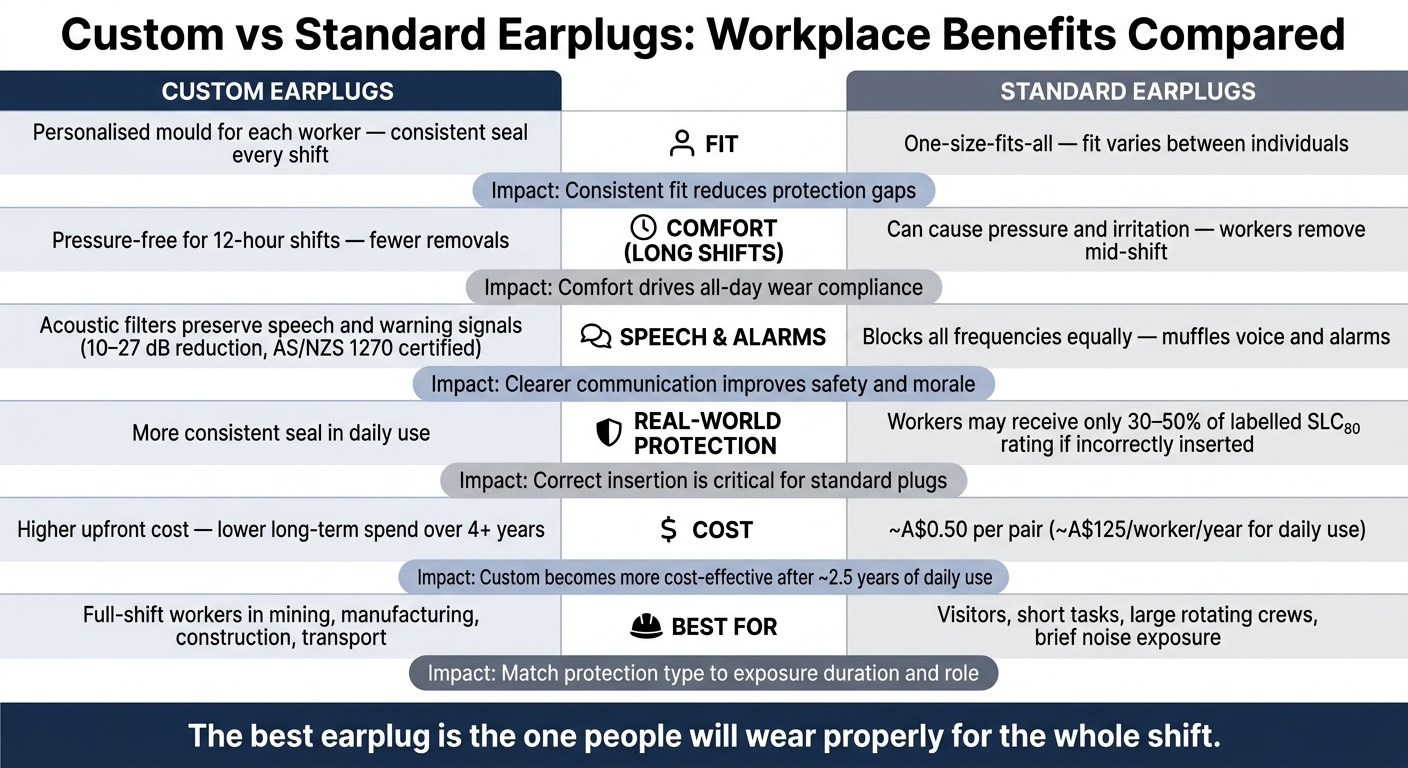
Custom vs Standard Earplugs: Workplace Comparison
Those gaps build up across shifts, teams, and staff turnover. Comfort, clear speech, and day-to-day use all shape how long people can stay on site and do the job well. Put together, they show the practical difference between custom and standard earplugs.
Side-by-side workplace comparison
| Factor | Custom Earplugs | Standard Earplugs | Impact on Satisfaction & Retention |
|---|---|---|---|
| Comfort | Personalised fit for steadier all-shift wear | One-size-fits-all; can cause irritation over long shifts | Encourages all-day wear |
| Communication | Filters preserve speech and alarms | Blocks all frequencies; distorts voice and warning signals | Improves speech clarity and reduces isolation |
| Compliance | Stays in place with less handling | Frequently removed or incorrectly inserted | Reduces protection gaps across the shift |
| Durability | Lasts 4+ years with proper care | Single-use or very short-term | Reduces reissuing and stock handling |
| Long-term Cost | Higher upfront cost, lower replacement spend | About A$0.50 per pair; pays off over time | Custom becomes more cost-effective after roughly 2.5 years |
| Signals employer care | Seen as a genuine investment in long-term health | Often perceived as a minimum-requirement commodity | Signals a stronger duty of care |
That’s where the case for retention starts to get hard to ignore.
Where custom earplugs make the strongest business case
Custom earplugs make the most sense in roles where people need to wear hearing protection for long stretches and still hear what matters. Mining stands out straight away. On 12-hour shifts in high-noise settings, comfort and a steady fit aren’t nice extras - they’re part of getting through the day safely. Earmuffs can also be awkward in tight spaces.
Manufacturing and construction are another strong fit. Workers often need to speak with each other while operating or working near loud machinery. Acoustic filters help them hear colleagues and alarms without pulling their protection out every few minutes. In live events and transport, the need is just as clear: people have to hear sound properly while filtering unsafe noise levels for safety and job performance.
A simple point sits underneath all of this: wear time matters. A higher rating on paper doesn’t help much if workers take the protection out halfway through a shift.
How ACS Custom fits into a hearing conservation strategy
For employers, the next step is matching the fit and filter level to the job itself. ACS Custom makes custom-moulded earplugs certified to AS/NZS 1270, with PRO Series filters that offer 14 attenuation levels from 10 dB to 27 dB. That gives employers room to match hearing protection to the actual noise profile of each role and aim for the recommended protected level of 75–80 dB(A) without over-protecting.
In plain terms, it means workers can get the protection they need without feeling cut off from the site around them. And that’s something off-the-shelf foam plugs can’t deliver with the same level of consistency.
Conclusion: Which Option Better Supports Satisfaction and Retention
Standard earplugs still make sense for visitors and short jobs with brief noise exposure. But when you look at day-to-day use, the choice usually comes back to three things: comfort, communication, and lifetime cost.
A lot of hearing loss on site doesn't happen because protection wasn't handed out. It happens because protection was issued, then not worn the whole time. And that gap matters. If a worker spends full shifts in high-noise areas, even small discomfort can lead to taking earplugs out. Once that happens, protection drops away.
Key points for decision-makers
- Comfort drives compliance: custom-fit earplugs tend to stay in longer. A custom fit can reduce pressure and cut down on removal.
- Communication affects safety and morale: filtered custom plugs help preserve speech and alarms. Clearer speech can support safer work.
- The long-term numbers favour custom: at about A$0.50 per pair, disposables cost roughly A$125 per year per worker. Custom earplugs usually become the lower-cost option after about 2.5 years of daily use.
For employers, that’s the part that counts: whether protection is worn every shift, not just supplied. Custom earplugs are the stronger option for retention because they support comfort, communication, and steady wear, while also showing a stronger duty of care.
FAQs
How do I know if custom earplugs are worth the cost for my team?
It comes down to two things: how often your team wears hearing protection and what you want over the long haul.
If workers use hearing protection all day, or they struggle with the feel of disposable plugs, custom earplugs can make good financial sense. They’re also a better fit if you want a lower-waste option.
The upfront cost is about A$300, and they usually last 4 to 5 years. That means they often work out cheaper after around 2.5 years. On top of that, they can improve comfort, fit, communication, and compliance.
Can custom earplugs work well in different noise levels?
Yes. Custom earplugs work well across different noise levels because they use advanced acoustic filters built for specific settings.
Unlike standard plugs, custom-moulded options can come with interchangeable filters that offer attenuation from 10 dB to 31 dB. That means they can cut harmful noise without blocking the sounds people still need to hear, like alarms, machinery cues, and communication with colleagues.
What’s involved in looking after custom earplugs on site?
Very little. Custom earplugs made from medical-grade silicone are built to resist dirt and bacteria, so they’re often more hygienic than disposable foam plugs.
After use, just wipe them down or rinse them clean. Their custom-moulded fit also helps them stay in place while you move, which means less fiddling during the day. That makes them a practical long-term option for daily use at work.


