

Custom earplugs are the best solution for long-term hearing protection in noisy workplaces. Unlike custom earplugs vs. foam earplugs, where disposable options often fit poorly and distort sound, custom earplugs are moulded to the exact shape of your ear. They provide reliable noise reduction, superior comfort, and allow essential sounds like alarms or conversations to remain audible. Whether you're in construction, music, or aviation, they can be tailored to meet your specific needs.
Key Benefits:
- Noise protection: Reduce harmful noise to safe levels (e.g., around 85dB).
- Comfort: Perfect fit for all-day wear without discomfort.
- Durability: Made from medical-grade silicone, lasting 4–5 years.
- Cost-effective: Higher upfront cost (~$300 AUD) but cheaper over time compared to disposable plugs (~$740 AUD over 4 years).
- Hygienic: Easy to clean and maintain.
Quick Overview:
- Noise Reduction: Custom filters block harmful sounds while keeping key sounds audible.
- Fit: Tailored to your ear for a secure, pressure-free seal.
- Longevity: Reusable for years with proper care.
- Industry-Specific: Options for construction, music, aviation, and more.
Comparison Table:
| Feature | Custom Earplugs | Disposable Foam Plugs |
|---|---|---|
| Fit | Exact ear shape | Expands to fit |
| Durability | 4–5 years | Single-use |
| Noise Reduction | 25–30dB, consistent | ~6dB (average) |
| Cost (4 years) | ~$300 AUD | ~$740 AUD |
| Hygiene | Easy to clean | Can trap bacteria |
If you're exposed to noise levels over 85dB, custom earplugs are a smart choice to protect your hearing and improve workplace comfort. Here's everything you need to know about how they work and why they’re worth considering.
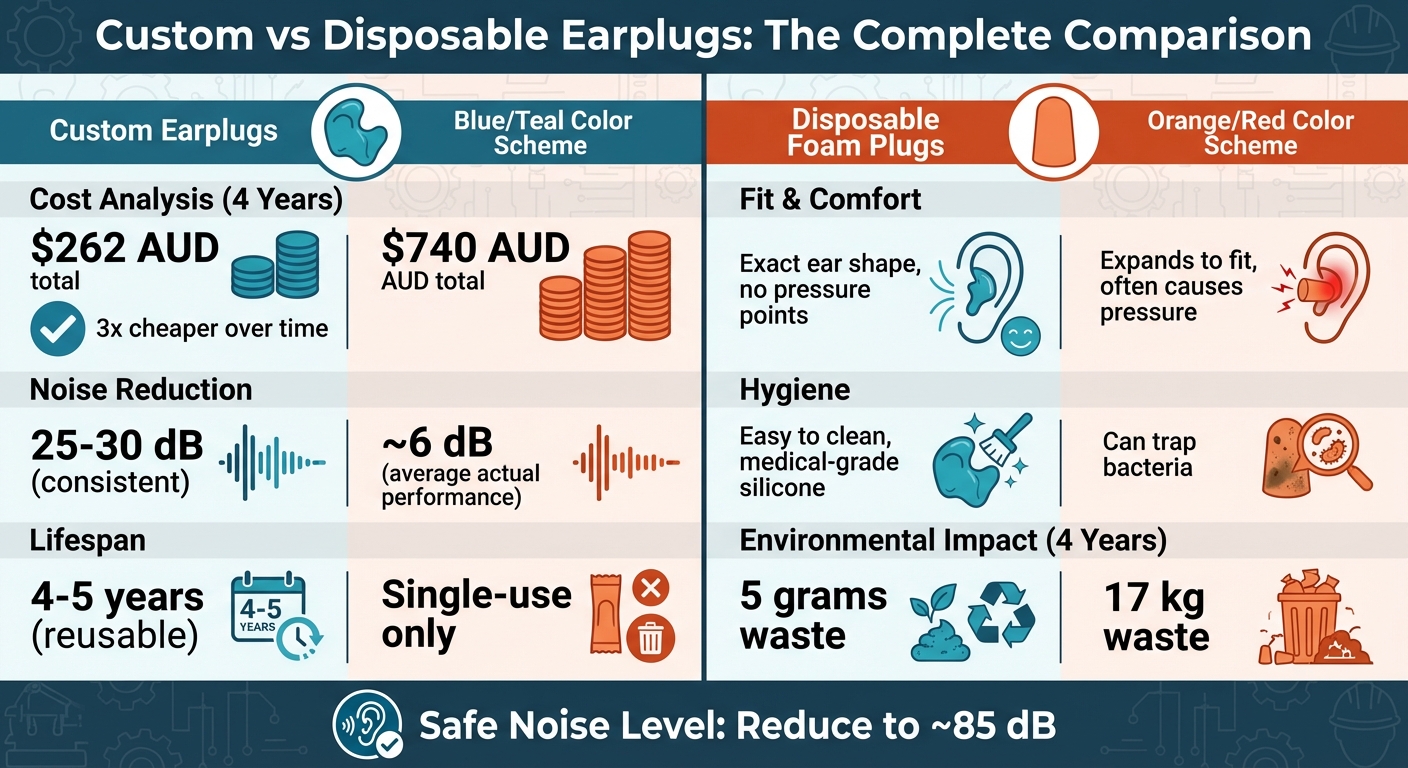
Custom vs Disposable Earplugs: 4-Year Cost and Performance Comparison
Are Custom Moulded earplugs worth the money?
sbb-itb-80b2a19
What Are Custom Earplugs?
Custom earplugs are individually crafted using an ear mould, designed to match the exact shape of your ear. Unlike generic foam or silicone earplugs that rely on expansion to fit, these provide a snug, secure fit without causing pressure or needing constant adjustment.
The standout difference is performance. Generic foam plugs often deliver uneven noise protection and can distort or muffle sound - a problem known as over-attenuation. Custom earplugs, on the other hand, use specialised filters to block harmful noise while maintaining natural sound quality and clear communication. Made from soft, medical-grade silicone, they’re durable, hypoallergenic, and comfortable enough to wear all day.
"Custom earplugs are designed to fit the unique contours of the wearer's ear, which offers superior noise reduction, comfort, and hygiene compared to disposable foam earplugs." - ACS Custom
Let’s take a closer look at how these tailored earplugs are made.
The Manufacturing Process
The process of creating custom earplugs begins with a consultation to understand your specific needs - whether they’re for work, music, or sleep. An audiologist then takes impressions of your ears using a putty-like material that hardens quickly, capturing every detail of your ear’s contours. It’s essential to ensure your ears are free of wax or obstructions beforehand, as these can interfere with the accuracy of the mould.
Once the impressions are complete, they’re sent to a lab where technicians craft the earplugs from medical-grade silicone. The entire process usually takes 10 to 15 working days after the lab receives your impressions. Once ready, a professional fitting ensures they’re comfortable and form a perfect seal. Some manufacturers even keep your ear impressions on file for up to three years, making it easy to order replacements without needing new impressions.
This meticulous process guarantees both comfort and effectiveness, tailored to your specific needs.
Advantages of Custom-Moulded Earplugs
Custom earplugs come with a range of benefits that generic options simply can’t offer. They stay securely in place during movement - even under helmets or during physical activity. Many users even forget they’re wearing them because of the comfort they provide.
These earplugs reduce noise by 25–30 dB and, made from durable silicone, typically last 4–5 years. While the initial cost ranges from around $300.00 compared to $23.00 to $50.00 for disposable options, the long-term value becomes clear. You avoid the constant replacement of disposables and gain reliable protection that fits perfectly.
| Feature | Custom-Moulded Earplugs | Disposable Foam Earplugs |
|---|---|---|
| Fit | Exact replica of the ear canal; no pressure points | Expands to fit; often causes pressure or discomfort |
| Sound Quality | Natural sound via vented filters; maintains clarity | Often distorts or muffles sound quality |
| Durability | Reusable for years; long-term investment | Single-use or very short lifespan |
| Security | Stays in place during movement or under helmets | Prone to slipping out or losing the seal |
Hygiene is another key advantage. Custom silicone earplugs are easy to clean with a damp cloth or sterile wipe and should be stored in a protective case to extend their lifespan. In contrast, disposable foam plugs can harbour bacteria if reused and are generally less hygienic.
These features make custom earplugs a smart choice for tackling the noise challenges of various industries.
How to Choose the Right Custom Earplugs
Finding the right custom earplugs means striking a balance between protection, comfort, and functionality. A poor choice can leave you under-protected or overly isolated, making it hard to hear warnings or engage in necessary conversations.
Noise Reduction Rating (NRR)
The Noise Reduction Rating (NRR) measures the maximum noise reduction earplugs can provide under ideal conditions. However, in real-world scenarios, factors like fit and movement can reduce their effectiveness. To account for this, it's recommended to subtract 5–10 dB from the NRR value.
Hearing protection becomes critical when noise levels exceed 85 dB, as every 3 dB increase cuts safe exposure time significantly. For example:
- 88 dB is safe for about 4 hours.
- 91 dB reduces this to 2 hours.
- 100 dB allows for just 15 minutes of safe exposure.
Instead of blocking out all sound, aim to reduce noise to around 85 dB. Custom earplugs with PRO Series filters can provide noise reduction from 10 dB to 27 dB, allowing you to adjust for your specific environment. Workplaces often have a mix of frequencies, so it’s crucial to match the earplugs’ damping characteristics to the noise spectrum. For instance, a Class 5 rating typically offers an average reduction of 26 dB or more, but this might break down to around 20 dB in lower frequencies, 25 dB in midranges, and up to 35 dB in higher frequencies.
Here’s a quick guide to class ratings and their typical uses:
| Class Rating | Noise Level Protection (dB) | Typical Work Environment |
|---|---|---|
| Class 1 | < 90 dB | Quiet settings (e.g., libraries) |
| Class 2 | 90–95 dB | Moderate noise (e.g., offices with machinery) |
| Class 3 | 95–100 dB | Loud environments (e.g., manufacturing plants) |
| Class 4 | 100–105 dB | Very loud areas (e.g., heavy machinery) |
| Class 5 | 105–110 dB | Extremely loud settings (e.g., airports, mining) |
Research reveals that standard earplugs often deliver only about 6 dB of actual noise reduction due to poor fit. Custom-moulded options address this issue by maintaining a consistent seal, even during movement or physical activity.
But protection isn’t enough - comfort is equally important, especially for long shifts.
Comfort for All-Day Wear
Comfort is key to ensuring earplugs are worn consistently. Removing earplugs for just 5 minutes during a 1-hour shift can reduce the effective attenuation of a 25 dB-rated earplug to roughly 11 dB. Custom earplugs, moulded to fit your ear's unique shape, eliminate pressure points and remain flexible throughout the day. Made from lightweight silicone, they sit flush in the ear, minimising the chance of being dislodged by helmets or other gear.
Vented filters further enhance comfort by allowing air circulation, reducing the occlusion effect (the sensation of your voice sounding "boomy") and keeping your ears cooler during long shifts or in hot conditions.
Materials That Withstand Workplace Conditions
The lifespan and hygiene of earplugs depend on the materials used. High-grade silicone is a popular choice because it’s durable, waterproof, and non-porous. Custom earplugs made from this material can last up to 4 years, making them a cost-effective alternative to disposable foam plugs, which can trap bacteria and cause irritation.
To keep your earplugs effective and comfortable, clean them regularly with mild soap and water, and check for changes in pliability or wear over time.
While durability matters, maintaining awareness of your surroundings is equally essential.
Maintaining Communication in Noisy Environments
Good hearing protection shouldn’t completely isolate you from your environment. Custom silicone earplugs with attenuating filters are designed to block harmful noise while still letting key sounds, like speech and alarms, pass through. Vented filters help reduce the occlusion effect, ensuring you can hear important conversations and warnings without compromising protection.
Custom earplugs, such as those with PRO Series filters, strike this balance perfectly, delivering adaptable noise reduction that suits a variety of workplace conditions. By reducing noise to around 85 dB, they help you stay safe while remaining connected to your surroundings.
Custom Earplugs by Industry
Workplaces vary widely when it comes to noise challenges. A bustling construction site has vastly different needs compared to a concert stage, and aviation professionals face their own unique sound environments. Despite these differences, the essentials - proper fit, effective noise reduction, and clear communication - are critical across all industries. Let’s look at how tailored earplug solutions address the specific demands of these sectors.
Construction and Manufacturing
Noise levels on construction sites and in manufacturing plants often range between 95–110 dB, far above the safe limit of 85 dB. Many workers in these environments report needing to shout to communicate, and noise-induced hearing loss is one of the most common occupational hazards in these fields.
Workers in these settings require Class 5 hearing protectors, which reduce noise by an average of 26 dB or more. Custom earplugs are a great option here, offering interchangeable filters to tailor protection to specific tasks. For example, lower attenuation filters can handle high-frequency noise, while higher protection filters are better for extreme noise levels. Built from medical-grade silicone, these earplugs provide a consistent seal and all-day comfort, unlike disposable foam plugs. Vented designs further improve communication clarity, which is essential on busy worksites.
Flat attenuation filters are particularly useful, as they lower noise to safe levels without distorting speech or other important sounds.
Music and Entertainment
Concert venues are another high-risk environment, with sound levels often hitting 100–115 dB SPL. At 100 dB, safe exposure is capped at 15 minutes; at 110 dB - common at rock concerts - that drops to less than 2 minutes. Unsurprisingly, musicians experience higher rates of hearing loss and tinnitus compared to the general population.
Standard foam earplugs aren’t ideal for musicians since they tend to muffle sound by blocking high frequencies unevenly. Custom musician earplugs, however, use flat attenuation technology to evenly reduce volume across all frequencies. As The Audiology Place puts it:
"Flat attenuation filters are like turning down the master volume on a mixing desk - everything stays in proportion, just quieter".
Musicians can choose filters based on their needs: acoustic players or teachers might go for 9–10 dB filters, general performers often use 15–17 dB, and drummers or rock musicians may require 20–27 dB. Interchangeable filters make it easy to adapt to different venues or practice spaces. Additionally, singers and wind instrument players benefit from the open-jaw impression technique, which ensures a snug fit even as the ear canal shifts during performance. Made from soft, medical-grade silicone, these earplugs are comfortable for long performances (3–8 hours) and can last 4–7 years with proper care.
Now, let’s explore how custom earplugs meet the needs of aviation and other specialised professions.
Aviation and Specialised Professions
The aviation industry has one of the highest rates of hearing loss, second only to metal manufacturing. A jet engine can reach around 140 dB, and even inside a general aviation cockpit, noise levels average 86 dBA - just above the threshold for hearing damage. As FLYING Magazine notes:
"Hearing is second only to seeing as the most important sense for attaining and ultimately processing information as a pilot".
Aviation professionals often rely on canal moulds - discreet custom earplugs that fit comfortably under headsets or helmets without causing pressure points. Commercial pilots typically use filters with lower noise reduction ratings (about 17 dB) to maintain natural sound quality and ensure clear radio communication during long flights. Helicopter pilots, who deal with louder cabin noise, may need higher attenuation (around 26 dB). Vented filters are especially helpful, as they allow sound to pass both ways, reducing the occlusion effect and accommodating pressure changes during takeoff and landing.
Ground crew and maintenance workers face even more intense noise on tarmacs and in hangars, often requiring Class 5 hearing protectors (NRR 27–30+ dB). Custom earplugs significantly increase safe exposure times in these extreme conditions. Similarly, specialised roles like shooting sports or motorsports benefit from impulse filters, which dampen sudden loud sounds while allowing normal conversation and awareness of surroundings.
How to Order Custom Earplugs
Ordering custom earplugs involves three straightforward steps: getting precise ear impressions, having the earplugs manufactured, and testing their fit in your work environment.
Getting Ear Impressions
The first step is to book an appointment with a qualified professional to take your ear impressions. In Australia, this service is widely available through ACS Custom's network of specialised clinics like earLAB in Richmond, Melbourne, or most local audiologists who can help you get a an impression as long as it matches the ACS impression taking guide.
Before your appointment, ensure your ears are clear of excess wax. A specialist will examine your ear canals using an otoscope, and if any blockage is detected, you may need professional cleaning, such as microsuction. If you have piercings in areas like the Daith, Rook, Conch, Snug, or Tragus, you may need to remove them to ensure an accurate mould can be taken.
The process itself is quick and painless. A foam or cotton otoblock is placed to protect your eardrum, followed by the injection of medical-grade silicone into your ear canal and outer ear. After curing for 5–10 minutes, the mould is removed. The entire appointment usually takes about 15–20 minutes for both ears.
Your impressions are stored electronically for 3–4 years, making reorders simple without needing another impression. After this, your impressions move to production.
Manufacturing Timeline
Once your impressions reach the lab, production begins. For PRO Series Custom Earplugs, the process usually takes about 20 working days, while Custom In-Ear Monitors may take 5–6 weeks. These timelines can vary depending on the lab’s current workload.
During production, technicians use 40 Shore hypoallergenic, medical-grade silicone, finishing the earplugs with a protective lacquer. You’ll also select filters tailored to your industry - whether you need lower attenuation for better communication or higher protection for extremely noisy environments.
Shipping within Australia typically costs $11–$19, with an express production option available for approximately $250 if you need your order prioritised. In most cases, your custom earplugs will arrive within three weeks of your appointment.
The final step is ensuring they fit correctly.
Testing the Fit
After receiving your custom earplugs, test them in your work environment to make sure they meet both safety and comfort standards. A proper fit should create a complete seal to block unwanted noise while remaining comfortable for extended use. If you notice a "blocked up" or occluded feeling, high-quality vented filters can help provide a more natural sound.
Most manufacturers include a 60-day fit warranty, giving you time to test your earplugs during full shifts and request adjustments if needed. For PRO Series products, there’s also a 60-day filter exchange warranty, allowing you to swap filters if your initial choice doesn’t meet your needs. If adjustments are required, the manufacturer will work with you to fine-tune the fit, ensuring your earplugs provide both comfort and the necessary noise protection for your specific work environment.
Long-Term Value and Durability
When it comes to hearing safety in demanding work environments, looking beyond short-term solutions is essential. While custom earplugs involve a higher initial cost, their durability and performance make them a cost-effective choice in the long run.
Materials and Maintenance
Custom earplugs are crafted from medical-grade soft silicone [7,14]. Unlike disposable foam plugs that wear out quickly, silicone earplugs maintain their quality and consistent noise reduction for several years. Typically, they last 4–5 years, though changes in ear canal shape over time may eventually affect their fit.
Keeping custom earplugs in good shape is simple: clean them with lukewarm water and mild soap, and store them in their protective case to ensure hygiene and a proper seal. Filtered models like the PRO Series require occasional checks to ensure their air passages are clear of debris. If the fit starts feeling loose, it might be time for new impressions.
The combination of durable materials and minimal upkeep not only ensures reliable performance but also contributes to long-term savings.
Cost Comparison Over Time
The upfront cost for custom-fitted earplugs is approximately $262.00 (excluding GST), and they last 4–5 years. In comparison, disposable foam plugs cost around $0.90 per day, adding up to roughly $190.00 annually or $740.00 over four years. Earmuffs, while cheaper initially at around $60.00, require regular maintenance - such as replacing cushions every 3–6 months at $30.00 each - resulting in over $300.00 in total expenses across four years.
| Hearing Protection Type | Initial Cost | 4-Year Total Cost | Maintenance Required | Waste Generated (4 Years) |
|---|---|---|---|---|
| Custom Silicone Earplugs | ~$262 | ~$262 | Simple cleaning (soap/water) | 5 grams |
| Disposable Foam Plugs | ~$0.45/pair | ~$740 | None (single use) | 17 kg |
| Earmuffs | ~$60 | ~$300+ | Replace cushions every 3–6 months | 6 kg |
Beyond the financial aspect, custom earplugs also minimise environmental impact. For example, they generate only 5 grams of waste over four years compared to 17 kg from disposable foam plugs. Plus, they provide a reliable defence against hearing damage caused by prolonged exposure to high noise levels.
Conclusion
Selecting custom earplugs for your industry starts with understanding the specific noise levels and communication requirements of your workplace. It’s all about finding the right earplug filter that aligns with your environment’s noise spectrum. This ensures harmful sounds are reduced to safe levels while still allowing you to hear what’s essential.
Getting the fit right is just as important. Custom-moulded silicone earplugs offer a snug, secure fit that won’t slip or shift during use.
Beyond comfort and performance, custom earplugs are a smart long-term choice. While the upfront cost might be higher, their durability and reusability make them more economical than disposable options. More importantly, they protect you from permanent hearing damage. Prolonged exposure to noise levels above 85dB can lead to irreversible hearing loss and tinnitus.
Whether you work in construction, music, aviation, or manufacturing, custom earplugs with tailored filters provide the protection you need without cutting you off from your surroundings. By focusing on a perfect fit, proper noise reduction, and durable materials, you’re not just protecting your hearing - you’re enhancing your overall safety and productivity on the job.
FAQs
How do I know which filter level I need?
When choosing a filter, it’s crucial to match it to your specific noise environment and the level of sound reduction needed to safeguard your hearing. Filters are categorised using a system (Class 1 to 5) and are rated with SLC80 or SNR values to indicate their effectiveness. For environments with intense noise, like construction sites or motorsport events, opt for filters that offer higher attenuation. Make sure to consult AS/NZS1270 standards and factor in the need for communication or maintaining situational awareness when making your selection.
Can I still hear speech and alarms with custom earplugs?
Custom earplugs are designed to match specific sound reduction levels and target particular frequencies. This means they can reduce harmful noise while still letting you hear important sounds like speech or alarms. They strike a balance between protecting your hearing and maintaining awareness, making them ideal for use in noisy environments where safety is a priority.
How often do custom earplugs need replacing?
Custom earplugs generally last 2 to 5 years, but their lifespan depends on how often you use them and how well you care for them. If you're wearing them daily at work, they might need replacing in 2 to 3 years. On the other hand, earplugs used occasionally - like for concerts or sleeping - can last closer to 3 to 5 years. Proper maintenance and storage play a big role here. Without good care, their lifespan could drop to just 1 to 2 years.
Partnering for Your Hearing Health: earLAB & ACS Custom
At earLAB, we are proud to support the ACS Custom community by providing the clinical expertise necessary to protect and enhance your listening experience. Whether you are a musician, an audiophile, or an industry professional, your hearing health is our priority. Our Melbourne-based clinics offer a full suite of specialised services, including professional ear impression taking for a perfect ACS fit, safe microsuction earwax removal to ensure clear sound delivery, and comprehensive hearing tests to monitor your auditory health. As an independent clinic, we also provide expert hearing aid fittings and rehabilitation, offering unbiased advice on the latest technology tailored to your lifestyle. Book your appointment at locations to ensure your ears—and your ACS devices—are performing at their absolute best.
Related Blog Posts
- Foam vs Silicone vs Custom Earplugs: Full Comparison
- Custom vs Universal Earplugs: Which Is Right for You?
- How to Get Custom Moulded Earplugs: Step-by-Step Guide
- 5 Benefits of Custom In-Ear Monitors for Musicians


