

If your workplace is noisy, your hearing could be at risk. Noise-induced hearing loss (NIHL) is one of the most common occupational health issues in Australia, but it’s entirely preventable. Custom-moulded earplugs provide better protection than standard foam plugs by offering a secure, comfortable fit and allowing clear communication while reducing harmful noise. Here’s how to know if you need them:
- Noise levels exceed 85 dB(A): Legal protection is required for workplaces above this threshold. Custom earplugs ensure proper noise reduction.
- Standard earplugs are uncomfortable: Poor fit or irritation from foam plugs compromises protection and comfort.
- You remove earplugs to hear others: Custom filters allow you to hear speech and alarms without removing protection.
- You experience ringing or fatigue after work: These are signs of inadequate protection.
- You work in tight or hot conditions: Custom earplugs stay secure and comfortable, even in challenging environments.
- Long shifts require all-day use: Custom earplugs provide consistent protection and hygiene for extended periods.
- Your industry has strict safety requirements: Custom earplugs meet Australian standards (AS/NZS 1270:2002) for compliance.
Protecting your hearing is non-negotiable. Custom earplugs last up to 5 years, cost less over time, and provide superior safety and comfort. Don’t wait for permanent damage - consider switching to custom hearing protection today.
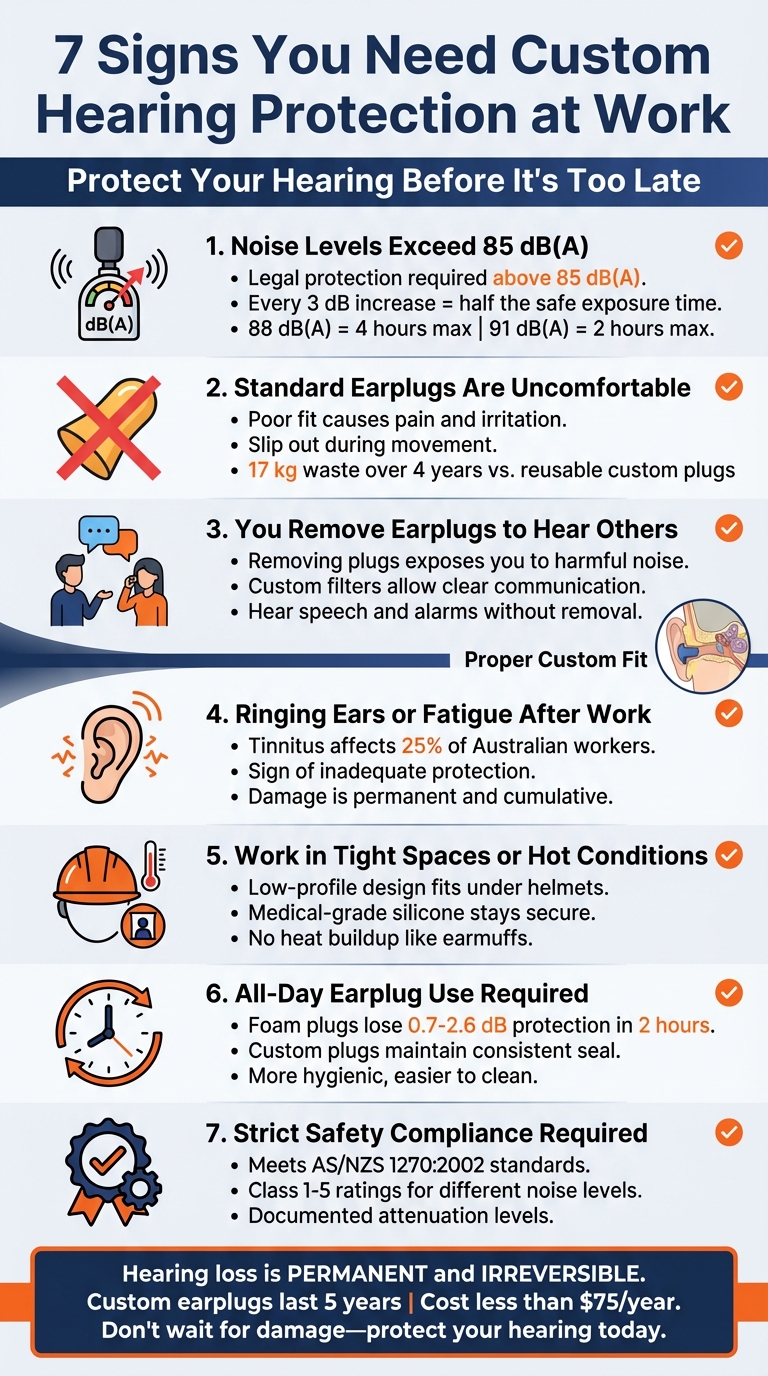
7 Signs You Need Custom Hearing Protection at Work
Why Custom Earplugs Are a Game Changer
1. Workplace Noise Levels Above 85 dB(A)
If your workplace noise exceeds 85 dB(A), wearing hearing protection isn't optional - it's a legal requirement. Safe Work Australia identifies this as the maximum average noise level allowed for an eight-hour shift. Exceeding this limit puts you at risk of permanent damage to the inner ear's hair cells, which are crucial for hearing.
Here's the thing: noise exposure doesn't increase linearly - it ramps up fast. For every 3 dB increase, the safe exposure time is cut in half. For instance, at 88 dB(A), you shouldn't be exposed for more than 4 hours, and at 91 dB(A), just 2 hours is considered safe.
However, achieving adequate protection isn't as straightforward as simply wearing earplugs or earmuffs. Studies show workers typically experience only about 6 dB of noise reduction due to improper fit. This is where custom-moulded earplugs shine. Designed to fit your unique ear shape, they create a perfect seal and comply with AS/NZS 1270:2002 standards. These earplugs are classified from Class 1 (suitable for noise levels below 90 dB) to Class 5 (for extreme environments between 105–110 dB).
Custom-moulded earplugs, like the PRO Series from ACS Custom, take things a step further with interchangeable filters. These filters are tailored to match your specific workplace noise levels, ensuring you're not overprotected. Why does this matter? Overprotecting - reducing noise below 75 dB(A) - can isolate you from essential sounds like warning signals or colleagues. Made from medical-grade silicone, these earplugs are not just effective but also comfortable, even during long shifts in Australia's hot and humid conditions. Unlike traditional earmuffs, they won't leave you sweaty or uncomfortable.
"The noise exposure standard is an 8-hour average of 85 dB(A) and a peak noise level of 140 dB(C) at the employee's ear position." - WorkSafe Victoria
2. Standard Earplugs Cause Discomfort or Don't Fit Properly
If you find yourself constantly adjusting or removing earplugs because they hurt, chances are you’re not getting the protection you need. The truth is, every ear canal is shaped differently. That’s why a one-size-fits-all approach often falls short when it comes to both comfort and effectiveness. Let’s break down the specific issues with standard earplugs and how custom options address these problems.
Standard foam earplugs are designed to expand inside the ear canal, pressing against its walls. While this helps create a seal, it also causes constant pressure, leading to soreness and irritation during long shifts. On top of that, this expansion can push earwax deeper into the canal, potentially causing painful blockages. The materials used in disposable earplugs don’t help either - they often trap moisture and heat, creating a breeding ground for bacteria that can result in itching or infections.
Another major issue is the inconsistent fit of standard earplugs. They can slip out with movement or when used alongside other protective gear like helmets. This not only compromises the seal but also allows harmful noise to sneak through. Beyond the discomfort and inefficiency, disposable foam plugs contribute significantly to waste. Over four years, one person can generate around 17 kg of non-recyclable waste from these plugs, costing approximately $740 in the process. In contrast, custom-moulded earplugs, which last 4–5 years, cost about $262 - making them a more economical and sustainable choice.
Custom-moulded earplugs, crafted from medical-grade silicone, are designed to fit the unique contours of your ears. This ensures a secure and comfortable seal, even during heavy movement. For example, the PRO Series from ACS Custom offers interchangeable filters with noise reduction levels ranging from 10 dB to 27 dB. This means you get balanced protection while still being able to hear important workplace sounds.
"Unlike generic foam earplugs that can put pressure on the ear canal, custom... earplugs fit perfectly, which can block out 100% of noise without causing discomfort." - ACS Custom
3. You Remove Earplugs Often to Hear Colleagues
Taking earplugs out frequently to talk to colleagues can seriously compromise your hearing protection. Even short removals expose you to harmful noise levels. This is a common problem, as communication is one of the main reasons workers remove their ear protection. However, custom moulded earplugs offer a solution by combining effective noise reduction with the ability to communicate clearly.
Traditional foam earplugs dampen sound unevenly, often blocking high-frequency sounds - like the consonants in speech - more than low-frequency background noise. This makes conversations difficult and forces workers to choose between protecting their hearing and talking to others. If you find yourself constantly removing earplugs to chat, that's a clear sign your hearing protection isn't meeting your needs.
Custom earplugs solve this issue with advanced filters that lower noise levels evenly across all frequencies, preserving speech clarity. This means they block harmful industrial noise while allowing you to hear speech, alarms, and warning signals clearly. For workplaces where conversation is essential, these filters can even be tailored to ensure natural communication without compromising protection.
Many custom options also include vented designs to eliminate the occlusion effect - that hollow, echoing sensation you might feel when speaking. This feature enhances comfort for all-day wear and reduces the temptation to remove earplugs whenever you need to talk. The goal isn’t to block all sound but to reduce noise to a safer range of about 75–85 dBA. A properly tailored filter ensures you can communicate effectively while keeping your hearing safe.
4. You Experience Ringing Ears or Hearing Fatigue After Work
If your ears ring or feel fatigued after work, it's a clear sign your hearing protection isn't doing its job. Ringing in the ears, or tinnitus, happens when loud noise permanently damages the cochlear hair cells. In Australia, tinnitus affects about 14–20% of people at some point, and currently, 25% of workers are dealing with it.
Hearing fatigue, also known as Temporary Threshold Shift (TTS), feels like a dull, muffled sensation that keeps coming back after noise exposure. This condition can lead to lasting harm over time. When you're constantly exposed to loud environments, your brain and ears work overtime to process the noise, leaving you irritable, mentally drained, and physically exhausted.
These symptoms are red flags - standard ear protection isn’t cutting it. Poorly fitting earplugs often let harmful noise sneak through. Custom-moulded earplugs, on the other hand, form a perfect seal and include vented filters that bring noise levels down to around 80 dB(A), aligning with Australian workplace safety standards. The best part? You can still hear speech and alarms clearly.
"The harmful effects of hazardous noise are cumulative, which means the damage causing hearing loss increases over time through a series of repeated exposures." - SafeWork NSW
Custom earplugs are designed to balance protection and awareness. With attenuation levels ranging from 10 dB to 27 dB, they shield your hearing while letting you stay alert to important sounds. Made from medical-grade silicone, they’re comfortable enough to wear all day and help prevent the blocked-ear sensation that contributes to fatigue. If you end your workday with ringing ears or exhaustion, it’s time to switch to custom earplugs for dependable, all-day hearing protection.
sbb-itb-80b2a19
5. You Work in Tight Spaces or Hot Conditions
Working in cramped or high-temperature environments can make standard hearing protection not just inconvenient but downright impractical. Bulky earmuffs tend to trap heat, making them uncomfortable in warmer conditions, while foam earplugs can easily shift or fall out in tight spaces or when used with helmets. This constant need to adjust them not only disrupts your workflow but also exposes you to potentially harmful noise levels. These challenges highlight why traditional options often fail in such demanding situations.
Custom-moulded earplugs are designed to tackle these issues head-on. Their low-profile shape fits snugly within your ear canal, staying secure even in confined spaces or under helmets. Unlike foam plugs, which rely on expansion to stay in place, custom plugs are moulded to the exact contours of your ear, ensuring they remain firmly in position throughout your shift.
Made from lightweight, medical-grade silicone, these earplugs are hypoallergenic and maintain their shape even in hot, sweaty conditions. They eliminate the pressure points and discomfort often caused by earmuffs, and many users report that they’re so comfortable, they barely notice wearing them.
"Custom noise plugs achieve a similar level of reduction when compared against Class 5 rated foam plugs... However, foam plugs achieve the level of attenuation by constantly expanding within the ear... This expanding can cause the foam plug to work its way out of the ear canal over the course of a shift." - NoiseGuard
Custom earplugs provide consistent noise reduction without the hassle of frequent adjustments. They’re also designed to integrate seamlessly with other protective gear like helmets, safety glasses, and respirators. Whether you’re working in a mine, a metal workshop, or any other tight and hot environment, these earplugs let you focus on your work without distractions. Their secure fit and ability to withstand tough conditions make them an essential choice for protecting your hearing in even the most challenging workplaces.
6. Your Shifts Require All-Day Earplug Use
When it comes to long work shifts, the challenges of wearing earplugs go beyond just discomfort - they can significantly compromise protection over time. Foam earplugs, for instance, apply constant pressure on the ear canal, which can lead to irritation and discomfort after just a few hours. On top of that, they often shift during regular movement, reducing their effectiveness. A study even found that standard earplugs lose between 0.7 and 2.6 dB of noise reduction in just two hours. Over an eight-hour shift, these small drops add up, leaving workers far less protected than they might think.
Hygiene is another issue with extended use. Foam plugs need to be rolled with your fingers before insertion, which increases the risk of contamination. In contrast, custom-moulded earplugs eliminate this step, offering a cleaner and more hygienic option. Additionally, standard plugs block all sound, making it harder to hear colleagues or safety signals. Missing these cues can be dangerous, and research shows that even brief lapses in hearing protection can accelerate hearing fatigue by 5 to 30 years.
Custom-moulded earplugs, made from medical-grade soft silicone, address these problems head-on. They’re designed for all-day comfort and maintain a secure, consistent seal throughout your shift. Unlike foam plugs, they stay in place even during movement, ensuring reliable noise protection.
"Custom earplugs sit snugly in your ears without causing pressure or discomfort... without that painful or itchy feeling that comes from standard plugs." – Cruise Audiology
What sets custom earplugs apart is their filtered design. They reduce harmful noise levels while still allowing you to hear speech, intercoms, and safety alerts clearly. Plus, the non-porous silicone material is easier to clean, making it a more hygienic choice. For those working 8-, 10-, or even 12-hour shifts in noisy environments, custom earplugs offer a combination of comfort, consistent protection, and hygiene that’s hard to match. They’re not just a convenience - they’re a must for protecting your hearing and staying compliant with safety regulations.
7. Your Industry Has Strict Safety Compliance Requirements
In Australia, workplaces where noise levels average over 85 dB(A) during an 8-hour shift are legally required to provide hearing protection. This regulation ensures workers in high-risk sectors - like construction, mining, manufacturing, aviation, military, motorsport, and entertainment - are safeguarded against noise-induced hearing loss. Employers must supply appropriate personal protective equipment (PPE) and ensure it’s used correctly to meet these legal obligations.
Custom earplugs are designed to comply with AS/NZS 1270:2002, the key standard for acoustic hearing protectors in Australia and New Zealand. This standard categorises protectors into Classes 1 through 5, with Class 5 offering the highest noise reduction - at least 26 dB on average. For extremely loud environments, such as mining sites or airports where noise levels can reach 105–110 dB, Class 5 protection is crucial.
What sets custom-moulded earplugs apart is their precision. These devices provide documented attenuation levels, including specific damping curves and SLC80 ratings, allowing employers to tailor protection to the unique noise conditions of their workplace.
Custom earplugs also feature interchangeable filters that reduce harmful noise while preserving clarity for speech, radio communication, and safety alerts. This makes it easier for employers to meet their WHS requirements. By adhering to AS/NZS 1270:2002 and accommodating different noise environments, custom earplugs not only comply with legal standards but also contribute to a safer and more efficient workplace.
Conclusion
If any of the seven signs mentioned earlier resonate with you - like workplace noise exceeding 85 dB(A), discomfort with standard earplugs, frequently removing plugs to hear colleagues, experiencing ringing in your ears after a shift, working in tight or hot conditions, or needing all-day protection for safety compliance - it’s time to think about custom hearing protection. These aren’t just minor inconveniences; they’re serious indicators that your hearing could be at risk. And when it comes to hearing, prevention is key.
Hearing loss is permanent because damaged inner ear hair cells cannot regenerate.
If you wait until symptoms like tinnitus or muffled hearing set in, the damage will already be done.
ACS Custom earplugs offer a tailored solution, designed using advanced 3D technology from your ear impressions. These earplugs ensure a precise, leak-proof fit and are made from soft, medical-grade silicone for all-day comfort. The PRO Series includes interchangeable filters with options ranging from 10 dB to 31 dB, so you can adjust your protection while still hearing speech and safety alerts. They’re certified to AS/NZS 1270:2002 standards and have earned a 4.8/5 rating from over 2,000 customers. With this level of protection, taking action becomes straightforward.
Getting started is simple. Book an appointment with a local audiologist to have your ear impressions taken. In about three weeks, your custom earplugs will be ready. Prices for the PRO Series range between $150.00 and $300.00, and with their long-lasting durability, they can cost less than $75 per year per person.
Don’t wait for irreversible damage to take hold. Recognise the warning signs and act now to safeguard your hearing - because once it’s gone, it’s gone forever.
FAQs
How do I know my workplace is over 85 dB(A)?
If you’re wondering whether your workplace noise levels exceed 85 dB(A), there are a few tell-tale signs to watch for. Do you need to shout to be heard by someone standing just a metre away? Do your ears ring (tinnitus) after your shift? Or does the world sound muffled when you leave work? These are all red flags.
For a precise reading, you’d need tools like a sound level meter or a noise dosimeter. But if those aren’t available, pay close attention to the signs mentioned above and consult workplace safety guidelines or an occupational health professional for advice.
What filter level should I choose for my job?
The level of noise protection you need depends on your workplace environment and how much sound reduction is required. Custom earplugs come with filters ranging from 10 to 27 dB.
- Higher-level filters (around 27 dB) work well in extremely loud settings, such as construction sites or manufacturing facilities.
- Lower-level filters (10–15 dB) are more suitable for moderate noise levels, especially in jobs where clear communication is important.
To make the right choice, evaluate your specific needs or seek advice from a specialist to find the most effective option for your work environment.
How do I clean and look after custom earplugs?
To keep your custom earplugs in good condition, start by wiping them down with a soft or microfibre cloth after each use. This helps remove earwax and any debris. For a more thorough clean, gently wash them using warm water and mild soap, making sure to rinse them well. Let them dry completely before using them again. Avoid soaking them in water or using alcohol-based cleaners, as these can cause damage. If your earplugs have detachable parts, clean those separately and ensure they’re fully dry before putting everything back together.
Partnering for Your Hearing Health: earLAB & ACS Custom
At earLAB, we are proud to support the ACS Custom community by providing the clinical expertise necessary to protect and enhance your listening experience. Whether you are a musician, an audiophile, or an industry professional, your hearing health is our priority. Our Melbourne-based clinics offer a full suite of specialised services, including professional ear impression taking for a perfect ACS fit, safe microsuction earwax removal to ensure clear sound delivery, and comprehensive hearing tests to monitor your auditory health. As an independent clinic, we also provide expert hearing aid fittings and rehabilitation, offering unbiased advice on the latest technology tailored to your lifestyle. Book your appointment at locations to ensure your ears—and your ACS devices—are performing at their absolute best.
Related Blog Posts
- How to Choose Custom Earplugs for Your Industry
- How to Get Custom Moulded Earplugs: Step-by-Step Guide
- 5 Benefits of Custom In-Ear Monitors for Musicians
- Best Earplugs for Sleeping: Complete Buyer's Guide


