

Noise at work can cause permanent hearing loss, and the highest-risk jobs are concentrated in seven industries. In Australia, workers lodged nearly 30,000 hearing loss claims from 2015 to 2022, and workplace noise is estimated to cost at least $26 billion over 10 years.
If I had to boil this article down, it’s this:
- The highest-risk industries are manufacturing, construction, mining, aviation ground operations, live events, oil and gas, and agriculture/forestry.
- The legal exposure limit is 85 dB(A) over 8 hours, with a 140 dB(C) peak limit.
- Every 3 dB increase halves safe exposure time. So 91 dB(A) = 2 hours and 100 dB(A) = 15 minutes.
- The biggest risks come from machinery, engines, drilling, amplified sound, impact tools, chainsaws, and firearms.
- The main fix is simple: control noise at the source first, then use hearing protection that matches the job.
A quick rule I’d keep in mind: if you need to speak louder to talk to someone 1 metre away, the noise is likely at or above 85 dB(A).
Managing Occupational Noise Hazards | Chemscape Safety Technologies

sbb-itb-80b2a19
Quick comparison
| Industry | Main noise sources | Usual noise pattern | Common protection approach |
|---|---|---|---|
| Manufacturing | Presses, grinders, conveyors, pneumatic tools | Continuous + bursts | Source control, then Class 2–4 protection |
| Construction | Jackhammers, grinders, nail guns, compressors | Intermittent + impact | Task-based protection, often Class 4–5 |
| Mining | Drills, heavy plant, blasting | Continuous + impact | Class 5, with double protection for blasting |
| Aviation ground ops | Jet engines, apron traffic, maintenance | High continuous noise | Class 5, often plugs + muffs |
| Live events | Amplified music, pyrotechnics, tools | Long exposure + sharp peaks | Custom earplugs vs. foam earplugs or electronic muffs by role |
| Oil and gas | Compressors, turbines, pumps, pressure releases | Continuous + peak bursts | Source control, Class 4–5, double protection when needed |
| Agriculture and forestry | Tractors, chainsaws, firearms | Long exposure + sudden peaks | Task-based protection, often plugs in hot conditions |
The core point: these industries are not just loud. They combine long exposure, sudden peaks, and communication risks, which is why hearing control has to be matched to the task, not just the industry name.
Here’s the article in short, plain English.
Why Workplace Noise Risks Matter
Workplace noise damage builds up over time, and that’s what makes it dangerous. It often happens so slowly that people don’t spot the problem until hearing loss is already affecting day-to-day communication. The risk is highest in jobs where loud equipment runs for hours at a stretch.
And it’s not just about hearing. Tinnitus - persistent ringing or buzzing - can disrupt sleep and make it harder to focus. Loud noise can also drown out warning signals and make it tough to hear co-workers clearly, which lifts the chance of accidents on site. On top of that, noise adds stress and fatigue, which can blunt alertness and affect decision-making.
Rule of thumb: if you need to raise your voice to talk to someone at arm’s length, the noise level is likely above 85 dB(A), and hearing protection is needed. Early signs can include muffled hearing after work, trouble following conversations in noisy places, or turning up the volume more often than usual.
| Noise Level | Safe Daily Exposure | Workplace Example |
|---|---|---|
| 85 dB | 8 hours | Heavy machinery |
| 91 dB | 2 hours | Impact wrench |
| 140 dB | Peak limit (instant damage) | Impact noise or gunshots |
That pattern stands out most clearly in the seven industries below.
1. Manufacturing and Heavy Industry
Manufacturing is one of the noisiest work settings in Australia. General manufacturing can hit 95 dB(A), while heavy manufacturing can reach 100 dB(A). Some tools are even louder: angle grinders can reach 105 dB(A), and rock drills can hit 120 dB(A). Once noise reaches 100 dB(A), safe exposure time drops to 15 minutes.
That noise doesn’t just come from one source. Production lines and plant equipment create a constant background hum that can wear down hearing bit by bit over time. On top of that, metal stamping, forging, and pneumatic tools can produce peaks of 100–110 dB(A). It’s a rough combination: steady noise all shift, then sharp bursts on top. That’s why source control and the right hearing protection matter so much.
Hearing protection needs to match the noise level. Under AS/NZS 1270, Class 3 protection is rated to 100 dB(A), Class 4 to 105 dB(A), and Class 5 to 110 dB(A). But more isn’t always better. Over-protection can make it harder to hear warning signals and speech.
For long shifts, custom-moulded earplugs can be a good fit because they provide a steady seal, better hygiene, and more comfort. Still, personal protective equipment shouldn’t be the first move. Engineering controls should come first. For example, enclosing a grinding machine in an acoustic housing can cut noise by 15–30 dB. Replacing metal conveyor guides with low-friction polymer options can also reduce impact noise at the source.
The same approach makes sense anywhere grinders, presses, and pneumatic tools run all day.
2. Construction and Demolition
Construction noise is a different beast from factory noise. Instead of one steady sound all day, you often get a mix of background plant hum and sudden, sharp bursts. Generators, compressors, and idling machinery create a constant layer of noise, while jackhammers, powder-actuated nail guns, and piling hammers can spike levels in a split second. That mix makes hearing control harder than it is in workplaces with more stable noise.
The claim data shows the scale of the problem. Between 2012 and 2015, construction ranked second highest for noise-induced hearing loss (NIHL) claims in NSW, making up 17% of total claims. Day-to-day jobs like grinding, cutting, drilling, and jackhammering drive much of that exposure.
Because the noise changes from task to task, the control method needs to change too. Continuous noise from engines and compressors is best cut at the source by switching to electric equipment and moving generators away from work areas. Impact noise needs a different approach. Electronic earmuffs are a strong fit here because they allow speech through while cutting impulse peaks from tools such as nail guns.
PPE class should match the job in front of you:
- Class 3 suits general construction noise around compressors and generators
- Class 4 fits work with angle grinders and jackhammers
- Class 5 is for blasting or explosive tool use
For blasting or other tasks above 105 dB(A), workers should wear both earplugs and earmuffs. There’s also a practical issue on site: safety glasses can break the seal on earmuff cushions, which may cut attenuation by 5–10 dB. In that case, earplugs are the better option.
Custom-moulded earplugs are well suited to dirty sites because they stay comfortable and keep a reliable seal across full shifts.
3. Mining and Quarrying
Like construction, mining brings two kinds of noise at once: the steady drone of machinery and the sharp crack of impact noise. The difference is that mine and quarry crews often deal with it for longer shifts and in tighter spaces. Constant plant noise sits in the background, while blasting adds sudden impulse peaks. Over time, that exposure builds up, especially when workers move between several noisy jobs in a single shift. In these settings, noise can hit 110 dB(A), which is well above safe limits. That’s why fit, attenuation and communication all count.
This isn’t a job for one set-and-forget option. The right hearing protection depends on the task and the site.
- On open sites, cap-mounted earmuffs are the common pick because they work under hard hats and can be flipped aside when workers move between zones.
- In underground or tight-clearance areas, custom-moulded earplugs can make more sense because they give a steady seal without the extra bulk.
- In blasting zones above 105 dB(A), workers should use double protection - earplugs and earmuffs together. This adds about 5 dB to the higher-rated device.
Mining operations usually call for Class 5 hearing protection, with an SLC80 of 26 dB or higher. But the rating on the pack isn’t the whole story. A Class 5 device worn the wrong way may give less day-to-day protection than a Class 3 device that fits properly. ACS Custom offers custom-moulded earplugs certified to Class 5 under AS/NZS 1270:2002.
Electronic earmuffs should be near the top of the list on active mine sites, where workers still need to hear reversing alarms and radio traffic for safety.
4. Aviation Ground Operations
Aviation ground crew deal with some of the highest noise exposure in Australia. The main culprits are aircraft engines, jet engine maintenance, and day-to-day apron activity during arrivals, departures, and maintenance checks. In these areas, noise levels regularly go past 105 dB(A).
That creates a tricky balance. Ground staff need strong hearing protection, but they also need to hear radios, warning signals, and nearby vehicles. On an apron, shutting out too much sound can be just as risky as shutting out too little.
Class 5 hearing protection is the baseline for apron and engine-proximity work. In jet engine maintenance and taxiway zones, one device often isn't enough. That's where double protection comes in: Class 5 earplugs plus earmuffs. Used together, they give combined attenuation of about 35 dB.
In aviation, the goal isn't just to cut noise. It's to cut engine noise without losing critical calls and signals.
Electronic earmuffs with active noise reduction (ANR) are recommended for that reason. They help lower engine noise while still letting crew stay aware of what's happening around them. If you've ever tried to catch a radio call with turbines roaring nearby, you know how big that difference can be.
For long apron shifts, custom-moulded earplugs can be a good fit. ACS Custom's are certified to Class 5 under AS/NZS 1270:2002. And when crew move away from engine-heavy areas, it's worth easing back enough to hear vehicles and alarms. Over-protection in lower-noise zones brings its own safety risk.
5. Music, Entertainment and Live Events
Live events are a different beast. Here, the noise is part of the product, which means exposure comes with the job. For crew and venue staff, that makes noise an occupational hazard. Live venues and concerts often reach levels well above 100 dB, and sound crew, performers, and venue staff can all end up exposed beyond the 85 dB(A) shift limit.
There’s another layer to this too. Live events often combine long periods of high noise with short, sharp peaks that can do serious harm. During performances, workers face steady high-level sound. Then setup and strike can bring impulse noise from pyrotechnics, equipment, and power tools - sometimes above 140 dB(C) - with the potential to cause instant, permanent damage.
The right hearing protection depends on the role. Electronic earmuffs work well for supervisors and security, while custom-moulded earplugs are a better fit for performers and engineers. ACS Custom custom-moulded earplugs and in-ear monitors are well suited to long shifts because they balance protection, comfort, and clear communication. The aim is simple: reduce harmful noise without losing the cues, calls, and timing that keep the event moving.
6. Oil and Gas Processing
Like mining, oil and gas processing brings a rough mix of steady plant noise and sharp bursts. Compressors, turbines, pumps, and generators can keep machinery rooms above 110 dB(A), which is why Class 5 hearing protection is standard. On top of that, pressure releases and maintenance tools can push peak levels to 140 dB(C). Some solvents and fuels are also ototoxic, which can make noise-related hearing damage worse.
Start with noise control at the source. Use silencers, isolation mounts, acoustic enclosures, and soundproof control rooms first. In practice, that means dealing with both the constant plant noise and the short, harsh bursts that come with maintenance work.
For PPE, custom-moulded earplugs are a good fit for long shifts, while electronic earmuffs help when workers need to hear speech and alarms more clearly. If noise goes above 105 dB(A) LAeq,8h, double protection - earplugs under earmuffs - is recommended.
The target is 75–80 dB(A) at the ear. Go below 70 dB(A), and alarms and vehicle warnings can become harder to hear.
7. Agriculture and Forestry
Farming and forestry are high-risk, and they’re often underestimated. 65% of farmers aged 15 to 75+ have some level of hearing loss. Young farmers are also about seven times more likely to have hearing loss than other people their age. The danger usually comes from two things at once: long hours around noisy machinery, plus sudden blasts from chainsaws and firearms.
The noise profile here is a rough mix of steady and high-intensity stop-start sound. Tractors and harvesters sit at about 85 dB(A), which is the 8-hour limit. Chainsaws run at roughly 110 dB(A) and can damage hearing in less than 2 minutes. Firearms and gunshots can go past 140 dB(C), which can cause instant, permanent hearing damage. So the right hearing protection depends on the task, not just the site.
There’s another factor that can make things worse. Exposure to ototoxic substances such as solvents, heavy metals, and asphyxiants can increase the risk of hearing loss, which drops the effective threshold to 80 dB(A). And during long harvest days of 10 to 14 hours, add 1 dB(A) to the measured exposure.
For protection, the class should fit the job:
- Class 5 hearing protection (SLC80 26+) suits chainsaw and timber work.
- For general tractor use around 90 to 95 dB(A), Class 2 or 3 can be a better fit if workers still need situational awareness and communication.
- Where workers need to hear speech, radio calls, or warning signals, electronic earmuffs can help by compressing sudden loud noise while still letting them stay aware.
- In hot, physically demanding outdoor work, earplugs are often a better option than earmuffs because they avoid heat build-up and sweat under the muffs.
If you need to lift your voice at 1 m, the noise is likely 85 dB(A) or more. That same pattern - long exposure mixed with sudden peaks - shows up in the other high-risk industries below.
Common Risk Patterns Across These Industries
Across these industries, the same risks show up again and again: long exposure, sharp noise peaks, and poor communication.
NIHL is permanent and often goes unnoticed at first. Many workers don’t spot it until hearing problems start affecting day-to-day communication.
All seven industries mix steady machine noise with sudden peaks. Think explosives in mining, nail guns on construction sites, and firearms in agriculture.
That creates a tricky balance. Workers need protection, but they also need to hear alarms, spoken instructions, and nearby vehicle movement. The target is 75–80 dB(A) at the ear - enough attenuation to cut risk without shutting workers off from sounds they need to hear.
Chemical exposure can add to the risk from noise, especially in manufacturing, oil and gas, aviation, and agriculture.
Custom-moulded earplugs can help with comfort and day-to-day wear. If protection is uncomfortable, people tend to take it out, even for “just a minute” - and that’s often when the damage happens. These shared patterns set up the hearing protection tips below.
Hearing Protection Tips for High-Noise Workplaces
Across the seven industries above, the same controls-first approach applies: start at the source, not the ear. In plain terms, look at elimination and substitution first. For example, replacing a pneumatic impact wrench with a high-torque hydraulic model can cut noise before PPE is even part of the conversation.
If noise can't be removed, the next step is engineering controls. Acoustic enclosures around compressors, barriers around stamping presses, and sound-absorbing ceiling tiles can all cut the amount of noise that reaches workers.
Administrative controls also play a part. Job rotation can reduce how long each worker is exposed, and noisy tasks should be scheduled when fewer workers are on site.
When exposure still sits above the limit, move to matched hearing protection. And when PPE is needed, selection matters.
Australian hearing protection is rated under the AS/NZS 1270 Class system, from Class 1 to Class 5. Don't just default to Class 5 on every site. If protection drops sound levels below 70 dB(A) at the ear, it can create safety issues by making it harder for workers to hear alarms and verbal instructions. On top of that, real-world attenuation is often well below the label rating because fit and day-to-day use vary. That's why fit testing matters.
For workers doing long shifts, comfort isn't a small detail. If hearing protection feels bad after a few hours, people are less likely to keep it on the whole shift. ACS Custom offers custom-moulded earplugs that provide a stable seal, which can help with comfort and more consistent wear across the day.
In environments above 105 dB(A), dual protection is advised. That means wearing earplugs and earmuffs together. Used together, double protection adds about 5 dB to the higher-rated device.
Industry Comparison at a Glance
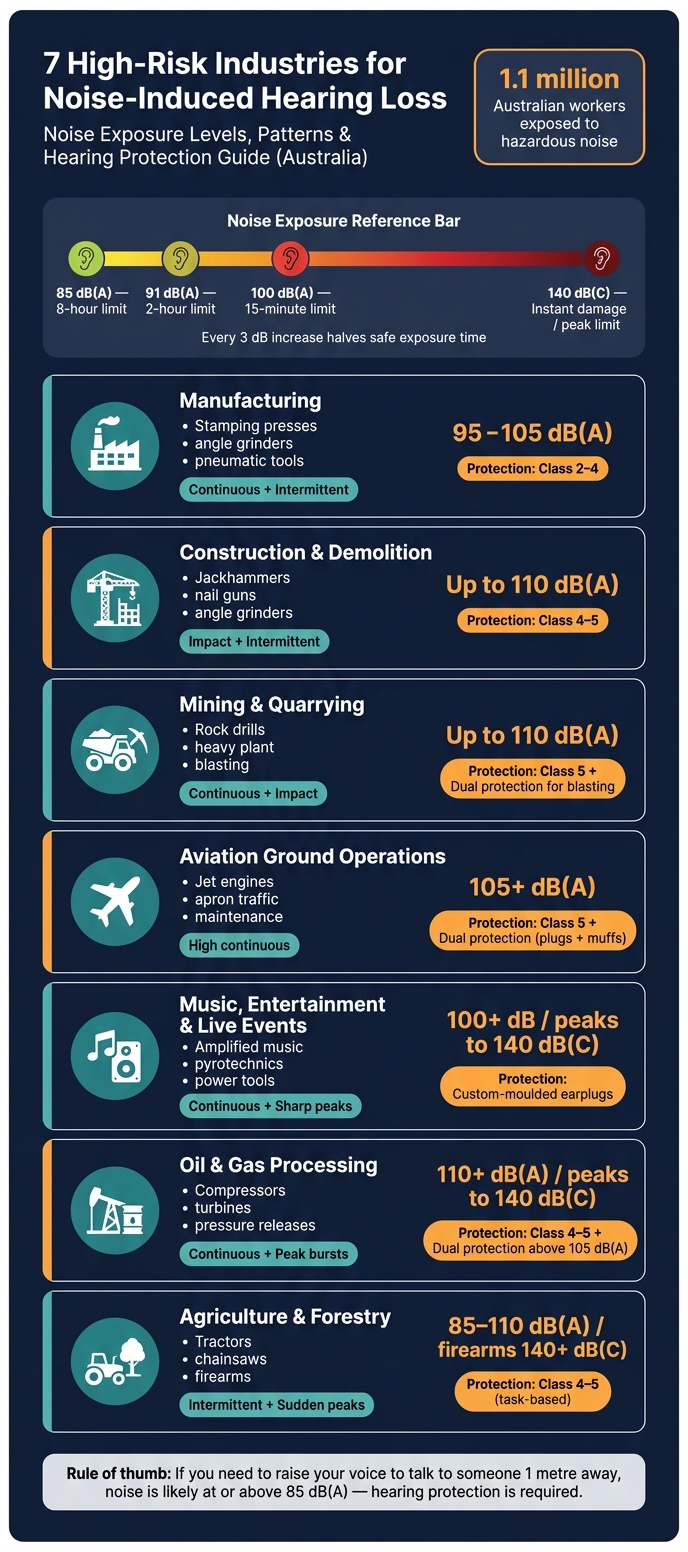
7 High-Risk Industries for Noise-Induced Hearing Loss: Exposure Levels & Protection Guide
Use this table to compare the seven industries side by side.
| Industry | Main Noise Sources | Noise Pattern | Primary Control Measures | Typical Protection |
|---|---|---|---|---|
| Manufacturing | Stamping presses, conveyors, pneumatic tools | Continuous / Intermittent | Acoustic enclosures, silencers on air lines, vibration damping | Class 2–4; reusable plugs or passive earmuffs |
| Construction | Jackhammers, angle grinders, nail guns | Impact / Intermittent | Acoustic barriers, tool maintenance, scheduling noisy tasks | Class 4–5; cap-mounted or electronic earmuffs |
| Mining | Rock drills, heavy plant, blasting | Continuous / Impact | Soundproof control rooms, remote operation, isolation | Class 5; dual protection (plugs + muffs) for blasting |
| Aviation | Jet engines, ground power units, apron traffic | Continuous | Exclusion zones, job rotation, scheduling | Class 5; dual protection (plugs + muffs) |
| Music, entertainment and live events | Amplified music, live crowds, high-level bass | Continuous | Volume limiters, quiet rest areas, distance from stacks | Custom-moulded earplugs for long shifts |
| Oil and Gas | Compressors, generators, high-pressure valves | Continuous | Acoustic lining, engineering enclosures, remote monitoring | Class 4–5; custom-moulded plugs or electronic earmuffs |
| Agriculture and forestry | Tractors, chainsaws, firearms, livestock | Intermittent / Impact | Enclosed cabins, quieter equipment, maintenance | Class 4–5; foam plugs or passive earmuffs |
The key point is simple: noise pattern should guide control and protection choices, not just the industry name.
A mining site and a building site can both be loud, but they don't always produce the same kind of noise. One may involve long exposure to steady machine sound, while the other deals with sharp bursts from tools or impact work. That difference matters when you're choosing controls and hearing protection.
Conclusion
Across all seven industries, the story is much the same: noise damage creeps up quietly. NIHL builds silently, so plenty of workers don’t spot it until the harm is already done. Across these seven industries, hazardous noise affects more than 1.1 million Australian workers.
The fix is pretty simple: measure exposure, control noise at the source, then match hearing protection to the job. The good news is that noise-induced hearing loss is preventable with the right controls. That starts with spotting exposure risks early, putting engineering and admin controls in place before leaning on PPE, and making sure any hearing protection is the right class for the noise level and fitted properly every single time. A poorly fitted earplug - or one removed for just two minutes during a 30-minute high-noise task - can cut effective protection to almost nothing. ACS Custom offers custom-moulded Class 5 earplugs for long shifts in high-noise workplaces. If current protection isn’t custom-fit and matched to measured noise, reassess it.
Hearing loss is permanent, so prevention has to happen before exposure does.
FAQs
How do I know if workplace noise is dangerous?
In Australia, workplace noise becomes hazardous when it goes above an 8-hour time-weighted average of 85 dB(A) or hits a peak sound pressure level of 140 dB(C).
There’s also a simple way to spot a problem on the floor: if you have to raise your voice so someone an arm’s length away can hear you, the noise level may be too high. Ringing in your ears after a shift, or hearing that feels muffled for a while, are warning signs too.
What hearing protection class do I need for my job?
In Australia, hearing protection is rated Class 1 to 5 under AS/NZS 1270. The class you need comes down to the noise level in your workplace. The aim is to bring noise exposure down to 75–80 dB(A) without blocking too much sound, because over-protection can make alarms, warning signals, or speech harder to hear.
Here’s how the classes line up:
- Class 1: up to 90 dB(A)
- Class 2: up to 95 dB(A)
- Class 3: up to 100 dB(A)
- Class 4: up to 105 dB(A)
- Class 5: up to 110 dB(A)
When should I use earplugs and earmuffs together?
Use earplugs and earmuffs together, known as dual protection, in very high-noise settings, usually above 105–110 dB(A).
Here’s the simple reason: bone conduction puts a cap on hearing protection at about 35–40 dB. So when noise levels get that high, one device on its own may not be enough. Wearing earmuffs over earplugs helps add the attenuation needed.


