

At 100 dB(A), just 15 minutes reaches Australia’s daily workplace noise benchmark. My advice: turn down the music first, then check both the sound level and how long you’re exposed.
Here’s what I take from the studies:
- Dose matters more than class type. Loud music and amplified instruction can put aerobics, Zumba and cycling participants at risk.
- Staff exposure adds up. Back-to-back classes need a full-shift assessment, not one session’s reading.
- Measure, then act. Apps can flag loud noise; calibrated readings and staff dosimetry help guide volume limits, scheduling and hearing protection.
- Keep safety cues audible. Earplugs support noise controls - they don’t replace them.
Noise readings show exposure, not hearing damage. I’d book a hearing assessment for persistent ringing or muffled hearing. <u>Sudden hearing loss needs urgent medical assessment.</u>
Lowering music volume in fitness classes may protect hearing without hurting workout quality
sbb-itb-80b2a19
What fitness class studies found
Across fitness classes, volume and duration matter more than the class name when it comes to noise risk.
High-intensity aerobics classes with loud music and amplified instruction can exceed safe listening levels. Choosing custom earplugs vs. foam earplugs can significantly impact comfort and protection levels. Zumba and indoor cycling show the same pattern: loud music and instruction make exposure time the main concern.
For members, even one session can pose a risk. Staff face repeated exposure across multiple classes.
Noise levels change with music volume, instructor microphone levels and room acoustics. One reading is only a snapshot of that session, so exposure needs to be assessed over time.
How exposure time affects hearing risk
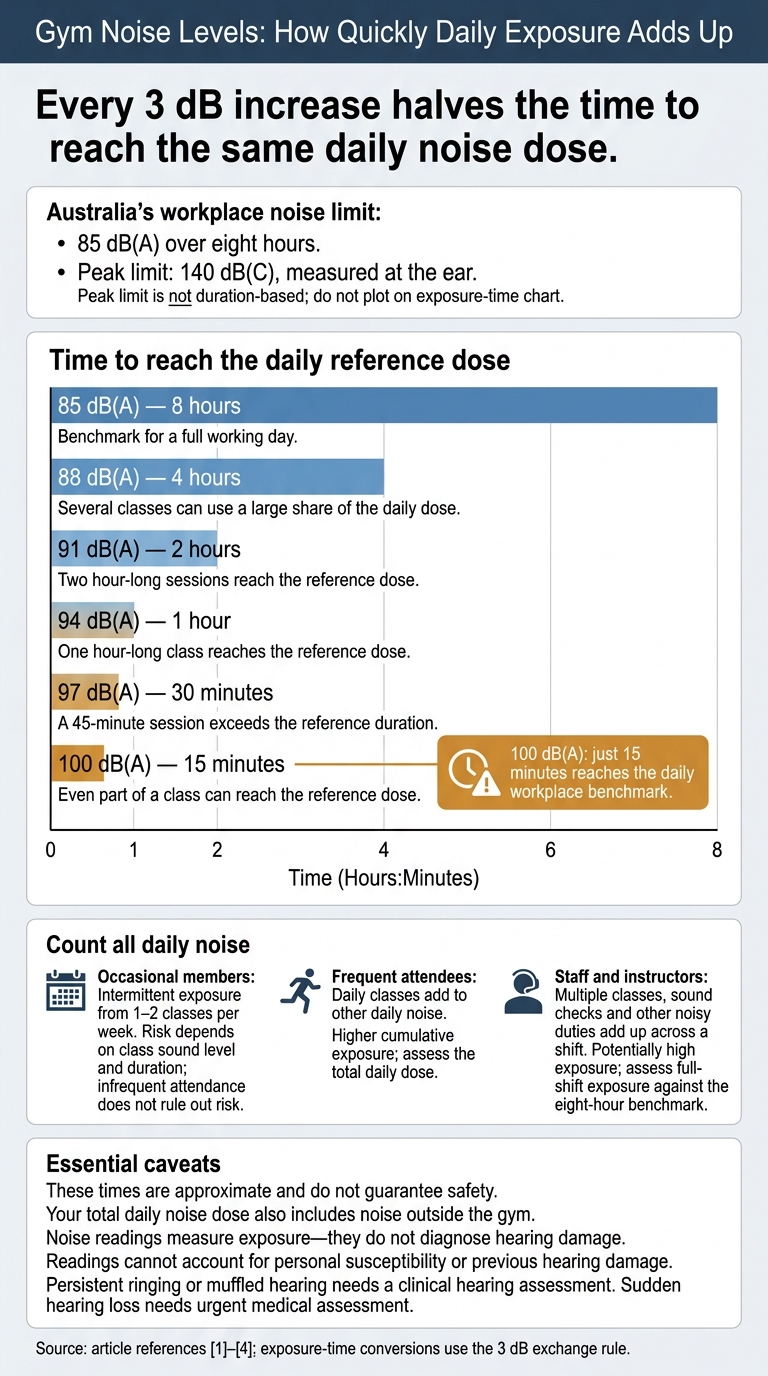
Gym Noise Levels: How Quickly Daily Exposure Adds Up
To compare classes, look at both the decibel reading and how long the exposure lasts.
Australian noise limits and exposure benchmarks
Australia’s workplace noise limit is 85 dB(A) over eight hours, with a peak limit of 140 dB(C) measured at the ear. The table converts that daily benchmark into exposure times: every 3 dB increase halves the reference time.
These times do not guarantee safety. Your total daily noise dose also includes noise outside the gym.
| Sound level | Approximate time to reach the daily dose | Relevance to a fitness class |
|---|---|---|
| 85 dB(A) | 8 hours | Benchmark for a full working day. |
| 88 dB(A) | 4 hours | Several classes can use a large share of the daily dose. |
| 91 dB(A) | 2 hours | Two hour-long sessions reach the reference dose. |
| 94 dB(A) | 1 hour | One hour-long class reaches the reference dose. |
| 97 dB(A) | 30 minutes | A 45-minute session exceeds the reference duration. |
| 100 dB(A) | 15 minutes | Even part of a class can reach the reference dose. |
Comparing member and staff exposure
Members need to count all daily noise, not just class time. For staff, exposure can build across several classes and other duties during a shift.
| Group | Exposure pattern | Risk level |
|---|---|---|
| Occasional members | Intermittent exposure from 1–2 classes per week. | Depends on class sound level and duration; infrequent attendance does not rule out risk. |
| Frequent attendees | Daily classes add to other daily noise. | Higher cumulative exposure; assess the total daily dose. |
| Staff and instructors | Multiple classes, sound checks and other noisy duties add up across a shift. | Potentially high; assess full-shift exposure against the eight-hour benchmark. |
What hearing-risk studies cannot tell us
Noise readings measure exposure - they do not diagnose hearing damage. They also cannot account for personal susceptibility, previous hearing damage or noise outside the gym. Ringing or muffled hearing needs a clinical hearing test.
The dose limits help guide the controls covered next.
Reducing noise in Australian gyms
Once you’ve measured exposure, reduce noise at the source first. Lower the music first; quieter does not mean less intense. Base controls on the measured noise dose, not the class label.
Measure class noise and full-shift exposure
Use smartphone apps only for initial screening. Engage a qualified occupational hygienist to take calibrated average and peak readings, and use personal dosimetry to measure staff exposure across a full shift.
Use the results to set class limits, speaker levels and staff rotation. Measure again after changes to check whether you need further volume reductions, scheduling changes or hearing protection.
Choose hearing protection that allows communication
Choose hearing protection based on measured exposure and fit. Instructor cues and safety warnings must remain audible. ACS Custom supplies custom-moulded hearing protection with acoustic filters that reduce volume evenly while preserving speech and music clarity. Hearing protection supports noise controls at the source; it doesn’t replace them.
What noise controls can and cannot do
| Measure | Benefit | Implementation consideration |
|---|---|---|
| Volume reduction | Reduces music noise for everyone in the room. | Set measured limits and check exposure after lowering the volume. |
| Staff exposure controls | Quieter duties and rotation can reduce each person’s exposure. | Assess each person’s total shift dose; rotation alone does not establish compliance. |
| Sound-level monitoring | Identifies hotspots and checks whether controls work. | Use calibrated measurements and act on the findings. Monitoring itself does not reduce noise. |
| Hearing protection | Reduces sound reaching the wearer’s ears. | Check fit during a live class, require consistent use and confirm that instructor cues and safety warnings remain audible. |
Conclusion: manage noise levels and exposure time
Across the studies, noise exposure dose - not the class name - drives risk. High-intensity classes can exceed safe listening levels, but one reading won’t show the total daily dose. Staff often get more exposure than members by working back-to-back classes.
Australia’s workplace benchmark is 85 dB(A) over eight hours. Every 3 dB increase halves the time it takes to reach the same dose.
Measure noise, turn down the music and assess exposure across the full shift. Shorten exposure time and use hearing protection where needed, before symptoms appear.
Book a hearing assessment if ringing, muffled hearing or other hearing changes persist. Sudden hearing loss needs urgent medical assessment.
FAQs
How do I add up noise exposure across my day?
Noise damage builds up over the day. The decibel scale is logarithmic: every 3 dB increase doubles sound energy and halves your safe exposure time [6].
Enter each activity into a noise exposure calculator. It adds up your entries to show your daily exposure as a percentage, using an 85 dB(A) benchmark. A result of 100% means you’ve reached the daily limit.
Does moving away from gym speakers reduce my risk?
Moving further from gym speakers can reduce your noise exposure because sound intensity drops with distance. But distance alone may not protect your hearing in fitness classes where the music is too loud. Decibels follow a logarithmic scale, so even small changes in noise levels can make a big difference to safe exposure time.
ACS Custom offers custom-moulded earplugs with high-fidelity acoustic filters. They reduce volume while preserving sound quality, giving you protection beyond simply moving away from the speakers.
How can I check my earplugs during a class?
Make sure your earplugs stay in place and keep a consistent seal throughout the class. Taking them out, even briefly, or wearing them with a poor fit can greatly reduce protection. If the seal shifts as you move, adjust them straight away so they fit properly.
For best results, use custom-moulded earplugs. They’re designed to stay secure and keep their seal while you’re active.


