

If you want the short answer: the shell material matters most. It has the biggest effect on comfort, seal, isolation, sound, and how well the IEM survives daily use.
If I were choosing custom IEMs, I’d look at it this way:
- Silicone is softer, moves with the jaw, and can give about 27 dB of passive noise reduction.
- Acrylic is hard, smooth, and good for detailed shell designs and custom artwork, with about 26 to 30 dB of isolation.
- 3D-printed resin feels much like acrylic, but the digital build process can make exact reprints easier if the shell is lost or damaged.
- Faceplates such as acrylic, wood, and carbon fibre change the look, surface feel, and scratch resistance more than fit.
- Cables affect flex, wear, sweat resistance, and connector life more than sound in day-to-day use.
In plain terms: pick the shell first, then the finish and cable. If you sing, talk a lot, or wear IEMs for long stretches, a softer shell may suit you better. If you want a rigid shell with detailed styling and more room inside for multi-driver layouts, acrylic or resin may make more sense.
Everything You Need To Know About IEM Shell Materials
sbb-itb-80b2a19
Quick comparison
| Material | Feel in ear | Seal | Isolation | Wear and damage | Best fit for |
|---|---|---|---|---|---|
| Medical-grade silicone | Soft and flexible | Moves with the jaw | About 27 dB | Less likely to crack from drops | Long sessions, stage use, vocalists |
| Acrylic | Hard and smooth | Depends on precise impressions | About 26–30 dB | Can crack if dropped | Artwork, frequent insertion and removal |
| 3D-printed resin | Hard and smooth | Depends on precise impressions | High | Can crack, but digital files help with reprints | Digital builds and exact remakes |
| Wood faceplate | No fit change | No seal change | No direct change | Needs more care with heat and moisture | Cosmetic finish |
| Carbon fibre faceplate | No fit change | No seal change | No direct change | Better scratch and impact resistance on the outer cover | Cosmetic finish with lower weight |
| Silver-plated copper cable | Flexible, depends on build | No seal change | No direct change | Handles sweat and oxidation better than plain copper | Daily use and stage wear |
The main point is simple: the seal does most of the work, and the shell material does most of the heavy lifting. From there, faceplates and cables shape how the IEM looks, feels in the hand, and holds up over time.
That’s the lens I’d use to read the rest of this guide.
Why Material Choice Matters in Custom IEMs
Material choice changes how a custom IEM fits, sounds and holds up over time. In practice, it affects four things: comfort, isolation, durability and sound quality. And there’s no one-size-fits-all answer here. Each material gives you a different mix of those traits.
Soft silicone flexes as your jaw moves. Rigid acrylic doesn’t. Instead, it relies much more on a highly accurate ear impression.
That difference matters most for isolation. A custom IEM only works as well as its seal, and the seal has to stay put. Custom silicone IEMs can provide up to 27 dB of noise reduction. Acrylic shells, by comparison, depend more heavily on impression accuracy to keep that seal consistent. The same rigidity that can affect seal retention also changes how the shell handles knocks and pressure.
Silicone shells are better at absorbing impact. Acrylic is hard and rigid, which means it can crack under pressure.
There’s also the day-to-day feel to think about. Silicone can feel tighter when you insert it. Acrylic tends to feel smoother going in, but it’s also more prone to damage from impact.
Next: the main shell materials, starting with medical-grade silicone.
1. Medical-Grade Silicone
Medical-grade silicone is the shell material most people find most comfortable for long sessions. It moves with your jaw and warms to body temperature, which helps keep the seal steady while singing, talking, or playing a wind instrument.
Comfort and Seal
Silicone softens slightly as it warms to body temperature and shifts with jaw movement. That helps it keep a stable seal.
Isolation and Acoustic Behaviour
A steady seal helps with passive isolation. Because the shell is solid, it can also change resonance a little, often giving the sound a slightly warmer character. That result depends on precise moulding, which also shapes how the shell is produced.
Durability and Maintenance
Silicone handles knocks well, so it’s less likely to crack under pressure. The weak point is usually the cable socket, where repeated flexing can add stress over time. Keep the sound channels clear, and try not to put strain on the cable sockets.
Role in the Build
ACS Custom uses a digital workflow with a 3D-printed mould before injecting medical-grade silicone. That process helps them recreate the same monitor if a replacement is needed.
The main trade-off is looks. Silicone works best with a clean, functional finish, not detailed faceplate design. Next comes acrylic, which swaps silicone’s flexibility for a harder, more rigid shell.
2. Acrylic Shells
Acrylic is rigid, so it keeps its shape instead of flexing like silicone. That’s why it’s the standard pick for rigid, highly detailed CIEM shells.
Comfort and Seal
Acrylic is firm, but it can still feel comfortable when it’s moulded and polished well. These shells are precision-moulded from your ear impressions, then smoothed for comfortable wear across long sessions.
For vocalists, an open-jaw impression with a 1-inch bite block helps keep the seal steady. That matters on stage, where even a small shift can change the fit. The catch is simple: acrylic relies more heavily on impression accuracy than silicone.
Isolation and Acoustic Behaviour
Because acrylic shells are hollow, they leave space inside for tuning. That gives makers room for tuned sound chambers, vents and pressure relief. In plain terms, there’s more control over how the earpiece behaves.
The result is a controlled sound character with strong frequency extension. Passive isolation usually lands between 26 dB and 30 dB, which is enough to block most stage noise.
Durability and Maintenance
Acrylic holds up well in normal use, but the hollow shell is more at risk from hard knocks. Drop a pair on a hard floor, or step on them, and the shell can crack or shatter. A hard case isn’t optional here. It’s part of the deal.
Maintenance is pretty straightforward:
- Check the sound tubes for wax buildup
- Use the wire cleaning tool to keep the channels clear
- Wipe the exterior with a soft cloth after each session
A little upkeep goes a long way, especially if you use them often.
Role in the Build
Acrylic’s hollow interior gives manufacturers room to fit up to eight drivers per side in high-end models. It also opens the door to more visual options than silicone. Detailed faceplates, custom artwork and logos are all possible.
Next: 3D-printed resin, which offers similar precision through a different build process.
3. 3D-Printed Resin
3D-printed resin gives you much the same rigid feel as acrylic, but with tighter control during the build. With Stereolithography (SLA) printing at 25–50-micron layers, manufacturers can reproduce tiny anatomical details from ear impressions with a high level of accuracy. Most 3D-printed shells use medical-grade, hypoallergenic resin, which creates a hard, smooth shell that stands up well to daily use.
Comfort and Seal
Resin shells are rigid, but the print process helps reduce pressure points before the shell is produced. If the ear impression is right, the seal usually stays steady even as your jaw moves.
Isolation and Acoustic Behaviour
Because the shell is hollow, manufacturers have space to build tuned acoustic chambers and pressure-relief vents inside it.
Durability and Maintenance
Resin shells are made for daily wear, but they can crack or shatter if you drop them on a hard surface or squash them. One handy part of the digital process is that the file can be saved and used to remake a damaged or lost shell.
Role in the Build
The digital workflow also makes more complex internal geometries possible.
Next: acrylic faceplates.
4. Acrylic Faceplates
The faceplate is the outer cover of a custom IEM shell. In acrylic builds, it’s a separate rigid piece bonded to the shell. That setup gives manufacturers room to place and protect drivers, crossovers, and other internal parts before final assembly.
It doesn’t shape the seal, but it does affect how the monitor is built, finished, and assembled. Once the shell is set, the faceplate becomes the visible outer layer. In practice, it’s the main place where design choices show up.
Isolation and Acoustic Behaviour
The faceplate helps close the shell and can support internal chamber design.
Durability and Maintenance
Maintenance is pretty simple. Wipe the smooth surface with a soft cloth, and remove wax from the canal with a cleaning tool.
Role in the Build
Beyond closing the shell, the faceplate sets the monitor’s look and finish. Most of the visual design sits here, including branding, colour, and decorative finishes.
From there, different faceplate materials can change the appearance, weight, and feel without changing the shell itself.
5. Wood Faceplates
Wood faceplates add a decorative finish to the same acrylic shell. Common choices include Elm Burl and Zebra wood, which give musicians and audiophiles a simple way to personalise their monitors. They change how the IEM looks, not how it fits or sounds.
Isolation and Acoustic Behaviour
Because the wood sits on the outside of the shell, it doesn't change fit or seal. High-quality custom IEMs can provide around 27 dB of passive isolation through a well-fitted shell. The faceplate itself is mainly for looks, while the hollow acrylic structure underneath supports bespoke-tuned internal sound chambers.
Durability and Maintenance
Wood needs a bit more care than a standard acrylic faceplate. A dry cloth is usually all you need after use. Skip wet wipes and liquid cleaners. And don't leave them in a hot car, where heat can damage the finish and weaken the adhesive.
Role in the Build
As the outer layer, wood shapes the monitor's look through its grain and colour. That's the main appeal here. It gives each piece a slightly different feel, with natural variation in the pattern and finish, without changing performance.
6. Carbon Fibre Faceplates
Carbon fibre faceplates sit on the outer shell cover of an acrylic CIEM. They add a premium look without adding much weight. If wood is mainly about finish, carbon fibre brings finish and toughness. The material is strong and light.
In day-to-day use, carbon fibre changes the look and wear resistance more than the sound. It doesn't affect fit or seal. Because it's low in weight, the monitor still feels light in the ear. It also doesn't change isolation, because isolation still comes from the shell seal.
Durability and Maintenance
Carbon fibre makes sense if durability is high on your list. It can improve scratch and impact resistance on the part of the monitor that gets the most exposure. For care, wipe it with a soft, non-abrasive cloth and keep it in a hard case.
Role in the Build
Carbon fibre is a strong pick when you want both durability and customisation. It's lighter than metal and gives you a durable faceplate option with a sharp finish.
Next: copper and silver cable materials, which affect flexibility, weight and conductivity.
7. Copper and Silver Cable Materials
After the shell and faceplate, the cable usually takes the most punishment.
It gets bent, pulled, packed away, and used day after day. So while people often focus on how a cable looks or what metal it uses, the bigger story is simpler: the cable has to hold up. It also plays a part in signal transfer, flexibility, and how easy the IEMs are to live with.
Conductivity and Build Quality
Silver-plated copper is common in custom IEM cables because it resists oxidation and handles sweat better than pure copper, which helps maintain signal transfer over time. That matters in day-to-day use, especially if the IEMs are worn on stage, during travel, or for long sessions.
Many professional-grade cables also use a twisted construction to improve flexibility and durability for stage and daily use. In plain terms, the metal matters, but build quality matters just as much. A well-made cable tends to deal better with repeated movement and general wear.
Durability and Maintenance
Cables built for stage use are made to cope with hot, sweaty, rough conditions. Some high-end cables include Kevlar lining for added pull strength, which helps prevent internal wire breakage at stress points.
Flexible shells can put more strain on the socket, so it’s worth checking the cable-to-socket connection from time to time. That’s one of those small habits that can save a lot of hassle later.
A bit of care goes a long way:
- Wipe cables with a soft cloth after use
- Keep connectors dry
Role in the Build
Most custom IEMs use a flush 2-pin detachable connector, integrated into the shell for a secure fit.
Shell Material Comparison at a Glance
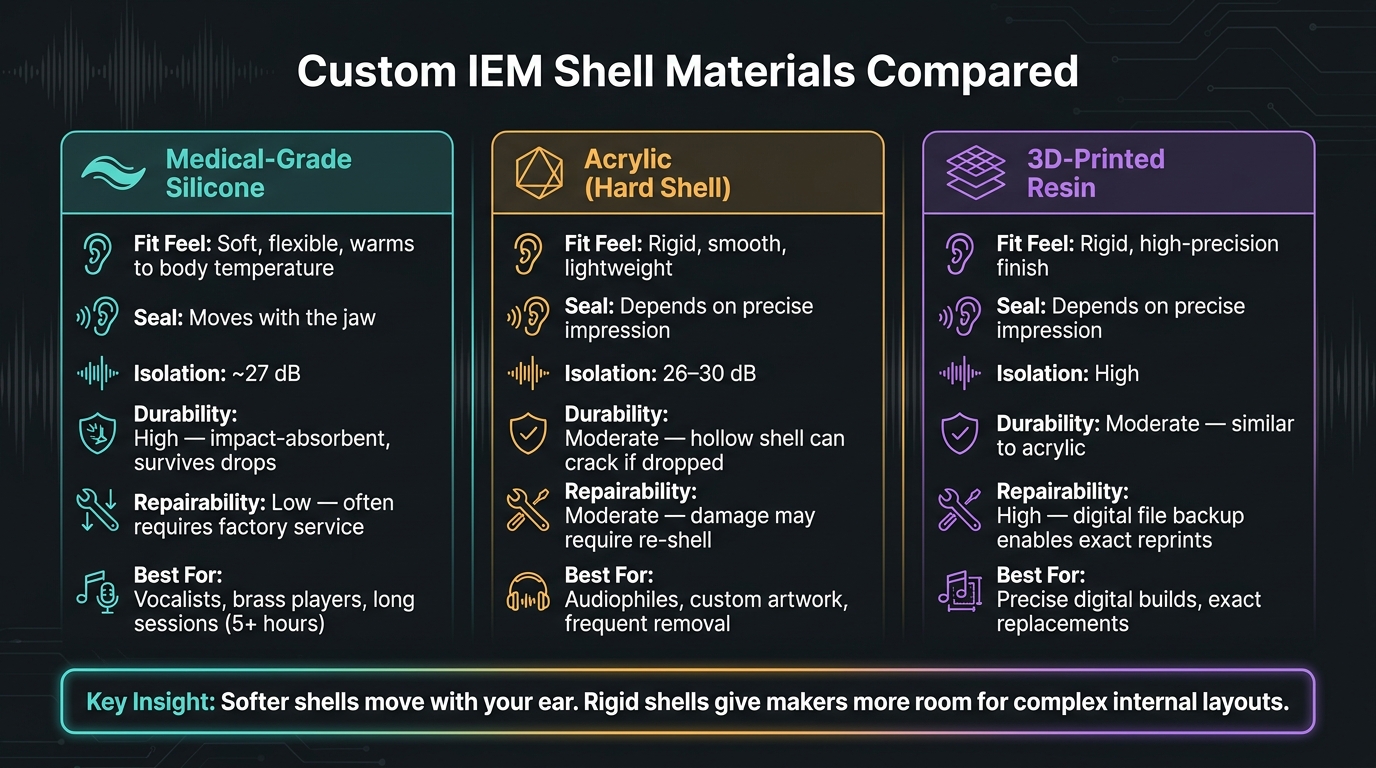
Custom IEM Shell Materials Compared: Silicone vs Acrylic vs 3D-Printed Resin
Choosing between silicone, acrylic and 3D-printed resin mostly comes down to how you use your IEMs from one day to the next. The shell material affects fit, seal and how well the earpiece holds up over time. Here’s the quick side-by-side view.
| Material | Fit Feel | Seal | Isolation | Durability | Repairability | Best For |
|---|---|---|---|---|---|---|
| Medical-Grade Silicone | Soft, flexible, warms to body temperature | Flexible; moves with the jaw | Very high (~27 dB) | High; impact-absorbent, survives drops | Low; often requires factory service | Vocalists, brass players, long shifts (5+ hours) |
| Acrylic (Hard Shell) | Rigid, smooth, lightweight | Rigid; depends on a precise impression | High; may break seal during wide jaw movement | Moderate; hollow shell can crack if dropped | Moderate; shell damage may require a re-shell | Audiophiles, frequent removal, custom artwork |
| 3D-Printed Resin | Rigid, high-precision finish | Rigid; depends on a precise impression | High | Moderate; similar to acrylic | High; digital file backup supports exact reprints | Precise digital builds, exact replacements |
In plain English, this is the trade-off: softer shells move with your ear, while rigid shells give makers more room for complex internal layouts. That matters if you sing, play brass, or wear your IEMs for 5+ hours at a stretch.
There’s also a practical angle. Silicone tends to handle movement and drops better, while acrylic and 3D-printed resin can be a better fit if you want a rigid shell with fine detail work. And if exact reprints matter, digital files make 3D-printed resin especially handy.
Next, faceplate and cable materials affect finish, weight and day-to-day handling, but they don’t change the core fit.
How Faceplate and Cable Materials Affect the Experience
The seal comes from the shell, not the faceplate or cable. So faceplates and cables do the parts you notice day to day: finish, feel, and resistance to wear.
Acrylic faceplates give you the biggest range of looks. They work well for logos, patterns, and layered artwork. Wood options like Elm Burl bring a premium, one-off finish. If your IEMs get knocked around, carbon fibre is the more practical choice because it handles scratches better than polished acrylic.
Cables shape daily use more than looks. A twisted cable is less likely to tangle and can cut cable noise, which matters when performers are moving on stage. Kevlar lining adds extra strength at stress points, so the cable can better handle repeated coiling and uncoiling. Detachable cables also make life easier. If a lead gets damaged, or you want a different connection, you can swap it without reshelling.
After that, care and storage play a big part in how long these materials stay clean and intact.
Care, Cleaning and Longevity
Material choice shapes more than fit and isolation. It also changes how you clean, store and inspect your monitors over time. If you want custom IEMs to last, regular upkeep matters. The core routine stays the same, but each shell material has its own weak spots.
Start with the basics. Use a wax loop or a small brush to clear debris from the canal tubes, and take care not to push it further in. Moisture is the big enemy of internal electronics, so keep a dehumidifier with your IEMs to pull out sweat and moisture after each use.
After that, check the shell itself. Silicone shells need a close look around the cable sockets, because the flexible material can put stress on those points as time goes on. Acrylic and resin call for a different kind of check.
- Acrylic shells: Look for cracks or chips, especially after any drop or knock.
- 3D-printed resin shells: Inspect the surface for print defects or other flaws.
- Faceplates and finishes: Watch for peeling or uneven spots, since those areas can harbour bacteria or irritate the ear canal.
Then move to the cable and connectors. Look for discolouration or stiffness, which may point to oxidation, especially with silver-plated copper leads. Check detachable connectors on a regular basis too. A loose fit can lead to intermittent audio, and over time it may wear out the internal socket. When you’re not using the IEMs, store them in a hard case, and arrange periodic servicing so signs of wear don’t slip by.
Conclusion
After comparing shell, faceplate and cable materials, the choice comes down to fit, use and durability.
The shell has the biggest effect on how a custom IEM feels, seals and holds up over time. Faceplates and cables matter too, but they play a different role. They shape the look, finish and day-to-day handling. Put simply: shell first, finish and cable second.
Start with the shell based on how you'll use the IEM. Focus on fit, isolation, use and upkeep, not just appearance. Once that's sorted, choose the faceplate and cable that give you the finish and handling you want.
ACS Custom's custom-fit range uses medical-grade materials and 3D manufacturing.
FAQs
Which shell material best suits my use?
The best shell material comes down to what matters most to you: comfort, durability, and how you plan to use your IEMs. ACS Custom specialises in medical-grade soft silicone, and that makes a big difference for long listening sessions.
Soft silicone is flexible, hypoallergenic, and moves with your jaw, which helps keep the seal snug and comfortable over time. If all-day comfort is your main focus, soft silicone is usually the better pick.
Rigid 3D-printed resins, on the other hand, are used when very precise shaping or more complex internal acoustic features are required.
Does shell material really affect sound quality?
Yes. Shell material can affect sound quality, but the effect usually depends on how it interacts with the internal drivers and the seal in your ear canal.
Both acrylic and silicone can work very well, but they behave a bit differently from an acoustic point of view. ACS Custom uses medical-grade silicone and systems such as IRIS to help control resonance and support consistent, high-fidelity sound.
How often should custom IEMs be cleaned?
Custom in-ear monitors should be cleaned after every use.
Use a dedicated wire pick or wax loop to clear the sound ducts, then wipe the shells with a soft, lint-free cloth. It’s best to do this straight after each session. That way, earwax and debris are less likely to harden, clog the sound path, or get pushed deeper into the parts.


