

Workplace noise regulations differ significantly between the EU and the US. The EU Directive 2003/10/EC focuses on early prevention, setting stricter limits and requiring action starting at lower noise levels. In contrast, the US OSHA Standard 1910.95 allows higher exposure limits and implements measures only when noise levels reach 85 dB(A) or higher.
Key Differences:
- Exposure Limits: EU caps exposure at 87 dB(A) (with hearing protection), while OSHA permits up to 90 dB(A) (measured in the environment).
- Action Levels: EU requires action at 80 dB(A) and mandatory protection at 85 dB(A). OSHA starts action at 85 dB(A), with mandatory measures at 90 dB(A).
- Exchange Rate: EU uses a 3 dB rate (doubling exposure risk every 3 dB increase), compared to OSHA’s 5 dB rate.
- Measurement Basis: EU considers daily/weekly exposure and hearing protection, while OSHA focuses on an 8-hour time-weighted average without adjustments for protection.
Quick Comparison:
| Parameter | EU Directive 2003/10/EC | US OSHA Standards |
|---|---|---|
| Lower Action Value | 80 dB(A) | 85 dB(A) |
| Upper Action Value | 85 dB(A) | N/A |
| Permissible Limit | 87 dB(A) (at the ear, with PPE) | 90 dB(A) (ambient TWA) |
| Exchange Rate | 3 dB | 5 dB |
| Peak Noise Limit | 140 dB(C) (at the ear, with PPE) | 140 dB (unweighted) |
| Health Surveillance Start | 80 dB(A) | 85 dB(A) |
Both systems aim to prevent hearing loss but differ in their thresholds, response strategies, and enforcement. For Australian businesses navigating these regulations, understanding these distinctions is critical to ensuring compliance.
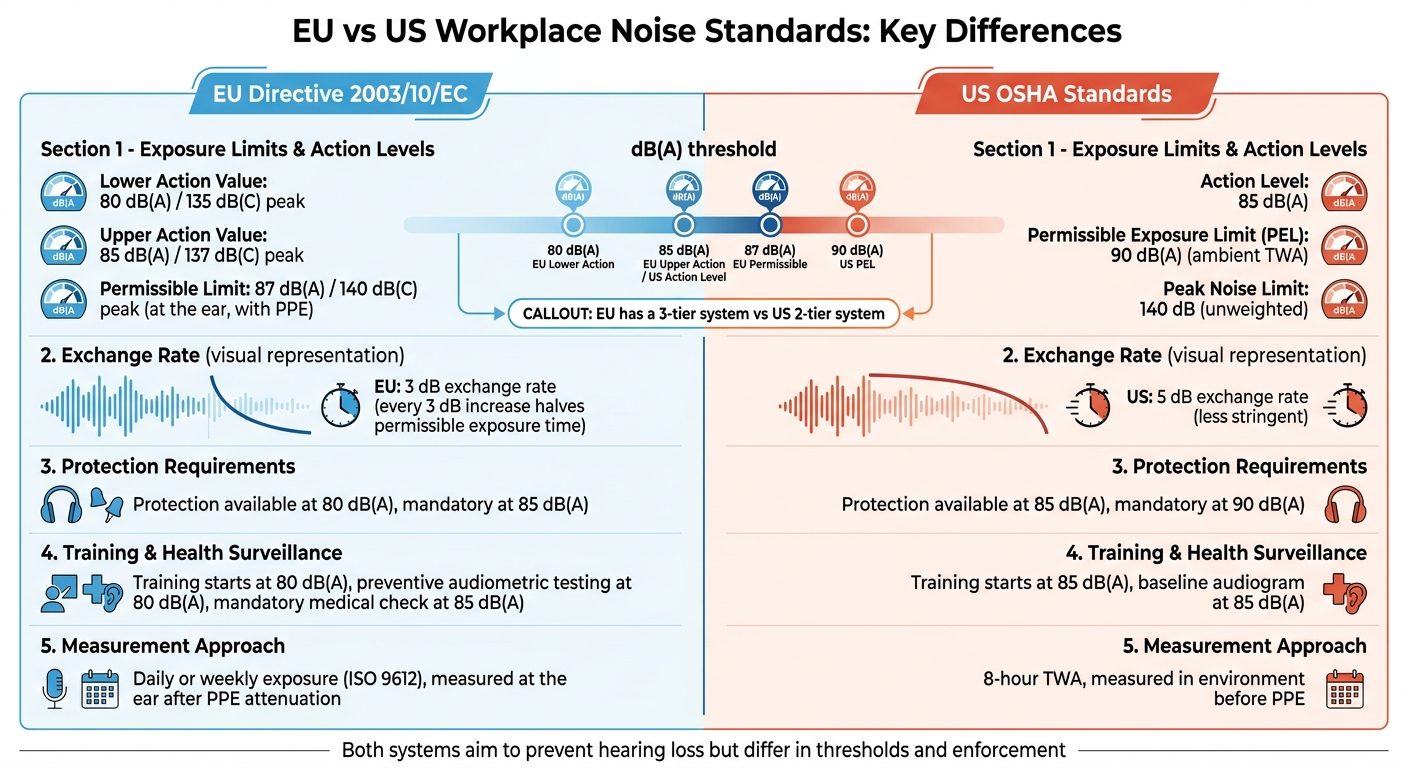
EU vs US Workplace Noise Exposure Standards Comparison Chart
OSHA and NIOSH Noise Rules What You Need to Know About Dosimetry
sbb-itb-80b2a19
Noise Exposure Limits: EU vs US Standards
The EU and US systems for managing workplace noise exposure differ significantly in their thresholds and how they measure risk. While the EU uses a three-tier system that imposes varying employer responsibilities at each action level, OSHA employs a simpler two-level framework. These differences shape how employers must respond to noise risks.
EU Directive 2003/10/EC Exposure Limits
The EU Directive sets out three distinct exposure values that require employers to take progressively stronger actions. At 80 dB(A), the lower action value, employers must provide workers with information and training while making hearing protection available. When noise hits 85 dB(A), the upper action value kicks in, requiring employers to implement noise reduction measures, mark noisy areas, and ensure workers use custom or foam hearing protection. The system enforces a strict cap of 87 dB(A), which includes adjustments for hearing protection and cannot be exceeded under any circumstances.
The EU also sets limits for peak sound pressure levels using C-weighting: 135 dB(C), 137 dB(C), and 140 dB(C) for the respective action levels. A 3 dB exchange rate is applied, meaning that every 3 dB increase halves the permissible exposure time. For instance, 2 minutes at 104 dB equates to 8 hours at 80 dB(A). Employers can assess noise exposure on a weekly basis ($L_{EX,8h}$) rather than daily, offering some flexibility.
OSHA, however, takes a more straightforward approach.
OSHA Exposure Limits
OSHA's system defines a Permissible Exposure Limit (PEL) of 90 dB(A), calculated as an 8-hour time-weighted average (TWA). When noise levels reach 85 dB(A), OSHA requires employers to implement a Hearing Conservation Programme, which it labels the "action level". Unlike the EU's strict 87 dB(A) limit measured at the ear, OSHA's 90 dB(A) PEL is based on environmental noise levels before accounting for hearing protection.
A key difference lies in OSHA's 5 dB exchange rate, which is less stringent than the EU's 3 dB rate. This means workers can be exposed to higher noise levels for longer periods under OSHA guidelines. For example, OSHA permits 8 hours at 90 dB but only 2 hours at 100 dB. For impulsive or impact noise, OSHA caps peak levels at 140 dB. This more lenient exchange rate can lead to higher cumulative noise exposure, particularly in workplaces with fluctuating noise levels.
| Parameter | EU Directive 2003/10/EC | US OSHA Standards |
|---|---|---|
| Lower Action Value | 80 dB(A) / 135 dB(C) peak | 85 dB(A) (Action Level) |
| Upper Action Value | 85 dB(A) / 137 dB(C) peak | N/A |
| Permissible Limit | 87 dB(A) / 140 dB(C) peak | 90 dB(A) (PEL) |
| Exchange Rate | 3 dB | 5 dB |
| Measurement Basis | Daily or Weekly ($L_{EX,8h}$) | 8-hour TWA |
| PPE Consideration | Measured at the ear (after attenuation) | Measured in environment |
Risk Assessment and Monitoring Methods
The EU and the US take distinct paths when it comes to assessing and monitoring workplace noise. The EU Directive enforces the use of an international standard for noise measurement, while OSHA relies on engineering surveys and personal monitoring. These differences highlight the contrasting philosophies behind each system's approach.
EU Assessment Requirements and ISO 9612
Under the EU Directive, all noise measurements must adhere to ISO 9612 standards. This standard provides three measurement strategies:
- Task-based: Breaking shifts into key tasks and measuring noise exposure during each.
- Job-based: Random sampling during specific tasks.
- Full-day: Continuous monitoring across an entire workday.
The EU system monitors both daily exposure levels ($L_{EX,8h}$) and weekly exposure levels ($L_{EX,8h,w}$) to provide a comprehensive view of noise exposure. Employers are required to update assessments whenever significant changes occur - whether in processes, equipment, or as a result of health surveillance findings. Additionally, the Directive considers the combined effects of noise and ototoxic substances, as well as the risks faced by specific groups of workers.
OSHA Assessment Procedures
OSHA takes a simpler approach, focusing primarily on engineering surveys and personal monitoring to calculate 8-hour time-weighted averages (TWA). Unlike the EU's detailed framework, OSHA does not place as much emphasis on weekly exposure or factors like ototoxic substances. Updates to noise assessments under OSHA are typically reactive, triggered by changes in production, processes, or controls, rather than being conducted at regular intervals. While this approach works well in stable environments, it may fall short in capturing the cumulative effects of fluctuating noise levels over time.
Noise Control and Hearing Protection Requirements
Both the EU and OSHA share a common goal: reducing noise exposure at its source. However, their approaches differ, particularly in the thresholds that trigger hearing protection requirements. The EU adopts a more cautious stance with lower action levels, while OSHA sets higher limits before requiring protective measures.
EU Protection Requirements
The EU Directive follows a three-tier framework to address noise exposure. At 80 dB(A), employers are required to provide hearing protection to workers, along with necessary information and training.
When noise levels reach 85 dB(A), hearing protection becomes mandatory. At this stage, employers must take additional steps, such as implementing technical or organisational measures and clearly marking noisy areas. The Directive emphasises designing workplaces, selecting equipment, and organising work schedules in ways that minimise risks.
What sets the EU system apart is its absolute exposure limit of 87 dB(A). This limit, measured at the ear after accounting for hearing protection, must never be exceeded. Additionally, peak noise levels are capped at 135 dB(C) for the lower action value, 137 dB(C) for the upper action value, and 140 dB(C) as the absolute limit. EU guidance also warns against "over-protection", where excessive noise reduction (more than 15 dB below the action value) could isolate workers or make warning signals hard to hear.
On the other hand, OSHA sets higher thresholds for mandatory protective measures.
OSHA Protection Requirements
Under OSHA standards, a Hearing Conservation Programme is required when noise levels reach 85 dB(A). Hearing protection becomes mandatory only at 90 dB(A). At this point, employers must also implement engineering or administrative controls to manage noise exposure.
A key difference lies in measurement methods. OSHA's 90 dB(A) threshold is based on ambient noise over an 8-hour time-weighted average (TWA), unlike the EU's "at the ear" measurement, which considers the effect of hearing protection. Unlike the EU, OSHA does not impose an absolute exposure limit equivalent to the EU's 87 dB(A) standard.
The EU's requirement for a written programme of technical and organisational measures at 85 dB(A) is also more detailed compared to OSHA's approach.
| Requirement | EU Directive 2003/10/EC | US OSHA Standards |
|---|---|---|
| Protection Available | 80 dB(A) | 85 dB(A) |
| Mandatory PPE Use | 85 dB(A) | 90 dB(A) |
| Absolute Limit | 87 dB(A) (at the ear, with PPE) | 90 dB(A) (ambient TWA) |
| Peak Noise Limit | 140 dB(C) (at the ear, with PPE) | 140 dB (unweighted) |
| Signage/Restricted Access | Required at 85 dB(A) | Required at 90 dB(A) |
These contrasting standards highlight different approaches to noise management and set the groundwork for examining training and enforcement practices further.
Training, Health Monitoring, and Enforcement
Both EU Directive 2003/10/EC and US OSHA standards place a strong emphasis on educating workers and monitoring their hearing health. While the EU prioritises earlier intervention, OSHA focuses on annual training and maintaining detailed records. Below, we explore how each system approaches these crucial elements, which work hand-in-hand with the exposure limits and risk assessments discussed earlier.
EU Training and Health Surveillance
Directive 2003/10/EC requires worker training to begin at 80 dB(A). This training must include clear guidance on the risks of noise exposure, methods to reduce exposure, proper use of hearing protectors, and the importance of health surveillance. Workers are also consulted about introducing hearing protection measures and kept informed about the results of noise level assessments.
The EU employs a two-tier health surveillance system:
- Preventive audiometric testing is provided when noise levels reach 80 dB(A).
- A formal medical examination by a doctor is required at 85 dB(A).
If work-related hearing damage is identified, employers must revisit their risk assessments, introduce additional control measures, and, if needed, reassign the worker to a quieter environment. For areas with noise levels exceeding 85 dB(A), clear signage and restricted access are mandatory.
"Noise-induced hearing loss is one of the most prevalent recognised occupational diseases in the EU" – EU-OSHA
Enforcement of this directive is carried out by individual Member States, which incorporate these rules into their national laws. Some Member States may even choose to implement stricter regulations.
OSHA Training and Recordkeeping
In the US, OSHA mandates annual training for workers exposed to noise levels of 85 dB(A) or higher under its Hearing Conservation Programmes. This training covers:
- The effects of noise on hearing
- How to select and fit hearing protectors
- The importance of regular audiometric testing
OSHA also requires a baseline audiogram to be conducted within six months of initial exposure, followed by yearly tests. If a standard threshold shift in hearing is detected, workers must be notified - typically within 21 days. Employers are then expected to reassess hearing protection measures and provide retraining if necessary.
To ensure compliance, OSHA conducts regular inspections and has the authority to issue citations or fines for lapses in areas like noise monitoring, hearing protection, or recordkeeping.
Comparing Key Requirements
Here’s a quick comparison of the training and health surveillance requirements under both systems:
| Requirement | EU Directive 2003/10/EC | US OSHA Standards |
|---|---|---|
| Training Trigger | 80 dB(A) | 85 dB(A) |
| Start of Health Surveillance | 80 dB(A) (preventive audiometric testing) | 85 dB(A) (baseline audiogram) |
| Mandatory Medical Check | At 85 dB(A) (doctor's hearing check) | When a standard threshold shift is detected |
| Enforcement | Managed by individual Member States | Federal inspections, citations, and penalties |
This summary highlights the nuanced differences in how the EU and OSHA address worker education and health monitoring, reflecting their respective priorities and enforcement mechanisms.
Conclusion
The EU Directive 2003/10/EC and US OSHA standards share a unified goal: protecting workers from noise-induced hearing loss. However, their approaches differ significantly. The EU takes a more preventive stance, setting action values at 80 dB(A) and capping exposure at 87 dB(A), factoring in the effects of hearing protection. OSHA, on the other hand, requires hearing conservation measures starting at 85 dB(A) and sets a permissible exposure limit at 90 dB(A), measured without accounting for protection. Both systems prioritise reducing noise at the source before relying on personal protective equipment, with the EU offering more structured measurement guidelines through ISO 9612.
A critical takeaway from both frameworks is the importance of consistent and proper hearing protection. For instance, removing a hearing protector with 30 dB attenuation for just 30 minutes during an 8-hour shift slashes its effective protection to only 12 dB. This highlights how essential it is to wear protection correctly and continuously to prevent occupational hearing damage.
Custom-moulded hearing protection offers a practical solution to these challenges. Unlike standard foam earplugs - which are often incorrectly inserted in real-world conditions - custom-moulded earplugs are designed for comfort and reliable performance. This is particularly important for workers who need to maintain speech clarity or stay alert to warning signals. Custom options with flat-response filters address these needs by reducing the sense of isolation that can lead to non-compliance.
For those navigating either EU or OSHA regulations, the principle remains the same: hearing protection only works if it is worn consistently and fits properly. Companies like ACS Custom provide tailored solutions, such as PRO Series earplugs, which offer noise reduction between 10 and 27 dB. These are made from medical-grade silicone and meet Class 5 AS/NZS 1270:2002 certification standards, ensuring both safety and comfort.
FAQs
How do the EU and US noise limits compare over a full shift?
The EU Directive 2003/10/EC sets tougher noise control standards compared to the US OSHA guidelines. Under the EU rules, action is required when noise levels reach 80 dB(A), with additional measures mandated at 85 dB(A). In contrast, OSHA permits exposure to 85 dB(A) over an 8-hour workday before requiring protective steps. Essentially, the EU takes a more proactive approach by addressing noise risks earlier, while OSHA permits slightly longer exposure to higher noise levels before intervention is necessary.
What does the 3 dB vs 5 dB exchange rate change in practice?
The 3 dB and 5 dB exchange rates play a key role in how noise exposure limits are adjusted based on changes in sound intensity.
With a 3 dB exchange rate, every 3 dB increase in noise level cuts the permissible exposure time in half. This approach provides stricter guidelines, aiming to minimise the risk of hearing damage. On the other hand, the 5 dB exchange rate allows exposure time to be halved only after a 5 dB increase, meaning workers can spend more time in noisier environments before reaching the limit.
These exchange rates directly impact workplace noise regulations and hearing protection strategies, shaping how organisations manage noise exposure to safeguard employees' hearing.
How should Australian sites handle EU-style “at the ear” limits vs OSHA ambient limits?
When addressing noise limits, Australian sites should carefully distinguish between the EU-style "at the ear" limits and OSHA's ambient noise limits, ensuring that the chosen standards fit the context. The EU Directive emphasises lower action thresholds, such as 80 dB, and focuses heavily on collective noise control measures. On the other hand, OSHA sets a higher permissible exposure limit of 85 dB over an eight-hour period, with a stronger reliance on ambient noise levels and the attenuation provided by personal protective equipment (PPE).
To maintain compliance and safety, it's important to align these international frameworks with local safety practices and metric-based regulations that are specific to Australia. This approach ensures both worker protection and adherence to national standards.


