

If you’re buying custom earplugs, ISO 9001:2015 tells you about the process behind the product - not how much noise it blocks. That matters because custom earplugs and foam earplugs can look the same but fit, seal, and last very differently.
Here’s the short version:
- ISO 9001:2015 checks how a maker runs production, records, staff training, defect handling, and remakes.
- AS/NZS 1270:2002 checks hearing-protection performance, including the Class rating.
- Material specs tell you what sits in your ear, such as medical-grade silicone.
- Fit still depends on your ear impression, your ear shape, and how you use the plugs.
In other words, I’d treat these as three separate checks:
- Process quality - is the product made in a controlled way?
- Noise performance - is it rated for your setting?
- Personal fit - will it seal your ears well?
A few points stand out straight away:
- A company can be ISO 9001:2015 certified and still sell a product that isn’t rated for your workplace.
- A product can have an AS/NZS 1270:2002 rating even if the maker doesn’t use a formal quality system.
- Stored digital ear scans can make replacement easier if your earplugs are lost or damaged.
- A 60-day fit or filter exchange period and a 12-month product warranty are worth checking before you order.
| What you’re checking | What it answers |
|---|---|
| ISO 9001:2015 | Is the making process documented and checked? |
| AS/NZS 1270:2002 | How much sound reduction is the product rated for? |
| Medical-grade silicone | Is the material suited to skin contact? |
| Custom impression quality | Will the earplug match your ear shape? |
Bottom line: ISO 9001:2015 matters because custom earplugs are hard to judge by looks alone. It won’t promise a perfect fit or a given attenuation level, but it does show whether the maker has a system for making, checking, tracing, and fixing the product properly.
That’s the lens I’d use before ordering: process, performance, and fit - checked one by one.
What ISO 9001:2015 actually controls
ISO 9001:2015 is an internationally recognised standard for building and maintaining a quality management system (QMS). Put simply, it sets the rules for how the quality system is run.
That matters because custom earplugs can look identical on the outside but still perform very differently. ISO 9001:2015 focuses on the process behind the product. And that’s exactly why it helps when quality issues need to be traced, fixed and stopped from happening again.
How ISO 9001:2015 principles apply to custom earplug production
The standard covers several areas that directly affect how a custom earplug is made. Staff competence means ear impressions are taken by qualified audiology professionals to defined standards. Documented procedures mean each production step is written down and followed the same way each time, instead of being left to personal judgement. Monitoring and measurement mean the product is checked against the specification at set stages.
When defects happen, they can’t just be ignored or patched over. Non-conformity handling means defects are documented. Corrective action means the root cause is investigated so the same issue doesn’t keep coming back. And continual improvement means the system is reviewed on a regular basis to spot where work can be done better.
A fully digital workflow - using 3D scanning, CAD design and 3D printing - cuts manual error and improves dimensional accuracy. It also helps with record control. When digital ear impression files are stored, they support the ISO requirement for controlled records. If a product is lost or damaged, the original scan is already on file, so a replacement can be made without taking a new impression.
How ISO controls address customer concerns
These controls line up closely with the concerns customers mention most often.
| Customer Concern | Relevant ISO 9001:2015 Control | Practical Benefit |
|---|---|---|
| Inconsistent fit | Monitoring and Measurement of Product | The final product is checked against the original specification at set stages |
| Material allergies or irritation | Control of production and service provision | Use of 40 Shore Medical Grade Silicone, selected for skin contact and comfort |
| Lost or damaged earplugs | Control of Documented Information | Digital scans kept on file allow identical replacements without a new impression |
| Recurring defects | Non-conformity and Corrective Action | Issues are formally tracked and investigated to help prevent them from repeating |
| Unqualified impression takers | Competence and Awareness | Qualified audiology professionals take ear impressions to defined standards |
The value of these controls becomes clear when there’s variation in production, a defect needs to be traced, or a customer’s requirements change.
sbb-itb-80b2a19
How ISO 9001:2015 helps resolve common quality problems
Reducing variation, catching errors, and preventing repeat defects
These controls matter most when a product has to be remade or reproduced. Custom earplugs can go wrong when shaping, finish, or internal geometry varies from one unit to the next. A controlled production process helps cut that risk.
If a product is lost or damaged, it can be remade from the stored scan without needing a new impression. That saves time and avoids extra hassle for the customer. Digital design and printing also improve dimensional accuracy and reduce repeated rework.
Keeping track of requirements when customer needs change
The same control system helps track changes in use, so the wrong filter isn't made to an old specification. Customer requirements can shift over time, and ISO 9001:2015 supports documented requirements and review steps.
That matters in practice. The filter is matched to the intended use before production starts. If those needs change later, a 60-day filter exchange warranty allows the level of protection to be adjusted.
What ISO 9001:2015 does not replace
ISO 9001:2015 has limits. It can't fix a poor impression or an ear shape that has changed. If the impression is wrong, the finished earplug will be wrong too.
The same problem comes up when ear shape changes over time, which is why impressions are recommended to be updated every four years. Piercings that affect the impression must be removed before the impression is taken. Proper insertion and care still sit with the user, not the certification. That's why process certification and hearing-protection requirements need to be checked separately.
ISO 9001:2015 and Australian hearing-protection requirements
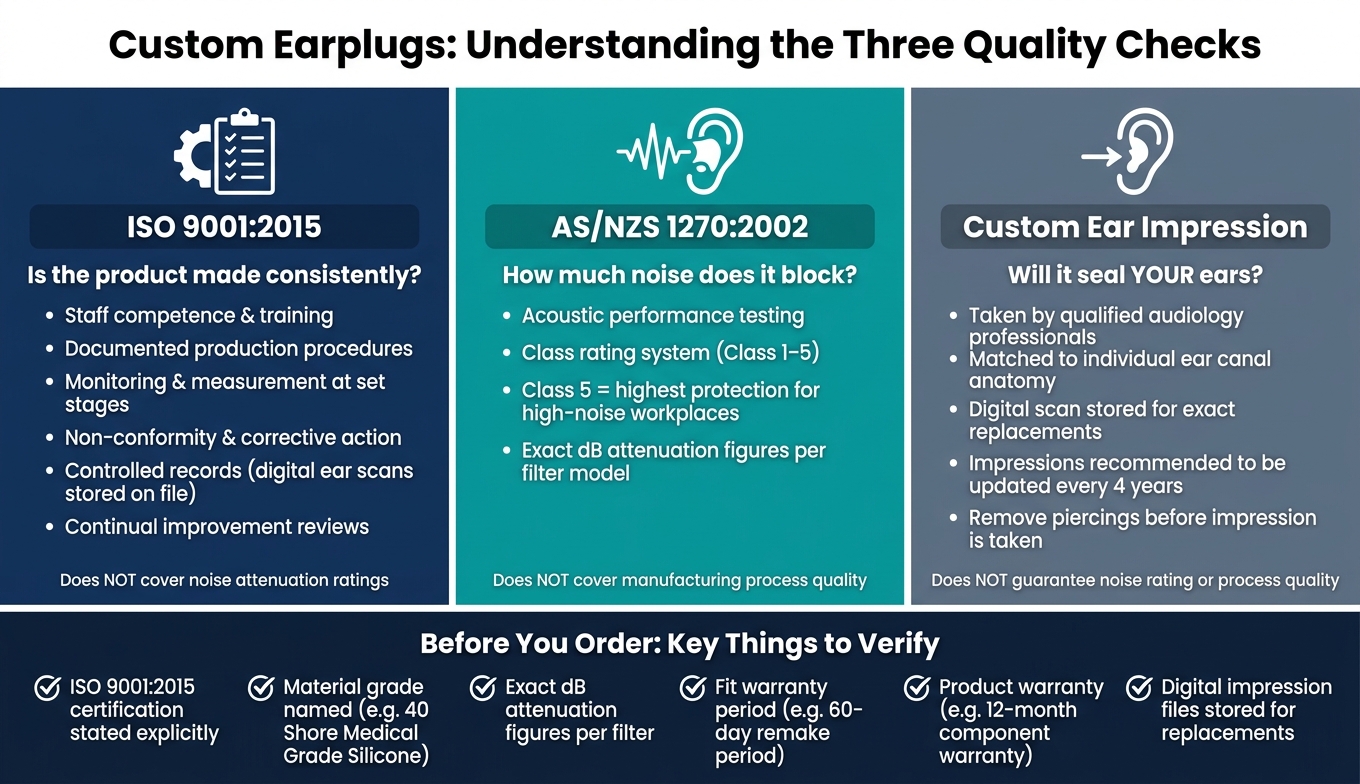
ISO 9001:2015 vs AS/NZS 1270:2002: What Each Standard Covers for Custom Earplugs
ISO 9001:2015 vs AS/NZS 1270:2002
These two standards deal with different parts of the buying decision. If you treat them as the same thing, it’s easy to end up with the wrong product.
ISO 9001:2015 is a management-system standard. It deals with quality processes like design control, record keeping, and defect handling. Put simply, it speaks to how a company runs its processes.
AS/NZS 1270:2002 is the Australian and New Zealand standard that applies directly to hearing protectors. It covers design, materials, and acoustic performance testing. It’s also the standard that gives you a Class rating - the number that helps show whether a product suits a given noise setting. For high-noise workplaces, look for Class 5 protection.
One standard does not replace the other. A manufacturer can be certified to ISO 9001:2015 and still make an earplug that is not rated for your workplace. On the flip side, a product can have an AS/NZS 1270:2002 Class rating even if the manufacturer has no formal quality management system in place.
What each framework tells the customer
Buyers need to separate three things: quality, performance, and comfort. Each claim answers a different question, so it helps to read them one by one.
| Quality question | Relevant framework or control | What it demonstrates |
|---|---|---|
| Is the manufacturing process consistent and documented? | ISO 9001:2015 | Management-system assurance; errors are caught and records are maintained |
| How much noise does the product block? | AS/NZS 1270:2002 | Product-performance evidence; provides attenuation ratings |
| Is the material suitable for skin contact? | Medical-grade silicone specification | Hypoallergenic material for extended wear |
| Will the earplug actually seal my specific ear canal? | Custom ear impressions | Correct user fit; ensures the physical device matches the individual's anatomy |
ISO 9001:2015 covers process control. AS/NZS 1270:2002 covers acoustic performance.
Quality signals from ACS Custom
With ACS Custom, those signals sit in separate buckets. Its ISO certification relates to process control, its Class 5 rating relates to attenuation, and its medical-grade silicone relates to skin-contact suitability. The Class 5 rating is achieved with the ACS Pro31 filter.
That matters because these claims should not be bundled together as if they prove the same thing. Process certification tells you one thing. Acoustic rating tells you another. Material specification answers a different concern again.
ACS Custom notes that certified hearing protection is designed to reduce hearing damage, not internal sounds such as tinnitus. Certification shows what a product is built to do. That distinction leads into the checklist below.
What to check before ordering custom earplugs
A short quality checklist
Marketing can make almost anything sound solid. The best way through the noise is to look for claims that are specific, testable, and easy to verify.
Use this checklist to sort hard facts from sales talk.
| What to check | What a specific answer looks like |
|---|---|
| ISO 9001:2015 certification | Explicitly stated, covering the relevant manufacturing activities |
| Material specification | Named grade, such as 35 or 40 Shore Medical Grade Silicone, with hypoallergenic properties noted |
| Attenuation data | Exact dB figures for each filter model, rather than generic "noise reduction" claims |
| Fit warranty | A defined period, such as 60 days, for remakes if the fit is not right |
| Product warranty | A separate component warranty, such as 12 months |
| Stored impression files | Stored impression files for exact replacements |
It also helps to check whether the provider has a documented complaint and defect process. If something goes wrong, you want to know there is a clear way to deal with it.
Fit, care, and intended use still matter
A checklist helps, but it doesn't decide everything. In day-to-day use, fit and intended use still shape how well custom earplugs work.
Before ordering, check the impression date, the filter match, and the care instructions. Remove any piercings that affect the impression. Then make sure the filter suits the noise setting you plan to use them in. A filter that works for live music may not be the right choice for a workshop or industrial site.
Care matters too. Even a well-made product won't perform as intended if it's looked after poorly. A good provider should include cleaning instructions and, where relevant, a comfort cream and carry case. Proper maintenance isn't optional. It affects hygiene, comfort, and how long the seal lasts.
Conclusion: Why ISO 9001:2015 matters for custom earplugs
Custom earplugs are hard to judge by looks alone. You can hold the finished product in your hand and still have no clear idea whether the process behind it was consistent, documented, or checked when problems came up.
ISO 9001:2015 speaks to that exact issue. It sets rules for how a manufacturer handles design, production, inspection, and defect handling - the parts of the process that shape whether your earplug is made the same way each time. That matters even more with a custom product than with something off the shelf, because there is no standard reference point to fall back on if the fit, seal, or finish is off.
Used alongside AS/NZS 1270:2002 ratings and clear material specs, ISO 9001:2015 gives you a more complete picture of what you're buying.
FAQs
Does ISO 9001:2015 mean better earplug fit?
Not by itself. ISO 9001:2015 shows that ACS Custom follows consistent processes, keeps clear documentation, and works on continuous improvement in manufacturing.
The fit of the earplugs mostly comes down to bespoke moulding, medical-grade silicone, and precise digital workflows. ISO 9001:2015 supports the reliable, repeatable production behind that consistent, high-quality fit.
Why do I still need an AS/NZS 1270:2002 rating?
ISO 9001:2015 and AS/NZS 1270:2002 do different jobs.
ISO 9001:2015 shows that a company follows a consistent quality management system. It’s about how products are made, checked, and kept up to standard over time.
AS/NZS 1270:2002, on the other hand, is the Australian and New Zealand standard used to test and rate hearing protector performance. It focuses on how well earplugs reduce noise under local test conditions.
Keeping this rating matters because it shows your earplugs meet local noise reduction rules. It also gives you tested proof that the product performs as claimed, which makes the choice a lot easier when hearing protection isn't something you want to guess on.
When should I get new ear impressions taken?
We recommend getting new ear impressions every 4 years to help keep the best fit, comfort, and level of protection. Over time, your ear canals can change little by little, so a new set helps your earplugs keep sealing the way they should.
You may need new impressions sooner if your earplugs start to feel loose, need constant adjusting, or create new pressure points. Those are common signs that the seal may no longer be working properly.


