

I treat custom earplugs as the last line of protection - not a replacement for quieter machinery. Australia’s workplace noise exposure standard is 85 dB(A) averaged over eight hours and 140 dB(C) peak. I start with noise measurements and source controls, then select and compare custom vs. foam earplugs before fit-testing for each worker’s tasks.
Here’s the checklist I use:
- Map exposure and set zone rules: include mobile workers, visitors and shift changes.
- Check fit and train workers: match protection to measured noise, other PPE and communication needs.
- Check wear every shift: plugs go in before entry and stay in throughout exposure; speech and warnings must remain audible.
- Clean, inspect and replace: withdraw faulty plugs and provide suitable interim protection.
- Keep dated records and review: track issue, fit tests, training and repairs; arrange hearing tests under local rules.
My rule is simple: a plug’s rating is not proof of protection. <u>Verify the fit, check its use and reassess when work changes.</u>
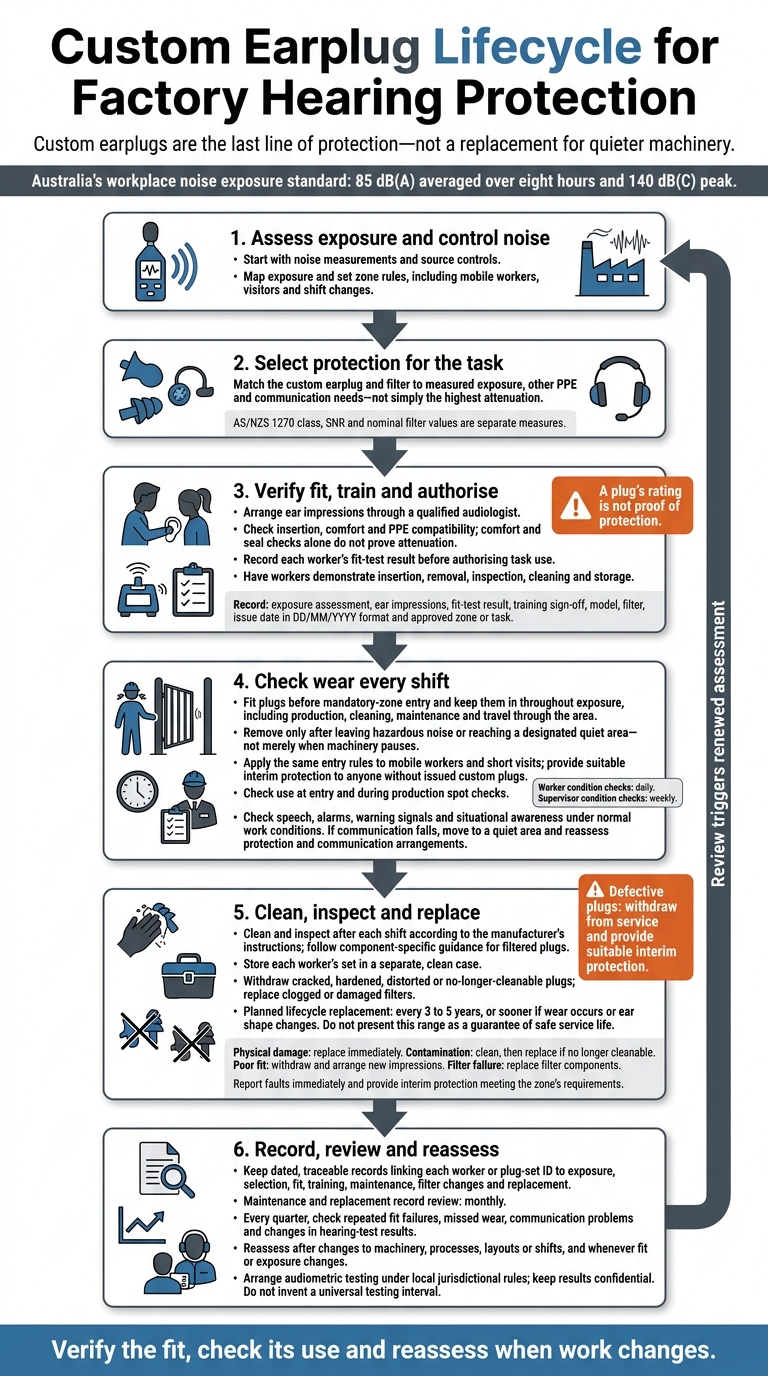
Custom Earplug Lifecycle for Factory Hearing Protection
Select and Fit Custom Earplugs
Match Earplug Ratings to Noise Exposure
Choose a custom-moulded earplug and filter rating to suit the measured noise exposure, rather than defaulting to the highest attenuation. Assess exposure first, then verify the fit.
AS/NZS 1270 class, SNR and nominal filter values are separate measures. The rating on the box is not the protection achieved in use. Check that workers can still hear speech, alarms and intercoms in the work area.
Arrange Ear Impressions and Verify Fit
Arrange ear impressions through a qualified audiologist. At fitting, check insertion, comfort and compatibility with required PPE. Comfort and seal checks alone do not prove attenuation. Record each worker’s fit-test result before authorising task use.
Refer persistent discomfort or poor fit back to the fitting provider. Reassess whenever fit or exposure changes.
Train Workers and Record Earplug Issue
Have each worker demonstrate how to insert, remove, inspect, clean and store their earplugs.
Before use, file the exposure assessment, ear impressions, fit-test result, training sign-off, model, filter, issue date in DD/MM/YYYY format and approved zone or task. Use the issue log for shift checks and replacement tracking.
sbb-itb-80b2a19
Manage Shift Wear and Supervisor Checks
Once earplugs are issued, the program relies on workers wearing them throughout noise exposure and supervisors checking their use.
Keep Earplugs In Throughout Noise Exposure
Fit earplugs before entering a mandatory zone and keep them in for every noisy task. This includes production, cleaning, maintenance and travel through the area. Remove them only after leaving hazardous noise or reaching a designated quiet area - not just because machinery has paused.
Breaks count as non-exposure periods only when taken outside hazardous noise. Provide quiet break areas away from hazardous noise.
Protect Mobile Workers and Check Communication
Apply the same zone-entry rules to mobile and maintenance workers, even for short visits. Anyone without issued custom plugs must receive suitable interim hearing protection before entering.
Check communication with hearing protection in place. Speech, alarms and warning signals must remain intelligible. Test these, along with situational awareness, under normal work conditions. If communication fails, move to a quiet area and reassess the protection and communication arrangements.
Supervisor checks must catch lapses in use early and prompt correction on the spot.
Check Earplug Use and Address Fit Problems
Check earplug use at entry and during production spot checks. Follow up privately and ask whether discomfort, task demands or communication difficulties are causing workers to remove their plugs. Record the issue, corrective action and any retraining or fit referral, then check that the problem has been resolved.
Apply the same checks every shift to catch problems before they become habits.
| Check | Responsible role | Frequency | Corrective action |
|---|---|---|---|
| Approved plug and filter in place before entry | Supervisor | Start of shift | Supply approved plug/filter before entry |
| Insertion | Worker and supervisor | Before zone entry | Move to a quiet area, coach reinsertion and refer unresolved fit problems |
| Condition | Worker; supervisor follow-up | Daily worker check; weekly supervisor check | Clean as instructed or arrange replacement |
| PPE compatibility | Supervisor | Production spot checks | Adjust PPE; refer unresolved interference for fit reassessment |
| Communication | Supervisor and worker | During tasks | Move to a quiet area; reassess filter and communication arrangements |
Clean, Inspect and Replace Earplugs
After each shift, put earplugs through the maintenance cycle: daily cleaning, removal of defective plugs and scheduled replacement.
Clean Earplugs and Check Storage
Clean and inspect earplugs after each shift, following the manufacturer’s instructions. Remove wax, dust and oils. For filtered custom plugs, follow the cleaning guidance for each component and keep filters free of contamination.
Store each worker’s set in a separate, clean case. Remove plugs from service if they are cracked, hardened, distorted or can no longer be cleaned. Replace clogged or damaged filter components.
Plan Replacement and Act on Defects
Set a replacement date based on the plugs’ condition and fit history, then enter it in the issue log.
| Replacement trigger | Required action | Record to retain | Interim protection |
|---|---|---|---|
| Planned lifecycle expiry | Replace every 3 to 5 years, or sooner if wear occurs or ear shape changes | Issue date and planned expiry | Approved temporary plugs |
| Physical damage | Replace immediately | Defect and disposal details | Approved spare plugs |
| Contamination | Clean; replace if no longer cleanable | Cleaning frequency and contamination notes | Approved temporary plugs |
| Poor fit | Withdraw from service and arrange new impressions | Fit-test result and re-moulding date | Approved hearing protection |
| Filter failure | Replace filter components | Filter type and replacement date | Approved temporary plugs |
Report faults immediately. Withdraw defective plugs and issue interim protection that meets the zone’s requirements. An audiologist or occupational hygienist can help with fit testing and replacement approval. Record maintenance, filter changes and replacements against each worker or plug-set ID to maintain the audit trail.
Keep Audit Records and Review the Hearing Program
Link each worker’s earplugs to their zone, exposure, selection and fit-test records. Date each record so it shows what was issued, why it was chosen and how its use was checked.
Keep Traceable Hearing Protection Records
Keep the records listed below to show that selection, fit and maintenance matched the zone rules. Use hearing-test results to guide reviews of noise controls.
| Requirement | Responsible role | Evidence to retain | Review frequency | Escalation route |
|---|---|---|---|---|
| Noise assessment | Safety manager / occupational hygienist | Noise maps, shift exposure assessments, time-weighted average and peak readings, noise-control decisions | After changes; scheduled review | Safety manager commissions reassessment |
| Earplug selection and fit | Safety manager / fitting clinician | Reasons for selection, model and filter specifications, certification, issue and impression dates, individual fit results | At issue and periodic re-check | Fitting clinician rechecks fit; safety manager reviews the control plan |
| Training and correct use | Supervisor / safety team | Fitting demonstrations, competency records, wear incidents and corrective actions | At induction; during shifts; quarterly trend review | Supervisor addresses missed wear or training gaps |
| Maintenance and replacement | Worker / supervisor | Cleaning, inspection, defect and replacement records | Monthly | Supervisor resolves outstanding defects |
| Audiometric testing | Occupational health provider | Confidential baseline and follow-up results | Jurisdictional hearing-test schedule | Clinician reviews changes; safety manager updates controls |
Check your jurisdiction’s audiometric testing duties, including who needs testing and when. Keep results confidential, explain them to workers in plain English and limit access to authorised people.
Review Protection After Factory or Shift Changes
When the worksite changes, your audit trail should show whether the existing controls still suit the work. Reassess zone exposure and earplug suitability after changes to machinery, processes, layouts or shifts, then update selection records and review dates. Every quarter, check for repeated fit failures, missed wear, communication problems and changes in hearing-test results.
Conclusion: Manage the Full Earplug Lifecycle
Connect assessment, zones, fit, wear checks, replacement and records. Custom earplugs support the broader noise-control program; they do not replace controls at the source.
For custom-moulded protection, discuss fit and documentation needs with ACS Custom.
FAQs
How do we manage earplug use across changing noise zones?
Rotate jobs to limit time in high-noise areas, and schedule loud tasks when fewer workers are present. For workers moving between zones, consider custom-moulded earplugs with interchangeable acoustic filters. These let workers adjust protection levels as noise exposure changes.
Where noise levels exceed 105–110 dB(A), use earplugs and earmuffs together for dual protection. Always clearly mark these areas with signs stating that hearing protection must be worn before entry.
What should we do if a worker repeatedly fails fit tests?
Investigate why failures keep happening rather than ignoring them. Give workers hands-on training in correct insertion and explain why a proper seal matters for hearing protection. If the fit is still inconsistent, check that the equipment is the right class for the noise level and suits the worker.
Ear canals can change, so consider taking new ear impressions to achieve a secure, comfortable seal. Record failures through a formal corrective action process to address the underlying issues.
How can earplug records support a safety audit?
Keep records of noise monitoring, PPE training and audiometric test results for at least five years. These records show auditors that you meet compliance requirements and run an active, effective hearing conservation program.
Store digital ear scans as controlled records so lost or damaged earplugs can be replaced with precise, identical copies without taking new impressions. This helps maintain consistent protection.


