

I’d choose earplugs by measured noise exposure and individual fit - not by price or the highest rating. Neither custom-moulded nor foam plugs are automatically safer. Start with noise controls, check the exact product’s Australian attenuation data, then test fit, comfort and communication.
SLC80 estimates protection for at least 80% of test subjects under standardised conditions. It isn’t a promise of protection during your shift. My rule: <u>check the seal, not just the label</u>.
Quick Comparison
| What I’d compare | Custom-moulded plugs | Roll-down foam plugs |
|---|---|---|
| Attenuation and fit | Made for each ear; the seal and exact filter still need checking | Depends on correct rolling, insertion and expansion |
| Shift comfort | Depends on mould accuracy and seating | Depends on size, pressure and insertion |
| Hygiene and replacement | Clean, dry, inspect and store as directed; replace when damaged or no longer fitting | Handle with clean hands; replace when dirty, damaged or unable to seal |
| Speech, alarms and PPE | Test the selected filter with normal work equipment | Test audibility with plugs correctly inserted and normal work equipment |
| Total cost | Include impressions, adjustments, cleaning and replacement | Include stock use, waste, training and replacement |
Before buying - including from ACS Custom - I’d request documentation for the exact model and filter, check AS/NZS 1270 data within an AS/NZS 1269.3 programme, and compare written quotes in AUD. Then I’d trial the plugs across representative tasks and a full shift.
The better choice is the one you can keep correctly fitted throughout noise exposure while still hearing required instructions and warnings.
How Custom and Foam Earplugs Work
Once you know the ratings, the next step is understanding how each plug seals the ear.
Custom Earplugs: Fit, Filters and Reuse
An authorised provider takes an impression of each ear to make a plug that fits that ear. Unlike foam, custom plugs don’t need rolling or time to expand. For consistent noise reduction, follow the manufacturer’s insertion instructions. Fully seat the shell and correctly position any stem, filter or retention feature.
The custom shape can make the fit easier to repeat, but it doesn’t guarantee a seal. A poor impression, damage or changes in ear shape can affect fit. Have it checked if the plug becomes loose, difficult to insert or uncomfortable.
The filter balances noise reduction with the ability to hear speech, alarms or radio communication. Its performance depends on the tested filter, the noise spectrum and how well the plug fits. Choose the tested filter configuration for the job, not just the one that sounds clearest.
Foam Earplugs: Insertion and Expansion
Roll-down plugs use slow-expanding foam to seal against the ear canal. With clean hands, roll the plug into a thin, smooth cylinder. Use the opposite hand to pull the outer ear up and back, then insert the compressed plug well into the canal. Hold it in place as it expands, following the product’s specified set time - expansion times vary.
Foam plugs are inexpensive, widely available and generally disposable. But inserting them only partway, letting them expand before insertion or releasing them too soon weakens the seal and makes noise reduction less consistent.
| Factor | Custom-moulded earplugs | Roll-down foam earplugs |
|---|---|---|
| Attenuation options | Solid or filtered configurations, with a product-specific tested rating | Multiple shapes, sizes and attenuation ratings |
| Fitting repeatability | Potentially high because the plug is made from an ear impression | Varies; depends on consistent roll-down and insertion technique |
| Comfort and hygiene | May suit long shifts when accurately made and correctly inserted; clean as directed and store in a clean case | Can be comfortable when correctly sized, but pressure or irritation may develop; use clean hands and replace when dirty or damaged |
| Durability | Reusable, but inspect and replace when damaged or no longer fitting | Usually disposable; reuse is limited by contamination, deformation and product instructions |
| Communication | Optional filters may help wearers hear speech and radio communication | May reduce the ability to hear speech and warning signals |
These are tendencies, not guarantees. With either type, a secure seal helps keep noise reduction consistent throughout the shift.
sbb-itb-80b2a19
Matching Attenuation to Workplace Noise
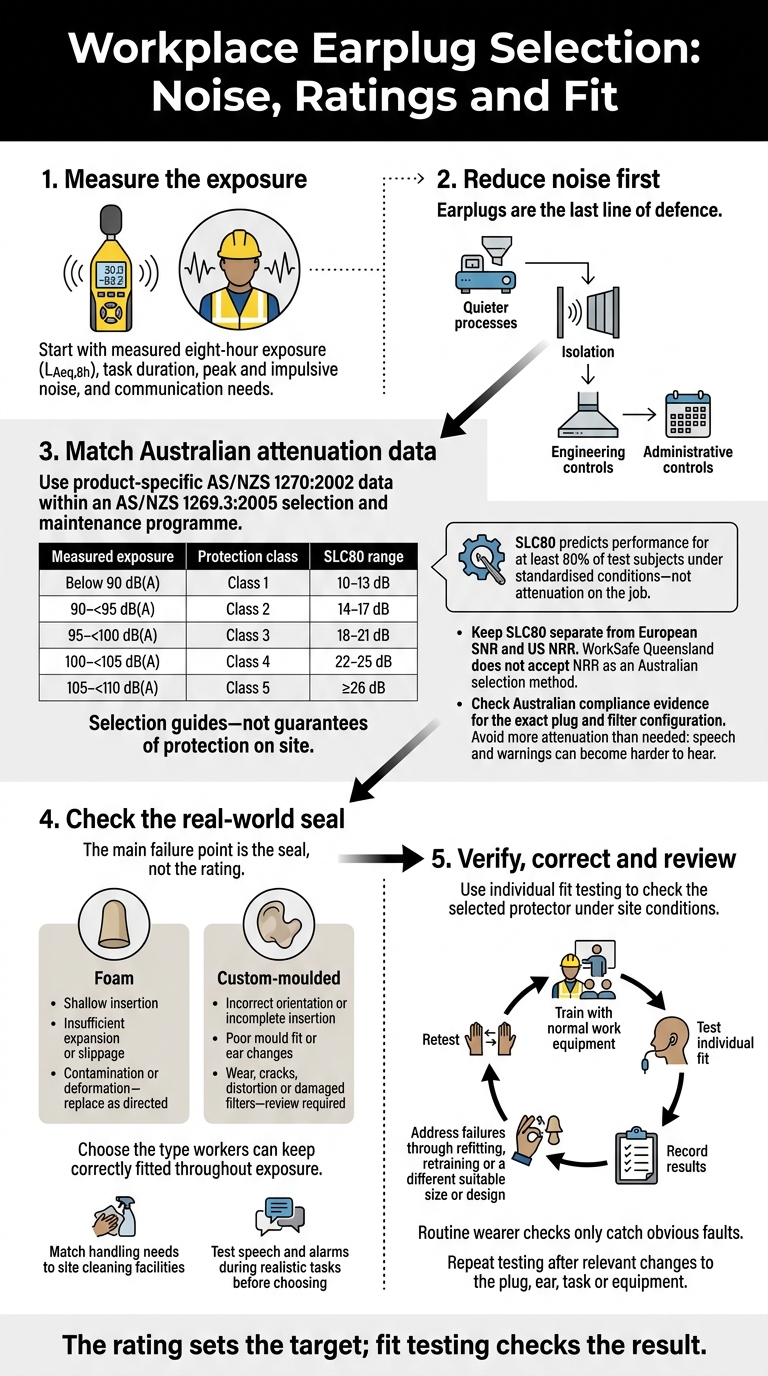
Workplace Earplug Selection: Noise, Ratings and Fit
Compare protection on the job, not the biggest rating on the packet. Start with measured eight-hour exposure ((L_{Aeq,8h})), task duration, peak and impulsive noise, and communication needs. Earplugs are the last line of defence. First, reduce noise through quieter processes, isolation, engineering controls and administrative controls. Then match the protector to the noise dose - not just the label.
Australian Ratings and Protection Selection
Australian rating tables only help when you match them to measured site exposure. Use product-specific AS/NZS 1270:2002 data within an AS/NZS 1269.3:2005 selection and maintenance programme. Australian classification guidance links exposure levels to these classes and SLC80 ranges:
| Measured exposure | Protection class | SLC80 range |
|---|---|---|
| Below 90 dB(A) | Class 1 | 10–13 dB |
| 90–<95 dB(A) | Class 2 | 14–17 dB |
| 95–<100 dB(A) | Class 3 | 18–21 dB |
| 100–<105 dB(A) | Class 4 | 22–25 dB |
| 105–<110 dB(A) | Class 5 | ≥26 dB |
These are selection guides, not guarantees of protection on site.
SLC80 predicts performance for at least 80% of test subjects under standardised conditions - not attenuation on the job. Keep it separate from European SNR and US NRR ratings. WorkSafe Queensland does not accept NRR as an Australian selection method. Check Australian compliance evidence for the exact plug and filter configuration, then verify each worker’s fit. Avoid more attenuation than needed, as it can make speech and warnings harder to hear.
| Workplace factor | Custom-moulded plugs | Foam plugs | Selection check |
|---|---|---|---|
| Wear pattern and insertion burden | Quick to refit after training; a stable, comfortable fit may help workers wear them for longer | Must be rolled, inserted and held while expanding each time; pressure or movement may prompt adjustment | Choose the type workers can keep correctly fitted throughout exposure |
| Dirty conditions | Need cleaning and clean storage | Replace after contamination; insert with clean hands | Match handling needs to site cleaning facilities |
| Communication | Check speech- and radio-friendly configurations against site needs | Check whether attenuation masks speech or warnings | Test speech and alarms during realistic tasks before choosing |
The rating sets the target; fit testing checks the result.
Fit Testing and Causes of Attenuation Loss
The main failure point is the seal, not the rating.
| Fit problem | Foam plugs | Custom-moulded plugs |
|---|---|---|
| Incomplete seating | Shallow insertion leaves a path for noise to leak through | Incorrect orientation or insertion prevents sealing |
| Unstable seal | Insufficient expansion or slippage reduces protection | Poor mould fit or ear changes can loosen the seal |
| Product condition | Contamination or deformation requires replacement as directed | Wear, cracks, distortion or damaged filters require review |
Use individual fit testing to check the selected protector under site conditions. Routine wearer checks only catch obvious faults. Train workers and check fit while they wear their normal work equipment. Repeat testing after relevant changes to the plug, ear, task or equipment. Record results and address failures through refitting, retraining or a different suitable size or design.
Once attenuation is right, assess comfort, hygiene and whether workers can keep the plugs in throughout the shift.
Shift Comfort, Hygiene and Communication
Comfort, Cleaning and Replacement
A plug that performs well in testing can still fall short if it feels uncomfortable, is hard to clean or makes communication difficult. Neither type is automatically more comfortable. Compare pressure, irritation, seal stability, heat, moisture and compatibility with other PPE. Check comfort across a representative shift, including hot or humid conditions and tasks that involve head movement. Persistent pain or irritation needs review - it isn’t something workers should accept as part of the job.
| Factor | Custom-moulded plugs | Foam plugs |
|---|---|---|
| Full-shift comfort | May reduce pressure for some workers; an incorrect mould, ear-canal changes or an unsuitable filter can cause discomfort | Can feel comfortable when correctly sized and inserted, but pressure, irritation or loss of fit can still occur |
| Handling | No rolling needed; clean hands still required | Clean hands needed for rolling and insertion |
Wash and dry hands before handling either type. Clean custom moulds and filters as directed, dry them fully and store them in a clean case away from excessive heat, chemicals and dust. Check for cracks, hardening, distortion, blocked filters, loose parts or a changed seal.
Replace foam plugs when they’re dirty, damaged, misshapen or no longer expand and seal properly. Many disposable models aren’t washable. Don’t assume all foam plugs are single-use or that custom plugs last a fixed number of years. Follow product instructions and report persistent discomfort or changes in fit.
Frequent removal adds handling and contamination risks. Take breaks in a low-noise area, store plugs in a labelled case and refit them before returning to noise exposure. Wear protection throughout hazardous noise exposure - not just during the loudest tasks.
If workers can’t keep their hands clean, provide suitable hygiene facilities or consider another compatible protector rather than repeatedly rolling foam with dirty fingers.
Comfort helps workers keep their plugs in place, including during conversations and alarm checks. But speech and alarm audibility still need separate checks.
Hearing Speech and Warning Signals
Filtered designs can still limit speech. Suitable filtered custom plugs may retain a more natural balance between speech and surrounding sound than conventional unfiltered foam plugs. Speech clarity still depends on the noise spectrum and level, distance, reverberation, the speaker’s voice, the wearer’s hearing ability and the protector’s actual attenuation.
| Communication check | What to verify | Action |
|---|---|---|
| Filters | The selected filter provides suitable protection for the task | Check its attenuation data; don’t choose solely for sound quality |
| Speech limits | Instructions, radios and intercoms remain understandable | Test at normal working distances with machinery running; record missed words and repeated instructions |
| Alarm audibility | Workers recognise required alarms and know how to respond | Check at actual work positions with normal PPE and representative background noise |
| Hearing ability | Workers with hearing loss can communicate safely | Include their feedback and seek occupational-health or audiological advice where needed |
Run these checks during normal tasks and the noisiest foreseeable conditions. Record communication failures and how long workers take to recognise alarms. Don’t remove protection in hazardous noise to hear instructions. If communication fails, review noise controls and signal placement, or introduce suitable communication equipment, visual alerts or vibrating alerts.
Choosing Earplugs and Comparing Costs
Once attenuation and fit are confirmed, compare the total programme cost - not just the price per pair. Balance cost with consistent attenuation, comfort during wear, hygiene and communication.
Start with a documented noise assessment, shortlist suitable protectors, then trial them on representative tasks and over a full shift. Use current written quotes and workplace consumption records. Don’t assume custom plugs have a fixed lifespan.
| Cost factor | Foam earplugs | Custom-moulded earplugs |
|---|---|---|
| Upfront cost | Obtain bulk pricing, including dispensers and delivery. | Request a quote in AUD for the exact model and filter, including impressions, cases and delivery. |
| Replacement | Budget using actual consumption, including contaminated, damaged and lost plugs. | Confirm replacement-part costs, refit terms and replacement criteria. Don’t assume a fixed service life. |
| Fitting appointments | Allow time for insertion training and fit verification. | Include impression appointments and follow-up adjustments. |
| Cleaning time | Include stock handling and any cleaning time for reusable models. | Allow time and supplies for approved cleaning, drying and inspection. |
| Storage | Budget for hygienic dispensing and clean storage. | Include an individually labelled protective case. |
| Losses | Track stock issued and discarded by work area. | Track lost sets, replacement costs and any need for a retention cord. |
| Training | Budget paid training time for rolling, insertion, hold time and seal checks. | Budget paid training time for insertion, seal checks, filter care and defect reporting. |
Record trial results alongside costs. Include fit-check outcomes, adjustments or removals, comfort issues, cleaning and storage costs, plug consumption and losses. Also record missed speech or alarms, plus time spent replacing or searching for plugs.
Document the selected product, training records, replacement rules and review date. Keep evidence of fit consistency, full-shift wear and signal audibility with these records. Use the cost and trial results to assess which option stays effective in daily use.
Workplace Earplug Selection Checklist
Before approval, check task and shift noise exposure, required attenuation and product-specific Australian documentation. This includes AS/NZS 1270:2002 test evidence, SLC80, protection class and octave-band attenuation data.
Confirm individual fit, comfort, PPE compatibility, hygiene and communication. Don’t wait for the scheduled review to reassess. Review the choice when workers report discomfort, repeatedly remove plugs, miss required signals or cannot get a consistent fit.
Checking ACS Custom for Workplace Use
Apply the same checks before ordering from ACS Custom. Request attenuation data and Australian certification for the exact model and filter combination. Don’t apply one configuration’s rating across the range. Confirm who takes the impressions, how fit is verified and what happens if refitting is needed.
Obtain maintenance instructions covering approved cleaning products, filter handling, storage and replacement triggers. Request a written quote in AUD that states what’s included, then check these details against the workplace noise assessment before approving the order.
Conclusion: Prioritise Fit and Consistent Wear
After testing fit and communication, choose earplugs that match the measured noise exposure, fit reliably and remain comfortable throughout the shift.
| Selection factor - suitability guides only | Custom-moulded plugs | Foam plugs |
|---|---|---|
| Use pattern | Daily use, stable crews, professional fitting and maintenance | Short-term tasks, visitors, changing workforces and new stock |
| Attenuation consistency | Repeatable fit, provided the seal stays effective | Depends on correct roll-down, insertion and expansion |
| Shift comfort | Accurate mould and comfortable seal | Suitable size and comfortable expansion |
| Hygiene | Regular cleaning, inspection and clean storage | Clean hands, hygienic insertion and regular replacement |
| Communication | Check that speech and warnings can be heard with the selected filter | Check that speech and warnings can be heard with plugs correctly inserted |
Choose earplugs workers can wear correctly and consistently throughout noise exposure, while still hearing essential speech and warnings.
FAQs
How can I tell if my earplugs provide enough protection?
Check the fit and match your earplugs to measured workplace noise levels. The rating on the box does not guarantee protection during use. Arrange professional fit-testing, check compliance with AS/NZS 1270:2002, and aim for approximately 80 dB(A) at the ear while keeping alarms and speech you need to hear audible.
Keep a comfortable, consistent seal and wear your earplugs for the entire time you’re exposed to noise. Ringing or muffled hearing after work may be a sign that your protection isn’t adequate.
Can jaw movement affect my earplug seal?
Yes. Talking or chewing can loosen standard foam earplugs or make them fall out. This breaks the seal and reduces noise protection.
Custom-moulded earplugs are designed to stay in place as you move. When your audiologist takes your initial ear moulds, you can request an open-jaw impression. This helps maintain a consistent seal as your ear canal shifts.
When should I wear earmuffs over my earplugs?
You generally don’t need earmuffs over custom-moulded earplugs if the plugs alone provide enough protection for your workplace.
Made to fit the shape of your ears, these plugs provide a secure seal and comfort during long shifts. Their low-profile fit also lets you wear them comfortably with other personal protective equipment, such as hard hats or welding helmets.


