

In-ear monitors (IEMs) and floor monitors are two popular options for live sound monitoring, but they serve very different purposes. IEMs fit inside your ears to deliver a personalised mix while blocking external noise (unlike custom earplugs vs. foam earplugs which focus solely on attenuation), offering better sound clarity, hearing protection, and freedom to move on stage. Floor monitors, on the other hand, are stage speakers that project sound outward, but they can cause feedback issues, increase stage volume, and limit mobility.
Key differences:
- IEMs provide isolation (up to 30dB), safer listening levels, and customisation for each performer.
- Floor monitors are cheaper upfront, already available in many venues, and allow performers to feel physical vibrations from the music.
For Australian performers, custom IEMs are becoming a preferred choice due to their tailored fit, comfort during long performances, and advanced sound quality. Prices range from $500 to $2,100 AUD depending on features like ambient filters and multi-driver setups.
Quick Comparison:
| Feature | Custom IEMs | Floor Monitors |
|---|---|---|
| Sound Clarity | High (personalised mix) | Moderate (shared mix) |
| Noise Isolation | –26dB to –30dB | None |
| Mobility | Full freedom | Limited to "sweet spots" |
| Feedback Risk | None | High |
| Cost | $500–$2,100 AUD | Often included in venues |
IEMs are ideal for performers prioritising sound quality, hearing safety, and stage freedom, while floor monitors may still suit smaller gigs or low-volume settings.
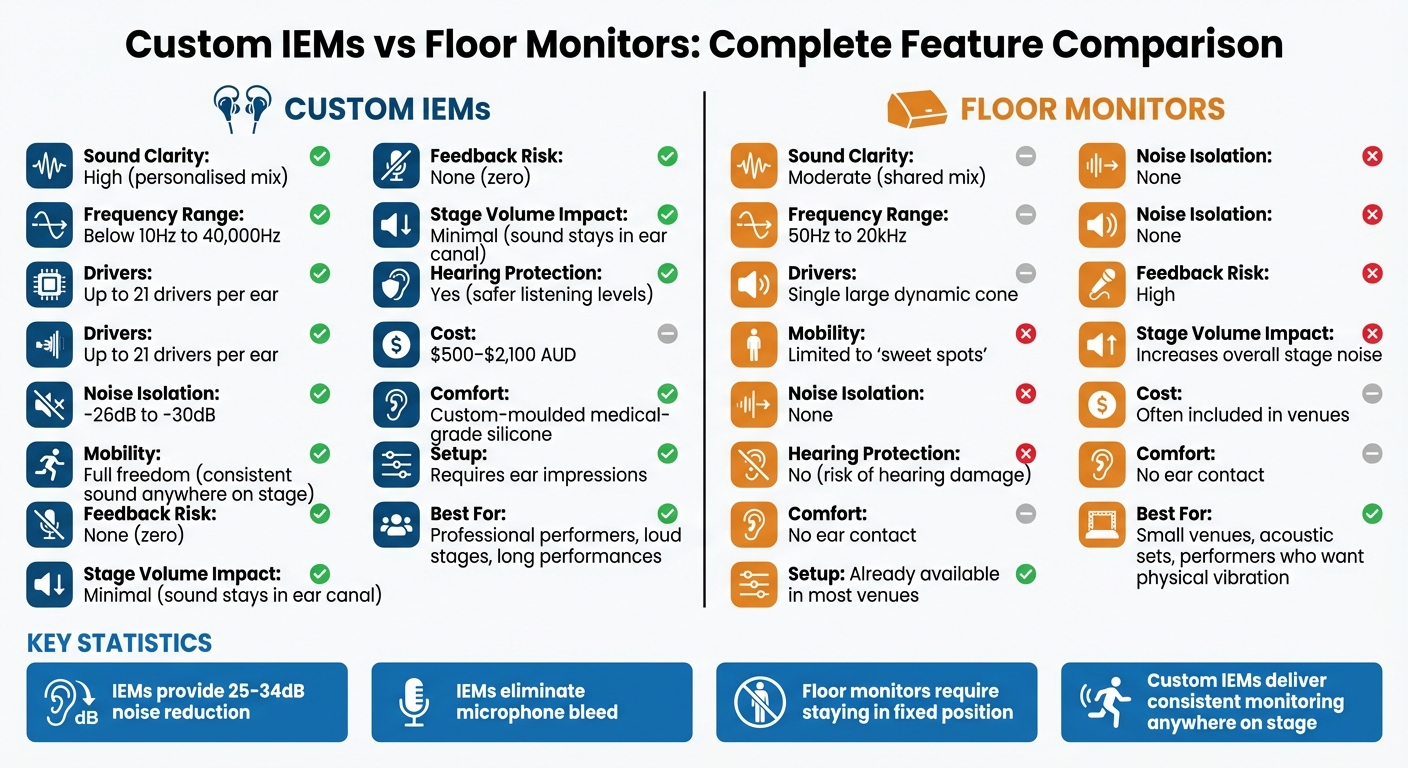
Custom IEMs vs Floor Monitors: Complete Feature Comparison
How IEMs and Floor Monitors Differ
Sound Quality and Customisation
Floor monitors generally deliver a frequency range of 50Hz to 20kHz. In contrast, high-end in-ear monitors (IEMs) can handle a much broader spectrum - starting below 10Hz and extending all the way to 40,000Hz. They can also include up to 21 drivers per ear, allowing them to capture fine details like transient sounds and subtle vocal textures that floor monitors often miss. Another major advantage of IEMs is their ability to provide a personalised mix for each performer, while floor monitors broadcast a single mix for the entire stage. These differences in sound and customisation lay the groundwork for understanding their impact on stage noise and mobility.
Stage Noise and Feedback
One of the biggest drawbacks of floor monitors is their susceptibility to feedback. When microphones pick up the sound from these monitors, it can create a chaotic stage environment, increasing the risk of hearing damage. On the other hand, custom-fitted IEMs deliver the mix directly to the performer’s ears while offering passive noise reduction of 26dB to 30dB. This isolation not only improves sound clarity but also allows musicians to monitor at lower, safer volumes. Vocalists, in particular, benefit from this setup, as it helps prevent voice strain during extended performances. Beyond sound quality, the difference in setup plays a big role in how performers move on stage.
Movement and Performance Freedom
IEMs not only provide superior sound quality and noise isolation but also offer unparalleled freedom to move. With floor monitors, performers need to stay within a specific "sweet spot" to hear the sound accurately. Moving out of this zone can disrupt the sound balance, limiting choreography and interaction with the audience. IEMs, however, deliver consistent audio no matter where the performer is positioned - whether at the centre of the stage or its farthest edge. Additionally, custom-moulded IEMs, made from medical-grade silicone, remain securely in place even during high-energy performances. By eliminating bulky floor wedges, IEMs also reduce tripping hazards and free up valuable stage space.
Audiologist Rachel Cruz highlights these benefits:
The performer has increased mobility on stage, highly individualised mixes with individual volume controls on his or her beltpack, and acoustic isolation from amplifiers or other (non-IEM users) floor wedges.
sbb-itb-80b2a19
Music Industry Roundtable: In Ear Monitors vs Floor Wedges
Custom IEMs: What Makes Them Different
Custom in-ear monitors (IEMs) tackle many of the challenges associated with traditional floor monitors by leveraging advanced design and technology.
Custom Fit and Comfort
Custom IEMs are crafted using detailed impressions of your ears, ensuring a fit tailored specifically to your unique ear shape. This personalised moulding creates a snug, secure seal that off-the-shelf monitors simply can't replicate. Made from soft, medical-grade silicone (typically 40 Shore silicone), they are far more comfortable for extended use compared to the hard plastic found in standard IEMs. This comfort is especially important during long performances or rehearsals, helping to reduce ear fatigue.
Before taking impressions, it’s essential to ensure your ears are free of wax. Keep in mind that these impressions usually stay accurate for about two years, after which changes in the shape of your ear canals may require new moulds.
Noise Isolation
One of the standout features of custom IEMs is their ability to isolate external noise. For example, the Classic series can reduce ambient noise by approximately 30dB, while the Ambient series offers around 17dB of reduction, allowing for some environmental awareness. This level of isolation means musicians can monitor their sound at much lower - and safer - volumes, which helps protect hearing and reduces ear fatigue.
The Ambient series also addresses a common issue known as the occlusion effect, where sealing the ear canal amplifies internal sounds like your own voice. These IEMs use a precision-tuned vent and filter to cancel out this effect while maintaining low-frequency clarity. This is particularly helpful for singers who need to hear subtle off-mic cues or stay aware of their surroundings without removing their monitors.
To maintain their performance, regular cleaning is vital. Even a tiny amount of earwax can affect the seal and sound quality. Using a wire pick to clean the sound ducts after every use is a simple but effective solution.
Driver Technology and Audio Performance
Custom IEMs are equipped with multiple Balanced Armature drivers, each dedicated to handling specific frequency ranges, all managed by professional crossover networks. Unlike the single, large speakers used in floor monitors, this multi-driver setup provides fast response times and captures intricate details, such as vocal textures and instrumental harmonics, that might otherwise get lost in the noise of a live stage.
ACS Custom takes this a step further with their Sound Stage Imaging (SSI) technology, which optimises driver placement within the mould. This ensures a flat frequency response and better separation between instruments, delivering a studio-quality monitoring experience directly to your ears. By bypassing the room’s acoustics - like reflections, feedback, and ambient noise - custom IEMs offer clarity that floor monitors simply can’t match.
| Feature | Custom IEMs | Floor Monitors |
|---|---|---|
| Driver Type | Multiple Balanced Armatures | Large Dynamic Cones |
| Isolation | –26dB to –30dB | None |
| Distortion | Extremely Low | Higher (influenced by room acoustics) |
| Feedback Risk | Zero | High |
Padge McQuillan, a professional monitor engineer for Lotus, highlights the practical advantages:
I love the feeling of being totally isolated. I can monitor at a much lower level and still hear everything in the mix.
Thanks to their precision design and personalised fit, custom IEMs deliver a sound experience that far surpasses what traditional floor monitors can offer.
When to Use IEMs vs. Floor Monitors
For Live Performances
Custom IEMs (in-ear monitors) are a game-changer for live performances. They let you monitor sound at lower, safer volumes while maintaining crystal-clear audio. Thanks to their secure, custom-moulded fit, you’ll get consistent sound no matter where you are on stage - no need to hover around a floor monitor's "sweet spot." Plus, because the sound stays in your ear canal, there's no microphone bleed, and overall stage noise is significantly reduced [6].
For performers who worry about feeling disconnected from the audience, the Ambient series offers a solution. It combines high-quality sound with the ability to stay aware of your surroundings, helping you feel more in tune with the crowd.
For Studio Recording and Personal Listening
Custom IEMs aren't just for the stage - they shine in the studio too. Their snug fit and precise audio reproduction make them perfect for long recording or mixing sessions, where comfort and accuracy are key. Unlike traditional monitors, they eliminate the influence of room acoustics, letting you focus on every detail.
Audiophiles also benefit from IEMs for personal listening. Their reference-quality sound reduces ear fatigue, making them ideal for extended use while enjoying music at its finest.
When Floor Monitors Make Sense
Despite their advantages, IEMs aren’t always the best option. Floor monitors, or wedges, are still practical in many cases. For one, most venues already have them set up, making them a convenient choice if you don’t have your own IEM system. They also make on-stage communication easier - unlike IEMs, which may require you to remove an earpiece to hear your bandmates clearly.
Some performers prefer the physical feedback floor monitors provide. Feeling the "thump" of the music through the stage can be an important part of the live experience. In smaller venues where stage noise isn’t a concern, floor monitors can help you stay connected to the room’s natural acoustics.
Ultimately, the decision between IEMs and floor monitors comes down to your specific needs, whether it's the type of performance, the venue, or your personal preferences. Each option has its strengths, so it’s all about finding what works best for you.
ACS Custom Solutions
ACS Custom provides tailored in-ear solutions designed to meet the needs of Australian professionals, building on decades of expertise in audio and hearing protection.
Product Range
With over 30 years of experience, ACS Custom specialises in custom-fit audio gear and hearing protection. Their offerings focus on two main in-ear monitor (IEM) series: the Classic Series, which prioritises maximum isolation, and the Ambient Series, featuring a patented filter that reduces the occlusion effect while preserving situational awareness.
The Classic Series starts at $500.00, with options extending up to $1,700.00 for configurations ranging from dual to five drivers. The Ambient models, which include a precision-tuned vent with a 17dB filter, are priced approximately $100 higher. Beyond IEMs, the PRO Series custom-moulded earplugs offer noise reduction with interchangeable filters ranging from 10dB to 27dB, priced between $150.00 and $300.00. ACS also provides specialised products for sleeping, swimming, shooting, and industrial use.
Quality Standards and Technology
ACS products are crafted from 40-Shore medical-grade soft silicone, ensuring they adapt to jaw movements and maintain a comfortable seal during extended use. This material is ideal for long performances, offering a snug fit without discomfort. Their manufacturing process integrates advanced features like Sound Stage Imaging (SSI) technology for a broader, more precise soundstage, and the Intelligent Resonance In Silicone (IRIS) system for fine-tuned acoustics.
The cables are built for durability, featuring 80-strand, oxygen-free copper coated in silver and reinforced with Kevlar. UV treatment of the internal strands prevents discolouration and oxidation over time. With a 4.8/5 rating from over 2,000 customers, ACS products are widely endorsed by professionals, including members of Pink Floyd, Radiohead, and U2. These innovations ensure exceptional sound clarity and a highly personalised listening experience.
Serving Australian Professionals
The entire ACS product line is available to Australian customers through their dedicated website, acscustom.com.au. To create a custom fit, customers need deep ear impressions taken by a local audiologist. ACS provides a detailed "How To Buy" guide and helps connect customers with impression-taking providers across Australia after purchase. Once impressions are submitted, the handcrafted products are shipped from the UK, typically within three weeks.
Custom-fit designs are especially beneficial for Australian performers with unique requirements. Singer Natalie Shay shared:
As a singer with a long term jaw syndrome, comfort is key for me. They are so soft and fit perfectly, I forget I am even wearing them.
Conclusion
Main Differences Summary
Custom in-ear monitors (IEMs) offer better control, hearing protection, and mobility compared to traditional floor monitors. They provide 25–34 decibels of noise reduction, ensuring safer listening while eliminating the risk of feedback that often affects floor wedges.
Floor wedges require performers to stay in a fixed position for the best sound, whereas custom IEMs deliver consistent monitoring no matter where you are on stage. They also prevent low-frequency bleed, which can muddy the audience's experience in smaller venues, and help reduce vocal strain by offering clear monitoring at lower volumes.
For those who want to stay connected to the crowd and their bandmates, vented Ambient models are a great option. These reintroduce some crowd noise while maintaining clarity and providing a 17-decibel ambient reduction, striking a balance between isolation and awareness.
Choosing What Works for You
Now that you’ve seen the technical advantages, the choice comes down to your performance style and environment. In loud settings with powerful drum kits or guitar stacks, custom IEMs provide unmatched protection and clarity. If you rely on off-mic cues or need to hear band communication, the Ambient series offers a practical blend of isolation and situational awareness.
The tailored fit and advanced driver technology of custom IEMs make them an excellent choice for demanding live performances. Unlike universal fits, custom-moulded silicone IEMs stay secure and comfortable, even during energetic movement, while eliminating ear fatigue. Professional drummer Will Taylor described the difference as "night and day" compared to generic brands, noting how he now finishes tours "feeling good and without any ears fatigued".
For Australian performers, ACS Custom offers a range of options starting at $500.00 for the Classic Evoke2 and going up to $2,100.00 for the flagship Ambient Emotion Hybrid. You’ll need deep ear impressions, which can be arranged through local audiologists with guidance from ACS.
While floor monitors might suit smaller, low-volume acoustic gigs or close harmony groups that rely on natural blending, most professionals will find the benefits of custom IEMs - like clarity, mobility, and hearing protection - far superior for demanding performances.
FAQs
Do I need a wireless pack to use custom IEMs live?
No, you don’t need a wireless pack to use custom IEMs during live performances. They can easily connect through a wired setup, which many performers favour for its consistent reliability. That said, wireless packs are a common choice because they allow for greater mobility on stage. The decision between wired and wireless ultimately depends on your preferences and the requirements of your performance setting, as custom IEMs are compatible with both options.
How do I choose between Classic and Ambient custom IEMs?
When deciding between Classic and Ambient custom in-ear monitors (IEMs), it all comes down to where and how you’ll be using them.
Classic IEMs are perfect if you need excellent sound clarity and maximum noise isolation. They’re designed to block out external noise, giving you an immersive audio experience - ideal for performances where focus on sound is key.
On the other hand, Ambient IEMs are built for those who need to stay aware of their surroundings. They feature sound ports or built-in microphones, letting you hear what’s going on around you while still enjoying the comfort and fit of custom IEMs.
In short, go for Classic if isolation is your priority, or pick Ambient if situational awareness matters without sacrificing sound quality.
How long do custom IEM ear impressions stay accurate?
Custom in-ear monitor (IEM) impressions typically maintain their accuracy for around 3 to 5 years, provided they're well looked after. However, factors like ear growth, changes in ear shape, and even moisture exposure can affect how long they stay effective. To ensure they continue to fit comfortably, it's a good idea to have them checked periodically.


