

If I want my custom IEMs to last 10+ years, I need to stay on top of four things: wax, moisture, fit changes, and cable strain. Most sound issues start with blocked bores, trapped sweat, a weaker seal, or worn connectors.
Here’s the short version:
- Clean after every use so wax doesn’t block the sound path
- Dry before storage to cut down moisture build-up and contact corrosion
- Keep them out of heat because parked cars in Australia can top 60°C
- Watch the fit over time if bass drops or outside noise gets in
- Handle cables by the shell, not the wire to avoid faults
- Replace ear impressions about every 4 years if the fit starts to drift
A simple routine does most of the work. I’d wipe the shells, clear visible wax, let the IEMs dry, and store them in a hard case. For heavier use, I’d add silica gel or a drying unit, especially in hot or humid conditions.
That’s the whole idea: keep the sound path clear, keep moisture low, protect the fit, and avoid cable stress.
In-Ear Monitor Maintenance 101
sbb-itb-80b2a19
How to stop wax and debris from blocking sound
Wax and debris are the fastest way custom IEMs lose clarity and channel balance. So it pays to clean them after each use. Fresh build-up is much easier to remove, and it's less likely to clog the sound path.
Start with the sound bore. That's usually where wax causes the fastest drop in clarity.
Check ducts and shells after every use
After every rehearsal, performance, or listening session, check the sound ports and vents. If you can see wax or debris, remove it early before it hardens. The sooner you deal with it, the easier it is to clear without pushing anything deeper inside.
Wipe the shells with a dry microfibre cloth or a lightly damp alcohol wipe. Keep any liquid well away from the sound outlets.
Safe cleaning methods for electronic devices
Use the gentlest method that gets the job done. For electronic custom IEMs, use a wire loop or pick to lift wax out of the sound bore. The goal is simple: pull debris out, not push it further into the bore.
Then use a cleaning brush to sweep away any loose material. If debris won't budge, use an IEM vacuum and follow the manufacturer's instructions. Never immerse electronic IEMs in liquid.
Once the sound path is clear, dry the IEMs before storage so moisture doesn't build up.
How to manage moisture, heat and storage
After cleaning, the next job is moisture control. Sweat, humidity and condensation can slowly corrode drivers and connectors over time. So the fix is pretty simple: dry your IEMs well and store them properly.
Dry IEMs properly after use
Let your IEMs air dry for a short time before you seal them in a case. It also helps to remove the ear tips first so air can move through more easily.
Skip direct heat. It can warp the shells and harm the drivers. You’ll also want to keep the cable socket dry, because moisture there can lead to contact corrosion and annoying audio cut-outs.
Pick a storage routine that suits Australian conditions
Don’t leave IEMs in a parked car or sitting in direct sunlight. On a hot day in Australia, the inside of a vehicle can go past 60°C, and that’s enough to damage shell materials and internal electronics.
Use the options below based on how often you use them.
| Storage Method | Moisture Removal | Portability | Approx. Cost (AUD) | Best Use Case |
|---|---|---|---|---|
| Basic Hard Case | Low - impact protection only | High | Included with IEMs | Casual daily users in low-humidity environments |
| Hard Case + Silica Gel | Moderate - absorbs ambient moisture | High | $5–$20 | Travellers, touring musicians and heavy performers |
| Electronic Drying System (e.g., ACS Revivo2) | High - active drying | Best kept at home or in the studio | $80.00 AUD | Daily home or studio use; professional performers |
For casual users, a hard case with a silica gel packet does the job. Swap the silica out when it changes colour.
If you’re playing nightly sets, sweating a lot, or using IEMs for hours each day, a dedicated drying system like the ACS Revivo2 makes more sense. It can run for 8 hours and actively remove trapped moisture.
How to keep fit, comfort and cables in good condition over time
Once cleaning and drying are sorted, the next things to watch are fit drift and cable wear. They can look similar at first, but they’re not the same problem. That matters, because fit, seal, and cable issues each need a different fix.
Signs of seal changes and material wear
If outside noise starts creeping in or the bass sounds thinner than usual, the seal has probably changed. That usually happens because your ear shape shifts bit by bit over time. In plain terms: this is a fit problem, not a cleaning problem.
You might also notice new pressure points, rubbing, or irritation. That’s another clue that the fit isn’t what it used to be. A good rule is to have your ear impressions checked every 4 years so you can stay ahead of those gradual changes. If the discomfort sticks around, get it checked by a professional instead of trying to patch it up yourself.
How to handle cables and connectors to avoid faults
When removing your IEMs, grip the shell, not the cable. Pulling on the cable puts strain on the connectors, and that can lead to faults over time.
For storage, wrap the cable in a loose loop rather than a tight coil. Tight coils keep steady pressure on the connectors and speed up wear. If you spot green or dark discolouration on the cable, that can point to corrosion, which often means it’s time for a replacement.
Use the table below to match each symptom with the most likely fault.
| Symptom | Likely Cause | Recommended Action |
|---|---|---|
| Reduced isolation or weak bass | Poor seal due to ear shape changes | Get new impressions |
| Slipping or new discomfort | Fit drift or shell surface needs cleaning | Wipe shells or get new impressions |
| Crackling or intermittent audio | Cable fatigue or connector oxidation | Replace the cable |
| Green or dark cable discolouration | Oxidation or UV damage | Replace the cable |
Build a care routine you can stick to
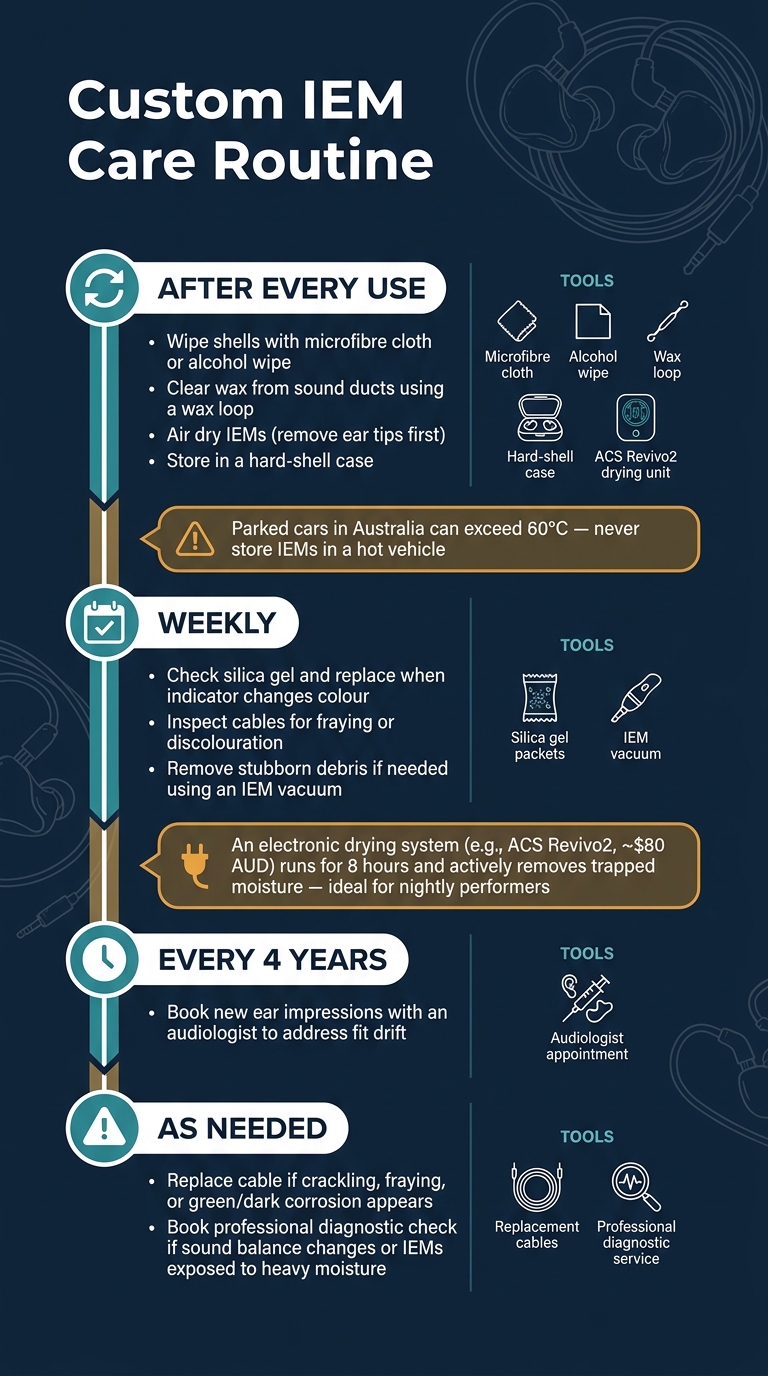
Custom IEM Care Routine: After Every Use to Every 4 Years
Wax, moisture, fit drift and cable strain are much easier to manage when care becomes part of your usual routine. The goal isn’t to make this a big chore. It’s to keep things simple enough that you’ll actually do it.
After every use, clean and dry your IEMs, then store them in a hard-shell case. Once a week, check your silica gel and swap it out when the indicator changes colour. If debris won’t budge, use an IEM vacuum. Book microsuction when needed, and get new ear impressions every 4 years. If your cable starts dropping audio, fraying, or showing green corrosion, replace it straight away. And if the sound balance changes or your IEMs have been exposed to a lot of moisture, book a professional check.
A set routine helps you stay on top of care without much thought.
| Frequency | Task | Tools |
|---|---|---|
| After every use | Wipe shells, clear wax ducts, dry, and store in a hard-shell case | Microfibre cloth or alcohol wipe, wax loop, ACS Revivo2, hard-shell case |
| Weekly | Check or replace desiccant, inspect cables, and remove stubborn debris if needed | Silica gel packets, visual check, IEM vacuum |
| Every 4 years | New ear impressions | Audiologist appointment |
| As needed | Cable replacement or professional check | Replacement cables, diagnostic service |
FAQs
How do I know if moisture has damaged my IEMs?
If your IEMs sound muffled, weak, or distorted, moisture may have damaged the internal balanced armature drivers. If the problem sticks around after you’ve cleared earwax from the sound ducts with the supplied wire pick, moisture is the most likely culprit.
Sweat and condensation can get trapped inside and lead to corrosion, low output, or complete failure. That’s why it’s worth making sure your IEMs are fully dry before you put them away. If you think moisture has built up, use the ACS Revivo2 Dryer and Sanitiser.
Can a poor fit be fixed without new impressions?
Yes, often.
First, check whether earwax or debris is blocking the nozzle. Even a small blockage can affect sound and make the fit feel off.
You can also make small changes to the insertion depth and angle. Sometimes that’s all it takes to get a better seal and a more comfortable fit.
A small amount of ACS Comfort Cream may help with comfort and sealing. If the fit feels loose, creates pressure points, or the seal has changed over time, it may be time for a professional assessment.
New impressions are recommended every four years.
When should I get my custom IEMs professionally checked?
If your IEMs still sound muffled after your usual clean and you've already cleared wax or debris from the sound bores, it's time to get help from a professional. Don't try to open or modify the monitors yourself. That can do more harm than good, and it's an easy way to turn a small issue into a bigger one.
For long-term care, have them reshelled or refitted every five years so they keep a proper fit and seal. Ear impressions are usually valid for two years before you need a new set.


