

In noisy workplaces, communicating effectively while protecting your hearing can be a major challenge. Custom earplugs solve this issue by reducing harmful noise while keeping speech and warning signals clear. Unlike custom earplugs vs. foam earplugs, these are moulded to fit your ears perfectly, offering consistent protection without compromising awareness.
Key Takeaways:
- Noise Reduction with Clarity: Custom earplugs lower dangerous noise levels but allow speech and alarms to remain audible.
- Acoustic Filters: Filters like the PRO Series offer tailored noise reduction (17–27 dB) for different environments.
- Integrated Communication: Models with built-in audio drivers connect to communication devices, ensuring clear radio transmissions.
- Durable and Hygienic: Made from medical-grade silicone, they’re long-lasting and easy to clean.
- Australian Standards Compliance: Fully meet AS/NZS 1270:2002 requirements for workplace hearing protection.
By combining safety and clear communication, custom earplugs are a practical, long-term solution for noisy industrial environments.
Communication Challenges in Noisy Industrial Environments
How Industrial Noise Affects Communication
In industrial settings across Australia, noise levels often surpass 85 dB(A), which is the maximum eight-hour exposure limit set by workplace safety regulations. At this intensity, background noise can completely drown out speech. A simple rule of thumb: if shouting is necessary to be heard from just one metre away, the noise level has likely hit or exceeded this legal threshold.
Effective communication is critical in industrial environments to ensure both safety and productivity. However, as noise levels rise, the chances of misinterpreted instructions, missed warnings, or coordination failures increase. Alarmingly, workplace noise exposure accounts for an estimated 28–37% of hearing loss among Australia's working-age population. These challenges underline the limitations of traditional hearing protection methods.
Where Conventional Hearing Protection Falls Short
Traditional hearing protection devices, like foam earplugs and earmuffs, are designed to block noise indiscriminately. While they reduce harmful sound levels, they can also suppress important sounds, such as speech and warning signals, when noise drops below 70 dB(A). This creates a trade-off between protection and awareness, which SafeWork NSW has addressed:
"Providing hearing PPE that over-protects a worker... cuts out too much sound and may cause workers to experience disadvantages, such as difficulty in communication, in hearing verbal instructions – even warning signals."
This over-attenuation often leads workers to remove their hearing protection entirely, especially when they need to communicate or stay alert to their surroundings. Even brief removal in a high-noise environment can drastically reduce the overall effectiveness of protection for the entire shift.
Adding to these issues, disposable earplugs can be tricky to insert with dirty hands, raising hygiene concerns and further discouraging proper use. These limitations highlight why custom-moulded earplugs are gaining traction as a safer and more practical alternative in industrial settings.
sbb-itb-80b2a19
How Custom Earplugs Improve Communication and Protection
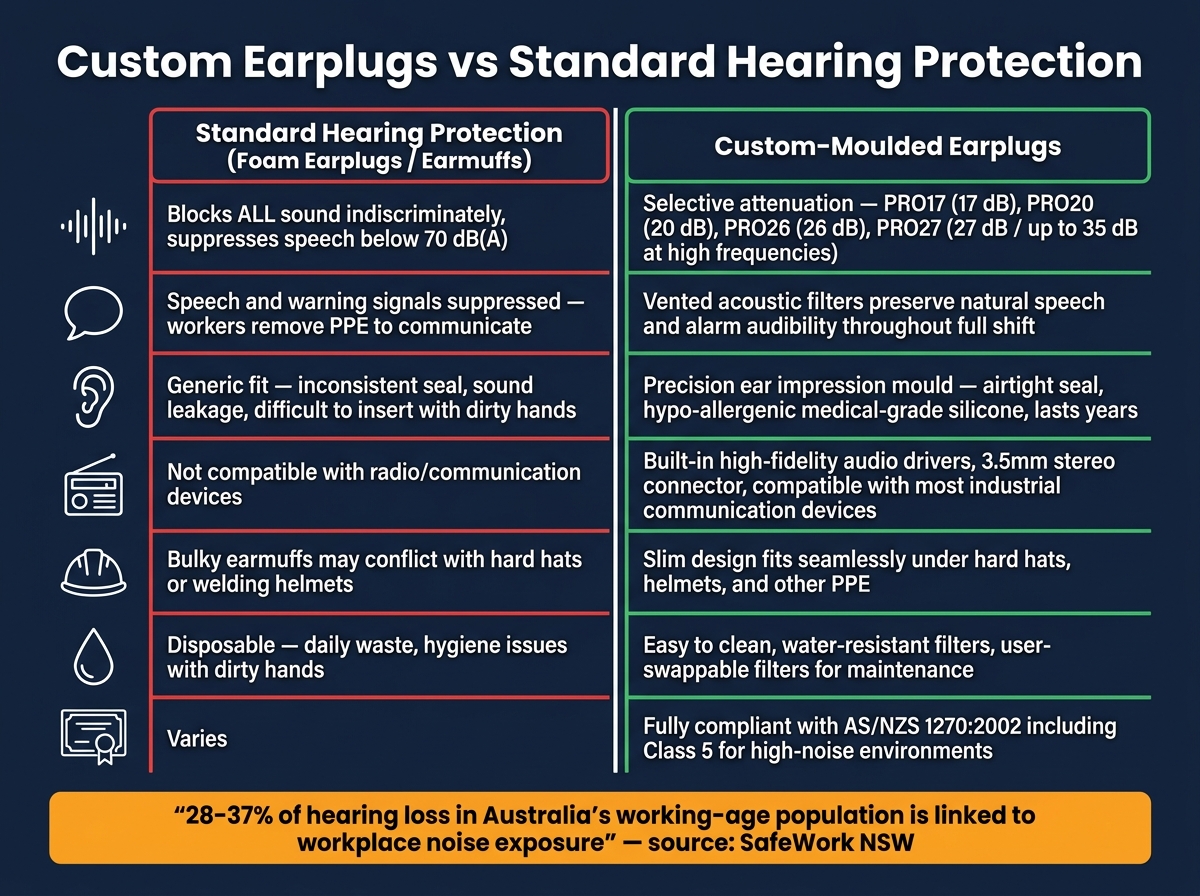
Custom Earplugs vs Standard Hearing Protection: Industrial Communication & Safety
What Are Custom-Moulded Earplugs?
Custom-moulded earplugs are made from an impression of the ear, creating a silicone plug that fits perfectly into the ear canal. This precise fit ensures an airtight seal that generic foam earplugs simply can't match, effectively preventing sound leakage.
These earplugs are crafted from hypo-allergenic, medical-grade silicone, making them easy to clean and durable enough to last for years. Compared to disposable plugs that are used and thrown away daily, they offer a practical and long-term solution. The snug fit also serves as the base for advanced acoustic filtering, which sets these earplugs apart.
How Acoustic Filters Balance Noise Reduction and Speech Clarity
The standout feature of custom earplugs is their acoustic filter. These filters reduce harmful noise frequencies while keeping speech clear, avoiding the occlusion effect - that booming sensation of hearing your own voice too loudly when your ears are blocked.
ACS Custom’s PRO Series filters feature a vented design that allows sound to travel in both directions, providing a natural listening experience:
"The PRO filters go one step further by being vented to allow sound to pass both ways, meaning that remaining sound can escape directly through the filter providing one of the most natural sounding earplugs available." - ACS Custom
The PRO Series offers filters tailored to different noise levels and uses:
| Filter | Average Attenuation | Best Use Case |
|---|---|---|
| PRO17 | 17 dB | Ideal for environments where maintaining natural conversation is key |
| PRO20 | 20 dB | Suitable for general high-noise areas, particularly those with high-pitched sounds |
| PRO26 | 26 dB | Designed for very noisy environments, offering balanced protection |
| PRO27 | 27 dB | For extreme noise levels, providing up to 35 dB protection at high frequencies |
These filters are user-swappable, so the same custom ear moulds can be adapted with different filters to suit specific tasks or locations. This flexibility ensures workers can hear critical sounds, like speech and warning signals, while still protecting their hearing.
How Custom Earplugs Support Face-to-Face and Radio Communication
By preserving the natural tone of voices, custom earplugs eliminate the need to remove them during conversations. This means workers stay protected without compromising communication. This feature is especially crucial for maintaining safety standards, as removing earplugs - even briefly - can significantly increase overall noise exposure throughout a shift.
Combining Custom Earplugs with Industrial Communication Systems
How Custom Earplugs Work with Industrial Communication Devices
Custom earplugs have taken a big step forward by integrating with industrial communication systems, thanks to advanced acoustic filtering technology. Many models now feature high-fidelity audio drivers embedded in custom-moulded silicone, delivering crisp audio directly to the ear. With a standard 3.5mm stereo connector, these earplugs easily connect to most industrial communication devices. The snug, custom seal not only blocks out background noise but also ensures that transmitted audio remains crystal clear. This means workers can hear radio transmissions at safe volume levels, avoiding the need to crank up the volume, which could otherwise lead to hearing damage.
Benefits of Custom Earpieces in Communication Systems
Custom earpieces bring more to the table than just great sound. Their design is tailored to fit comfortably under personal protective equipment (PPE) like hard hats and welding helmets. Water-resistant filters safeguard the internal components from sweat and humidity during long shifts, while vented filters minimise the "occlusion effect", ensuring the user's voice sounds natural over the radio. Additionally, user-swappable filters make cleaning and maintenance straightforward, without the risk of damaging the acoustic components.
| Feature | Benefit for Industrial Communication |
|---|---|
| Vented filters | Keeps the user's voice sounding natural during radio use |
| 3.5mm connector | Offers compatibility with most industrial communication devices |
| Slim design | Fits seamlessly under PPE, such as hard hats or helmets |
| High-fidelity audio drivers | Provides clear sound, even in noisy environments |
| Water resistance | Shields components from sweat and humidity |
These features make custom earpieces a practical solution for workers who need both protection and reliable communication.
ACS Custom's Communication Solutions for Industrial Use
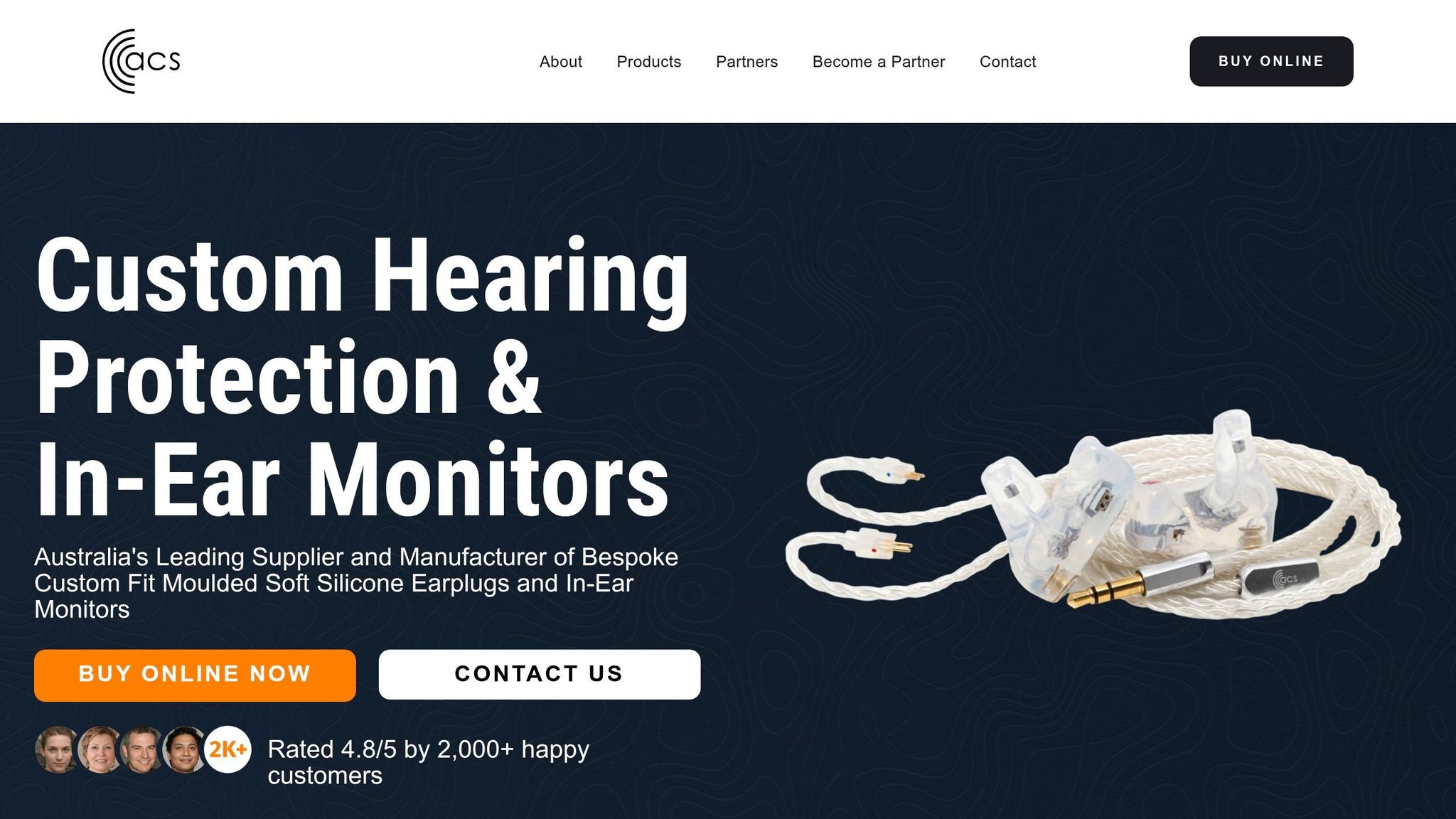
ACS Custom delivers a wide range of industrial hearing protection options, including both standard and communication-enhanced solutions. Their PRO Series - ranging from PRO10 to PRO27 - offers custom hearing protection with interchangeable filters designed for various noise levels, priced at $300.00 AUD per pair. For environments where radio communication is critical, the PACS PRO Communicator combines top-tier hearing protection with high-fidelity audio drivers, akin to those found in professional in-ear monitors, and is available for $580.00 AUD.
All ACS Custom products are crafted using advanced 3D technology in their Australian lab and meet the AS/NZS 1270:2002 standards, including Class 5 certification for high-noise environments. Additionally, specialised options cater to industries like aviation and motorsport, ensuring clear communication even in some of the loudest workplaces.
How Australian Workplaces Can Adopt Custom Earplugs
Noise Assessment and Choosing the Right Custom Earplugs
Start with a formal noise assessment. In Australia, hearing protection becomes essential when average noise exposure exceeds 85 dB(A) over an 8-hour shift or when peak noise levels hit 140 dB(C). A thorough noise survey identifies which workers are at risk, the processes generating the most noise, and whether additional hazards like vibration or ototoxic substances are present.
The goal is to reduce in-ear noise levels to around 80 dB(A). However, over-protection can be a real safety issue - workers who can't hear verbal instructions or alarms are at risk. This makes selecting the right filter for the measured noise levels critical. According to AS/NZS 1270:2002, hearing protection is divided into five classes based on exposure:
| Measured Exposure dB(A) | Required Class |
|---|---|
| Less than 90 | Class 1 |
| 90 to less than 95 | Class 2 |
| 95 to less than 100 | Class 3 |
| 100 to less than 105 | Class 4 |
| 105 to less than 110 | Class 5 |
For roles where communication is essential - like site supervisors, crane operators, or emergency responders - custom earplugs with acoustic filters are ideal. These earplugs reduce harmful noise while allowing speech and alarms to remain audible. If noise levels exceed 110 dB(A), an octave-band analysis is necessary to determine the correct protection level. Including workers in the selection process also boosts compliance, as people are more likely to use protection that fits comfortably with other safety gear like hard hats or safety glasses.
Once noise levels are measured and the appropriate filter is chosen, the focus shifts to ensuring a proper fit and providing worker training.
The Fitting Process and Worker Training
Custom earplugs begin with a professional ear impression. An audiologist or technician creates an exact mould of the ear, which is used to craft a sealed, comfortable earplug - a process that typically takes about three weeks. ACS Custom, for example, has received a 4.8 out of 5 rating from over 2,000 customers, with many praising the comfort of the custom fit during long shifts in noisy environments.
Training is just as important as the fit itself. Workers need to learn how to properly insert and remove their earplugs, clean and store them, and recognise when they’re damaged or worn out. Regular spot checks by supervisors help reinforce proper use, and management setting an example by wearing hearing protection in designated areas encourages team-wide compliance. Since ear canal shapes can change over time, it's recommended to update ear impressions at least every two years to maintain an accurate fit.
A combination of a precise fit and thorough training ensures compliance with Australian standards and promotes consistent use.
Meeting Australian Standards for Hearing Protection
Custom-moulded earplugs, when correctly selected and fitted, align with Australia's workplace hearing protection standards. All hearing PPE must comply with AS/NZS 1270:2002, and broader hearing protection programmes - including selection, use, and maintenance - should follow AS/NZS 1269.3:2005. It’s important to note that the US-based Noise Reduction Rating (NRR) system isn’t acceptable for compliance in Australia. Instead, use the Class or SLC80 (Sound Level Conversion) ratings when selecting and documenting hearing protection.
Workplaces should clearly mark "Hearing Protector Areas" where PPE is mandatory and have written safe work procedures requiring protection to be worn before entering hazardous noise zones. Fit testing, which verifies that each worker achieves the intended level of protection with their specific earplugs, adds confidence that the programme is effective. This structured approach ensures that custom earplugs not only safeguard hearing but also enable clear communication in noisy industrial settings.
Conclusion: Better Communication and Hearing Safety with Custom Earplugs
Custom earplugs tackle the dual challenges of communication and safety in noisy industrial workplaces. Designed with acoustic filters, these earplugs effectively reduce noise levels while maintaining clarity for speech and alarms throughout an entire shift.
The use of vented filters ensures a balance between noise reduction and natural sound clarity. As ACS Custom highlights:
"There is no need to take the ear plugs out during the day at all, so the wearer is constantly protected."
This thoughtful design eliminates the need for workers to compromise between safety and situational awareness, addressing the communication-protection issue at its core.
ACS Custom provides tailored solutions for different industrial settings. For instance, the PRO20 model enhances situational awareness, while the PRO27, priced at $300.00 AUD, offers up to 35 dB of high-frequency noise protection. For those requiring integrated radio communication, the PACS PRO Communicator - available at $580.00 AUD - features high-quality speakers and advanced noise isolation.
With over 2,000 customer reviews averaging 4.8 out of 5 and access to more than 350 impression-taking locations across Australia, these custom earplugs are designed for comfort and consistent use. By seamlessly combining protection with clear communication, they provide an effective solution for industrial workers to stay safe and connected.
FAQs
Which filter dB level should I choose for my worksite?
To select the right filter, consider the noise levels at your worksite and whether clear communication is essential. Hearing protection becomes necessary when noise levels exceed 85 dB, with the goal of bringing it down to a safer range of 75–85 dB. The ACS Custom PRO Series provides filters offering protection levels from 10 dB to 27 dB. For environments requiring Class 5 protection (105–110 dB), the PRO26 or PRO27 filters are recommended. It's best to consult an audiologist to ensure the filters suit your specific workplace conditions.
Can custom earplugs work with my two-way radio or headset?
Custom-moulded earplugs can integrate effectively with two-way radios or headsets. The PRO Series filters from ACS Custom are designed to reduce harmful noise while maintaining the clarity of important sounds. This allows for safe and efficient communication, even in noisy environments. Plus, you can wear them all day without needing to take them out, ensuring continuous hearing protection and seamless communication.
How often do I need new ear impressions or a refit?
Custom earplugs require updated ear impressions every two years to maintain a snug fit and ensure they provide effective protection. Although these earplugs can last anywhere from 3 to 5 years (or more with proper care), having fresh impressions on hand makes replacements faster and more precise. While some providers might store impressions for up to three years, the two-year timeline is ideal for preserving a dependable seal and peak performance.


