

Cockpit noise can sit at 85–95 dB(A) in light aircraft and often go past 100 dB(A) in helicopters and turboprops, so the right hearing protection is about cutting noise without losing speech.
If I had to sum up the article in one line, it’s this: pilots need hearing protection that lowers engine and wind noise, keeps radio calls clear, fits under headsets or helmets, and matches the noise level of the aircraft. For many pilots, that means filtered earplugs or ANR headsets. In louder aircraft or during run-ups, it can mean double protection.
Here’s the short version of the 7 options covered:
- ACS Custom PRO Series filtered earplugs: custom fit, flat attenuation, strong for clear comms
- Communication Earplugs (CEP systems): direct in-ear comms with low-profile fit
- ANR aviation headsets: cut steady low-frequency engine drone
- Passive circumaural headsets: simple headset-based noise control
- Disposable foam earplugs: cheap backup, but can muffle speech
- Custom sleep and travel earplugs: for layovers and rest, not cockpit use
- Custom in-ear monitors (IEMs): direct audio plus passive noise blocking
What matters most:
- Above 80–85 dB(A), hearing protection starts to matter
- Around 115 dB(A), using earplugs plus a headset is often the safer setup
- Foam plugs can cut too much speech detail
- Custom silicone plugs can last about 4 years
- Custom filtered plugs are about $300.00 AUD per pair
Aviation Headsets Ranked
sbb-itb-80b2a19
Quick Comparison
| Option | Best for | Comms clarity | Noise control | Use under headset/helmet |
|---|---|---|---|---|
| ACS Custom PRO Series | General flying | High | High | Yes |
| CEP Systems | Direct radio/intercom audio | High | High | Yes |
| ANR Headsets | Long flights, engine drone | High | High for low-frequency noise | N/A |
| Passive Headsets | Simple all-in-one use | High | Medium | N/A |
| Foam Earplugs | Backup only | Low | High if fitted well | Yes |
| Sleep/Travel Earplugs | Rest between duties | Low | High | No for cockpit use |
| Custom IEMs | In-ear comms and low bulk | High | High | Yes |
So if you fly light GA, a filtered plug or headset may be enough. If you fly helicopters, turboprops, or spend long periods in loud cockpits, you may need higher attenuation or layered protection.
Why Pilots Need Purpose-Built Hearing Protection
Pilots need hearing protection that lowers engine noise without burying radio calls, intercom chat, or cockpit alerts. That’s the whole point of purpose-built filtered earplugs like the ACS PRO Series. They’re designed to cut noise while keeping speech and warning sounds usable. And that matters, because cockpit noise can change a lot depending on the aircraft and the job.
Common aviation noise exposure ranges
Cockpit noise isn’t one-size-fits-all. In light piston aircraft, levels usually sit around 85 to 95 dB(A). In helicopters and turboprops, cruise noise can often push past 100 dB(A). Then you’ve got ground run-ups and taxiing, where levels can jump even higher.
How noise damage affects pilots
Noise-induced hearing loss often hits the higher frequencies first. That’s a problem for pilots, because those frequencies help with speech clarity and radio intelligibility. In plain terms: hearing damage might not seem obvious at first, but one day ATC starts sounding less sharp, and key instructions are easier to miss.
Long stretches in a noisy cockpit can also lead to listening fatigue, which can chip away at concentration and slow reaction times on longer flights.
Foam plugs can make things worse in one key way. They often dull high frequencies more than speech, which can make radio calls and warning tones harder to hear. Purpose-built filtered earplugs work differently. They use even attenuation across frequencies, so speech and alarms stay clearer while overall volume drops to a safer level.
They also help reduce occlusion, so your own voice sounds more natural instead of booming inside your head.
Australian standards and when double protection helps
In Australia, AS/NZS 1270 rates hearing protection using the SLC80 system. As a general guide, sustained exposure above about 80–85 dB(A) calls for hearing protection. Once noise gets to around 115 dB(A), double protection becomes the safer move: filtered earplugs under an aviation headset.
So the right setup comes down to the aircraft, the task, and the noise level you’re dealing with.
| Scenario | Typical Noise Level | Recommended Approach |
|---|---|---|
| Light piston aircraft (cruise) | 85–95 dB(A) | Filtered earplug or passive headset |
| Helicopter or turboprop (cruise) | Often exceeds 100 dB(A) | Higher-rated filtered earplug or active noise reduction headset |
| Ground ops / engine run-up | Can spike even higher | Double protection (earplugs + headset) |
The options below mainly differ in attenuation, communication support, and comfort.
What to Look For in Pilot Hearing Protection
Pick hearing protection that lowers noise, stays comfortable over long sectors, and still lets you hear speech clearly. That’s the balance that matters in the cockpit. The points below make it easier to judge the options that follow.
Passive, active and filtered protection
Passive protection blocks sound by physical means. Think foam plugs or the ear cups on a standard headset. It’s simple and dependable, but there’s a catch: it often dulls everything, including voices and radio calls.
Active Noise Reduction (ANR) works differently. These systems use microphones and electronics to produce a cancelling signal that reduces low-frequency engine drone. They do a good job with steady background hum, but they need power and add extra parts to the setup. If the battery dies in flight, you’re back to passive attenuation only.
Filtered protection sits in the middle in a smart way. Filtered earplugs lower sound more evenly, so speech and alerts stay clearer while the overall volume drops.
That difference shapes the seven options below.
Fit, comfort and heat management
A poor fit is annoying on a one-hour circuit. On a long cross-country sector, it can become a constant distraction. Custom-moulded silicone plugs match the shape of your ear canal, which means fewer pressure points and less chance of the plug moving or falling out.
This becomes even more important under a headset or helmet. A standard plug that sticks out can press into the ear cup and start to wear on you. Low-profile custom plugs sit flush, so that problem is less likely.
Hot Australian flying conditions add another layer. Heat and sweat matter. Soft medical-grade silicone stays flexible and comfortable over long periods. Foam can soak up moisture and irritate the ear canal.
Communication, durability and cost in $AUD
For pilots, speech clarity isn’t optional. You need to hear radio calls, cockpit talk, and alerts without strain. Filtered custom plugs keep that clarity much better than solid foam plugs, which tend to muffle sound.
Durability is where the gap gets even clearer. Disposable foam plugs cost under $1.00 per pair, but they’re single-use. Custom-moulded silicone plugs are made for the long haul and usually last about four years before natural changes in your ear canal mean it’s time for a new fitting. At about $300.00 AUD per pair, they cost more upfront, but they stay in service far longer. Ear impressions should be counted in that upfront price.
| Feature | Custom Filtered Silicone | Disposable Foam Plugs |
|---|---|---|
| Speech Clarity | High (flat-response) | Low (muffled) |
| Long-Sector Comfort | High (no pressure points) | Moderate to low (irritation) |
| Service Life | ~4 years | Single use |
| Approx. Cost ($AUD) | ~$300.00 per pair | <$1.00 per pair |
| Heat Management | Good (flush, flexible silicone) | Poor (can absorb moisture and irritate) |
The comparisons below show how those trade-offs play out in practice.
1. ACS Custom PRO Series Custom-Moulded Filtered Earplugs
The ACS Custom PRO Series helps cut cockpit noise without making radio calls and warnings hard to hear. They’re made from soft, medical-grade silicone and moulded from an impression of your own ear canal—a key difference when comparing custom earplugs vs. foam earplugs, which makes them a strong fit for pilots who want hearing protection and clear comms.
For pilots, that’s the whole game: reduce noise without dulling speech.
Noise attenuation and frequency profile
ACS Custom PRO Series filtered earplugs reduce cockpit noise while keeping radio calls and warnings clear. The flat-response filters lower noise evenly across frequencies, so speech stays intelligible instead of sounding muffled. You can pick the filter rating based on the aircraft’s noise level and the kind of flying you do.
| Filter Model | Attenuation | Suited To |
|---|---|---|
| PRO 17 | 17 dB | Light GA and training aircraft; clear vocal communication |
| PRO 26 | 26 dB | High-performance piston and open cockpit environments |
| PRO 27 | 27 dB | Helicopters, turboprops, extreme engine noise |
PRO 17 is a good match for training and light GA flying. In louder aircraft, PRO 26 or PRO 27 makes more sense.
Radio and intercom intelligibility
Because the filter attenuates evenly, intercom and radio audio stays clear, just quieter. That matters in the cockpit. You want less wind roar and engine noise, not a fog over the words coming through your headset. These filters help block the harmful background noise while keeping situational awareness and intercom intelligibility in place.
Compatibility with helmets and headsets
The low-profile design sits flush in the ear canal, so it works well under aviation helmets and headsets without creating pressure points. That slim shape also helps when you want to wear them under a headset for extra attenuation.
Long-flight comfort and fit
The soft 25-shore silicone is built for comfort over long flights. One pair will usually keep its fit for about four years, though ear shape can change over time. To get the rated level of protection, impressions need to be taken by a qualified audiologist.
If built-in microphone support matters more than passive filtering alone, the next option shifts toward comms support.
2. Communication Earplugs (CEP Systems)
Filtered earplugs cut noise in a passive way. CEP systems go a step further by sending audio straight into the ear canal for pilots who depend on comms. They route radio and intercom audio directly to the ear, while still reducing engine and rotor noise. That means radio calls and intercom traffic stay intelligible, and speech stays clear without cranking the volume.
Noise attenuation and frequency profile
CEP systems are a good match for pilots who want clearer voice comms in a low-profile in-ear setup. The key is to choose attenuation that fits the cockpit noise level. In plain terms, match the attenuation to the aircraft and the duty profile.
Radio and intercom intelligibility
Direct in-ear audio helps keep radio and intercom speech clearer without leaning on higher volume. That can make a big difference in busy cockpits, where missed words aren't just annoying - they can become a problem.
Compatibility with helmets and headsets
The low-profile design cuts down on bulk under helmets and headsets. CEP units sit flush inside the ear canal, which reduces pressure against the inside of a flight helmet or circumaural headset on long sectors.
Long-flight comfort and fit
That flush fit also helps with comfort on long sectors. With less pressure under helmets and headsets, CEP systems can feel less intrusive over time.
CEP systems suit pilots who put radio intelligibility first and want a minimal in-ear setup. They make sense for pilots who want direct comms without extra bulk.
If you need more cockpit-wide noise reduction, the next option moves to headset-based ANR.
3. Active Noise Reduction (ANR) Aviation Headsets
For pilots who need more cockpit noise control than filtered plugs can offer, ANR is the next step. These headsets use microphones and electronics to cancel steady cockpit noise. Built-in microphones pick up ambient sound, and the circuitry generates a cancelling signal to reduce it.
Noise attenuation and frequency profile
ANR works best against low-frequency engine noise. That makes it a solid fit for long flights, where the steady drone can wear you down and add to fatigue.
Radio and intercom intelligibility
Less background noise means radio calls and intercom speech are easier to follow. In a busy cockpit, that can make communication feel far less strained.
Compatibility with helmets and headsets
Fit matters more than many pilots expect. Check that the earcups sit cleanly with helmets and headsets, without breaking the seal.
Long-flight comfort and fit
A tight earcup seal plays a big part in whether the headset reaches its rated attenuation. If the seal lifts, even a little, performance can drop.
Where cockpit noise climbs further, the next option shifts to passive earcup protection.
4. Passive Circumaural Aviation Headsets
When ANR is more than you need, passive circumaural headsets are a simpler pick. They use earcups and padding to block outside noise, which suits pilots who want straightforward, self-contained hearing protection.
The big thing here is fit. If the seal slips, passive noise reduction drops fast. So the headset needs to cut noise without drowning out radio calls, intercom speech, or warning tones. That balance matters. You want enough attenuation to ease fatigue, but not so much that speech or alerts get lost.
With circumaural headsets, the earcups need to sit cleanly around the ear to keep that seal in place. If the cushions or foam inserts are worn out, swap them over. A tired seal can undo the whole point of the headset. And if you want even less bulk with lower running cost, the next step is disposable foam plugs.
5. Disposable Foam Earplugs
Foam plugs are the cheapest option, but they’re better as a backup than your main form of cockpit hearing protection.
Noise Attenuation and Frequency Profile
Foam plugs offer strong passive attenuation, but there’s a catch: they reduce speech and alerts along with engine noise.
Radio and Intercom Intelligibility
Foam plugs can make your own voice sound hollow and make radio audio harder to follow across radio calls, intercom conversations, and warning tones. In the cockpit, the goal isn’t maximum attenuation at all costs. It’s protection that still lets you hear communication and warning sounds clearly.
Fit matters a lot too. Poorly inserted foam plugs can lose more than half their rated attenuation, which leaves you in the worst spot: less protection and muddier audio.
Compatibility with Helmets and Headsets
Use foam plugs under an aviation headset only when you need extra attenuation in very noisy conditions. That makes them more of a last-line option than the best pick for flying where speech is a big part of the job.
Long-Flight Comfort and Fit
Foam plugs can become hot and moist on long flights, so treat them as single-use only.
For better all-day comfort outside the cockpit, the next option moves to custom sleep and travel earplugs.
6. Custom Sleep and Travel Earplugs
Between sectors, recovery matters just as much. Custom sleep and travel earplugs aren't made for the cockpit - they're made for proper rest between flights.
For pilots doing long-haul sectors, overnight layovers, or staying in noisy accommodation, better sleep can help cut fatigue on the next sector. That's why they make sense as an off-duty part of a pilot's hearing conservation kit.
Noise Attenuation and Off-Duty Use
Unlike filtered aviation earplugs, which are tuned to let speech and warning tones come through, sleep earplugs use a solid silicone design to block snoring, hotel noise, and ambient traffic. They're built for one job: helping you switch off.
Do not use sleep earplugs in the cockpit. They muffle radio and intercom speech, which makes them unsuitable for any duty that involves communication or situational awareness.
Sleep Comfort
ACS Custom's sleep plugs are made from 35 Shore soft, medical-grade silicone and sit flush within the ear canal. That custom-moulded silicone helps remove pressure points during overnight wear, including for side-sleeping during rest periods.
Use sleep plugs for rest, not in flight.
7. Custom In-Ear Monitors for Aviation Communication
If cockpit comms matter more than off-duty rest, custom in-ear monitors are the next step. Unlike filtered earplugs, IEMs focus on getting radio and intercom audio straight to your ears while also cutting noise. They feed comms directly into the ear canal, and the custom silicone shell helps block ambient noise at the same time. For pilots, that means a low-profile fit with clearer audio where it counts.
The upside is pretty simple: less bulk, clearer comms, and a secure custom seal.
Noise Attenuation and Frequency Profile
IEMs lower the overall noise level without making speech sound dull. With flatter attenuation, cockpit alerts and radio calls stay more natural and easier to follow, instead of sounding muffled.
Radio and Intercom Intelligibility
The in-ear driver helps keep radio and intercom audio clear. At the same time, the custom shell reduces engine and wind noise leaking past the seal, which can make a big difference when the cockpit gets loud.
Compatibility with Helmets and Headsets
They sit flush under helmets and can also be worn under a passive headset for double protection. That makes them a neat option if you want less gear sticking out or need something that works in tighter spaces.
Long-Flight Comfort and Fit
ACS Custom's IEMs are made from soft, medical-grade silicone that moves with the ear canal. That matters on long flights, where pressure points can wear you down. Side-specific moulding also plays a part, because the left and right ear canals are usually shaped differently.
Quick Comparison for Australian Pilots
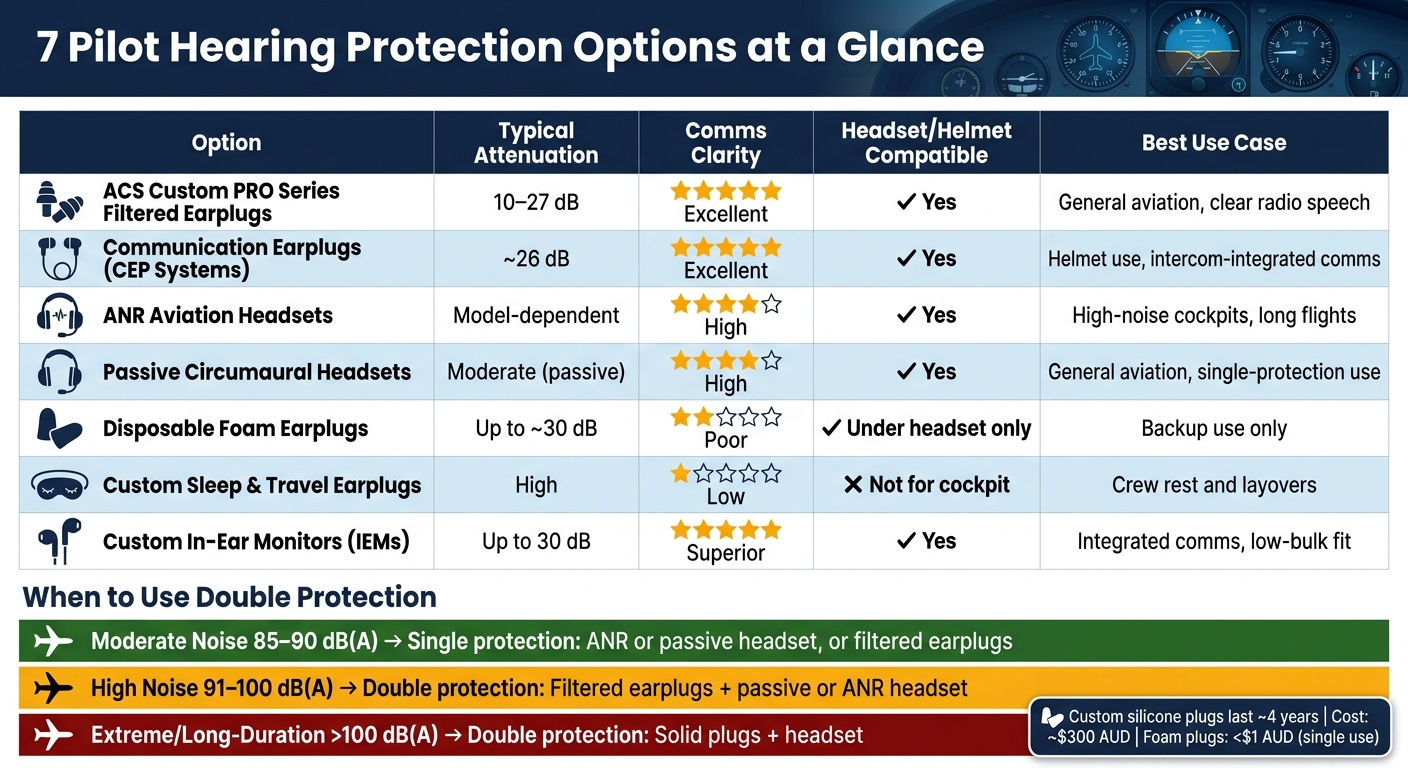
7 Pilot Hearing Protection Options: Quick Comparison Guide
The tables below give you a fast side-by-side view of the seven options. Use them to line up noise level, comms needs, and how long you’ll wear them with the best fit.
Comparison table: 7 pilot hearing protection options
| Option | Typical Attenuation | Communication Clarity | Headset/Helmet Compatibility | Ideal Use Case | Approx. Cost ($AUD) |
|---|---|---|---|---|---|
| ACS Custom PRO Series Filtered Earplugs | 10–27 dB | Excellent | High | General aviation; clear radio speech | Mid–high |
| Communication Earplugs (CEP Systems) | ~26 dB | Excellent - intercom-integrated | Helmet and headset compatible | Helmet use | Mid–high |
| ANR Aviation Headsets | Model-dependent | High | High | High-noise cockpits | High |
| Passive Circumaural Aviation Headsets | Moderate, passive | High | High | General aviation; single-protection use | Mid |
| Disposable Foam Earplugs | Variable (up to ~30 dB) | Poor - muffled audio | Compatible under headsets | Backup use only | Very low |
| Custom Sleep and Travel Earplugs | High | Low - no filter for comms | High | Crew rest and travel | Mid |
| Custom In-Ear Monitors (IEMs) | Up to 30 dB | Superior - direct in-ear driver | High - flush fit under helmets and passive headsets | Pilots needing integrated comms | High |
Comparison table: single vs double protection
As exposure goes up, the setup usually shifts from single protection to layered protection. Double protection can lift attenuation, but there’s a trade-off: speech may be harder to follow.
| Flight Environment | Noise Level (Approx.) | Recommended Setup |
|---|---|---|
| Moderate-noise | 85–90 dB(A) | Single: ANR or passive headset, or filtered earplugs |
| High-noise | 91–100 dB(A) | Double: Filtered earplugs + passive or ANR headset |
| Extreme or long-duration | >100 dB(A) | Double: Solid plugs + headset |
Treat this as a quick rule of thumb, not a substitute for an aircraft-specific check. In moderate-noise cockpits, single protection is often enough. In louder aircraft, or when exposure stretches out, double protection tends to make more sense.
Final Thoughts
Start with the table above to narrow your options, then choose based on the conditions you fly in most often. For pilots, the right hearing protection usually comes down to three things: the aircraft, the length of the duty, and how clear comms need to be.
Match the option to your aircraft and duty profile
Helicopter and turboprop pilots often need more attenuation than light GA pilots. That makes high-attenuation filtered earplugs such as the ACS Custom PRO 27 a strong fit, with double protection worth using in very loud conditions. In quieter jet cockpits, lower-attenuation filtered plugs can help protect hearing without taking too much out of radio calls and cockpit conversation.
If you wear a helmet, low-profile custom plugs that sit flush in the ear canal can help avoid pressure points over a long shift. It also makes sense for most pilots to keep a second option on hand for ground work or louder sectors.
Build a practical hearing conservation kit
A practical kit should include:
- Filtered communication earplugs for the cockpit
- High-attenuation plugs for ramp walks and maintenance checks
- Custom sleep and travel earplugs for rest during layovers or in noisy crew accommodation
Custom products need ear impressions, but once those impressions are on file, reorders and filter swaps are usually much simpler.
The best hearing protection is the one you can wear consistently on every sector.
FAQs
How do I choose the right attenuation for my aircraft?
Start with a professional noise assessment to find your exposure levels. In Australia, hearing protection should meet AS/NZS 1270:2002 and aim to bring noise down to 75–80 dB(A). That way, you stay protected without blocking out critical communication, alarms, and warnings.
If noise goes above 105–110 dB(A), use dual protection: custom earplugs plus earmuffs. ACS Custom’s PRO Series filters range from 10 dB to 27 dB.
When should I use earplugs and a headset together?
Use earplugs and a headset together, known as dual protection, in very loud spaces above 105–110 dB(A).
One device can only do so much. In practice, attenuation tops out at about 35–40 dB because sound can still reach the inner ear through bone conduction.
That’s why pairing earplugs with earmuffs matters in these conditions. The combo usually adds about 5 dB beyond the higher-rated device alone, which can make a big difference when safe exposure times are measured in minutes or even seconds.
Are custom filtered earplugs worth the cost for pilots?
Yes. Custom filtered earplugs are worth the spend for pilots.
Unlike generic foam plugs, custom-moulded earplugs sit securely and stay comfortable over long shifts. They also help protect clear radio communications and the small cabin sounds pilots need to hear.
They can make sense on cost too. With an upfront price of about A$180 to A$300 and a lifespan of 4 to 5 years, they can cut repeat spending compared with disposable options.


