

In-ear monitors (IEMs) are essential for musicians who want clear sound, hearing protection, and control during live performances. Unlike traditional stage monitors, IEMs deliver a personalised audio mix directly to your ears while blocking out external noise. They consist of three main components: a transmitter, a receiver, and earpieces. Here's how they work:
- Custom Sound Mix: Your audio mix is created on a mixer and sent wirelessly from a transmitter to a belt-pack receiver.
- Noise Isolation: Custom-moulded IEMs block 25–40 dB of external noise, letting you hear clearly at lower volumes.
- Driver Technology: IEMs use drivers (balanced armature, dynamic, or hybrid) to produce detailed sound across low, mid, and high frequencies.
Key benefits include improved sound clarity, reduced risk of hearing damage, and the ability to customise your mix for better performance. Custom-fit IEMs, like those from ACS Custom, offer greater comfort and a secure seal, making them ideal for extended use. Whether you're a drummer, vocalist, or guitarist, IEMs can transform your live experience.
How In-Ear Monitors Work
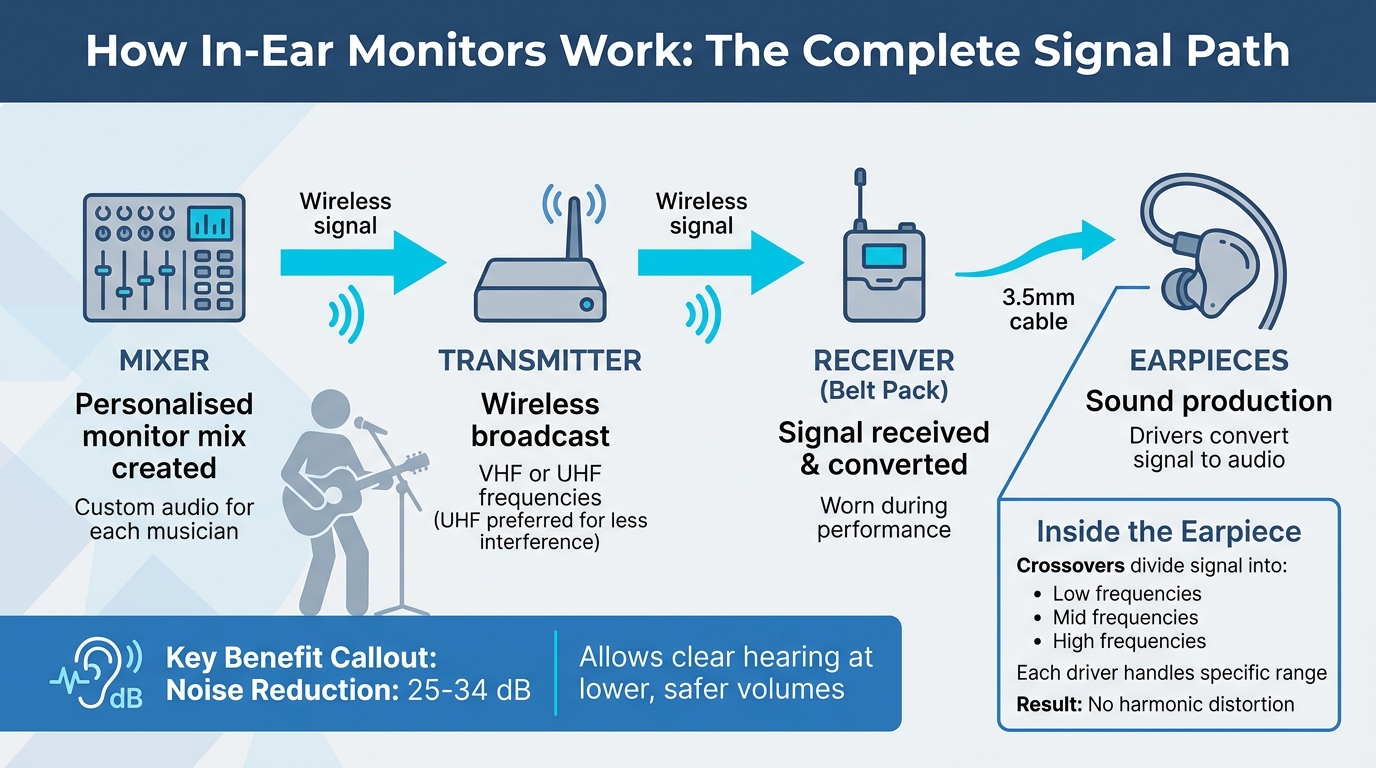
How In-Ear Monitors Work: Signal Flow from Mixer to Earpiece
IEM systems rely on three main components to deliver clear, isolated audio - essential for professional musicians.
Main Parts of an IEM System
An IEM system includes a transmitter, receiver, and earpieces. The transmitter, typically located offstage, wirelessly sends your audio mix using either VHF or UHF frequencies. UHF is often preferred because it’s less prone to interference, which results in higher sound quality.
The receiver is a belt-pack device worn during performances. It picks up the wireless signal from the transmitter, converts it back into audio, and sends it through a 3.5mm cable to the earpieces. Inside the earpieces, drivers transform the signal into sound.
Now, let’s look at how these components work together to produce sound.
How Sound Is Produced in IEMs
The process begins with your mixer creating a personalised monitor mix. This mix is sent to the transmitter, which broadcasts it wirelessly to the receiver. The receiver, in turn, delivers the signal to the earpieces via a cable. High-quality cables, such as ACS Custom's Classic Evolve IEM cable made with 80 strands of silver-plated oxygen-free copper, ensure stable and reliable connectivity.
Within the earpieces, crossovers divide the signal into low, mid, and high frequencies. Each driver is responsible for reproducing a specific frequency range, which eliminates harmonic distortion. The result? A sound profile that ACS Custom describes as offering a "reliable flat frequency response", with tight low end, detailed mids, and precise highs.
Custom-fit IEMs also deliver noise reduction of 25 to 34 decibels by sealing off your ear canal. This isolation allows you to hear your mix clearly at lower volumes, while also protecting your hearing.
Understanding this process lays the groundwork for exploring the different driver technologies used in IEMs.
Types of Drivers Used in IEMs
Balanced armature drivers are a favourite in professional-grade IEMs. Originally designed for hearing aids, they use a tiny reed within a magnetic field to produce sound with outstanding clarity and quick response. High-end IEMs can feature up to 18 balanced armature drivers per ear for a broader dynamic range.
Dynamic drivers, on the other hand, function like traditional speakers, using a diaphragm attached to a voice coil. They are often chosen for their deep, powerful bass. Hybrid systems combine the strengths of both technologies, such as using a dynamic driver for bass while employing balanced armatures for sharp mids and highs.
| Driver Type | Mechanism | Primary Benefit |
|---|---|---|
| Balanced Armature | Miniature reed in a magnetic field | Exceptional detail, fast response, compact size |
| Dynamic | Diaphragm with attached voice coil | Strong bass response |
| Hybrid | Combination (e.g., Dynamic + Armature) | Blends impactful bass with detailed highs |
For example, ACS Custom's Ambient Emotion Hybrid, priced at $2,100, merges different driver technologies to deliver full-spectrum sound with rich bass. It’s especially suitable for drummers and bassists who need robust low-end performance. The five-driver Ambient Emotion includes one low, two mid, and two high drivers to achieve this balance.
sbb-itb-80b2a19
Benefits of In-Ear Monitors for Musicians
Better Sound Quality and Noise Blocking
In-ear monitors (IEMs) deliver incredibly clear audio, thanks to high-fidelity drivers positioned right in your ear canal. This design eliminates muddled sound and stage feedback. According to audio experts, IEMs can improve the signal-to-noise ratio by 20–30 dB, while foam tips or custom moulds physically block 25–40 dB of ambient noise. This setup ensures you catch even the subtlest harmonics and vocal details, making it easier to stay on pitch during live performances.
For drummers, especially in loud venues, this isolation is a game-changer. It allows them to clearly hear rhythm sections that might otherwise be lost amidst cymbal crashes and drum kit resonance. Beyond just sound clarity, IEMs give musicians the tools to fine-tune their audio experience to perfection.
Personalised Monitor Mixes
One of the standout features of IEMs is the ability to customise your monitor mix. Musicians can amplify specific elements in their mix by 6–10 dB, whether it’s a vocalist boosting their voice or a guitarist focusing on their instrument. This level of control enhances ensemble synchronisation by 15–20%. Click tracks also come through with pinpoint clarity, which is crucial for performances where timing is everything.
Guitarists, in particular, report hitting fewer off-pitch notes during long sets because they no longer rely on the inconsistent sound bouncing off walls and floor monitors. Unlike shared wedges, IEMs give you complete control over your mix while also ensuring your ears are protected in high-volume settings.
Hearing Protection and Comfort
Stage volumes often reach levels above 110 dB, far exceeding the safe limit of 85 dB for an eight-hour period. IEMs help musicians maintain safe listening levels (85–100 dB) while reducing external noise by 20–30 dB, significantly lowering the risk of long-term hearing damage. Health experts recommend IEMs for musicians performing over four hours a week, as they are four times more likely than the general population to experience hearing loss, with 34% reporting tinnitus.
Custom-fit IEMs, such as those offered by ACS Custom, use medical-grade silicone to create a secure seal. These provide over 30 dB of noise attenuation while remaining comfortable during extended performances. Professional drummer Will Taylor highlights their impact:
"I'm coming back from drumming on tours feeling good and without any ears fatigued. The difference in sound quality and how they fit was night and day against the other generic brands I've used."
In the humid conditions of Australian festivals, musicians often choose custom IEMs for their lightweight design, which reduces jaw tension and prevents the sweat buildup common with bulky floor wedges.
Equipment Needed for In-Ear Monitor Systems
Core Equipment: Mixer, Transmitter, Receiver, and IEMs
An in-ear monitor (IEM) system relies on four critical components: a mixer, transmitter, receiver, and the in-ear monitors themselves. The mixer creates a personalised audio mix, which the transmitter sends wirelessly to the belt-pack receiver. From there, the receiver delivers the audio directly to the IEMs, providing musicians with clear and isolated sound.
This wireless setup eliminates the need for traditional floor wedges and messy cables, giving performers the freedom to move around while enjoying a tailored sound mix. Once these core pieces are in place, opting for custom-fit IEMs can take your setup to the next level.
Custom-Fit IEMs and Their Advantages
Custom-fit IEMs are made using medical-grade silicone moulded to your ear impressions, ensuring a perfect fit. ACS Custom offers a range of options, from the entry-level Classic Evoke2 priced at $500.00 to the premium Ambient Emotion Hybrid, which costs $2,100.00.
The Ambient series stands out with patented filters that provide 17 dB attenuation while maintaining your ability to hear your surroundings. This vented design minimises the "occlusion effect" - that uncomfortable, blocked-ear sensation - and lets you pick up off-stage cues without needing to remove the IEMs. The snug fit also eliminates pressure points, making them comfortable for extended use compared to universal-fit models.
Professional drummer Ciara Chinniah highlights their benefits:
"If you are looking for IEM's that not only deliver on fantastic sound but also guarantee comfort and sound protection, look no further."
Cables, Batteries, and Maintenance Tools
Reliable signal transmission and proper care are essential for a flawless performance. High-quality IEM cables are built to last, featuring up to 80 strands of oxygen-free copper plated with pure silver, reinforced with durable Kevlar fibres. Avoid disconnecting cables too often, as this can weaken the sockets and lead to audio dropouts.
Moisture is one of the biggest threats to IEMs. Using an electronic dryer like the ACS Revivo2 for 8 hours not only removes moisture but also sterilises the monitors with UV light. After every use, clean the sound ducts with a wire pick to prevent earwax from reaching internal components. During travel, store your IEMs with silica gel packets to keep them dry, and apply a small amount of comfort cream to the in-ear portion to improve the seal and protect your ears from irritation.
Additional must-haves include a 3.5mm to 1/4" adapter for connecting to mixers and a sturdy carry case to protect your equipment while on the road.
Setting Up and Adjusting Your In-Ear Monitor System
Getting your in-ear monitor (IEM) system set up properly is key to achieving consistent, high-quality audio during live performances.
Connecting Audio and Building Monitor Mixes
Start by plugging all microphones and instruments into your mixer. Use the aux sends on your mixer to assign specific outputs for each musician, allowing them to have their own customised monitor mix. These outputs are then connected to a wireless transmitter, which sends the audio signal to each performer's belt pack receiver, where the IEMs are plugged in directly.
For performers who remain in one spot, like drummers or keyboard players, a wired IEM setup can be a more affordable option.
If the noise-cancelling nature of IEMs makes you feel disconnected from the audience, try setting up a microphone to capture the ambient room sound. Mixing this ambient audio into your IEM feed can help you feel more in touch with the crowd while still protecting your hearing. Many modern digital mixers also let band members control their own monitor mixes using a smartphone or tablet, which cuts down on the need for constant adjustments by a sound engineer.
It’s best to create your monitor mixes during rehearsals. Features like the "More Me" slider make it easier to adjust your own instrument or vocal level compared to the rest of the band. Once you’ve fine-tuned your mix, save it as a preset for a consistent starting point at every performance.
After setting up your mixes, the next step is to test and adjust your system for optimal performance.
Testing and Fine-Tuning Your Setup
Before performing, make sure your IEMs fit securely and form an airtight seal in your ear canal. A poor fit can lead to weak bass and let in unwanted noise.
If your mixer allows, take advantage of a virtual soundcheck. This feature lets you record a rehearsal and play it back through your system, so you can fine-tune mixes without needing the entire band to play live. Using stereo mixes instead of mono can also improve clarity, as panning instruments left or right helps separate individual parts more effectively.
During setup, balance your levels to minimise the need for adjustments during the show. Walk around the stage to test your wireless range, ensuring there are no dead spots. Also, check that your transmitter antenna is unobstructed and that your batteries are fully charged.
Fixing Common IEM Problems
Once your system is set up, you might encounter some common issues. Here’s how to address them:
- Audio dropouts: These are often caused by damaged cables or RF interference. Try replacing the cable first. If the problem continues, rescan for a clean frequency and double-check your antenna placement.
- Distorted or weak sound: This is usually due to a poor seal in your earpiece or wax build-up. Clean the sound ducts after each use with a wire pick and ensure your IEMs fit correctly.
- Intermittent static: This can result from low batteries or RF interference. Replace your batteries immediately and ensure the transmitter antenna has a clear line of sight to the receivers.
- Hollow or phase-inverted sound: This may be caused by miswired cables or stereo-to-mono adapters. Inspect your wiring and make sure everything is connected properly.
If you feel overly isolated on stage, you can consider ambient-vented IEMs or add talkback channels to your mix. For example, the ACS Custom Ambient series reduces external sound by about 17 dB, allowing you to hear stage cues while still protecting your ears.
Conclusion: Improving Your Performance with In-Ear Monitors
In-ear monitors (IEMs) are a must-have for musicians who prioritise sound clarity, hearing protection, and precision on stage. With features like balanced armature drivers and snug, custom-fit designs, they not only enhance audio quality but also safeguard your hearing.
The benefits of IEMs are clear: they provide crisp audio, tailored mixes, and excellent noise isolation, all while protecting your ears during extended rehearsals and tours. Considering that about 60% of active musicians experience some form of hearing loss - four times the rate of the general population - custom-fit IEMs are a practical way to avoid becoming part of that statistic.
The choice between universal and custom-fit IEMs can also impact performance. Professional drummer Will Taylor swears by custom-moulded monitors from ACS Custom, crafted from soft medical-grade silicone. These provide a secure seal that generic foam tips simply can’t match, reducing ear fatigue during long tours. This level of comfort and fit is a game-changer for musicians who perform regularly.
Whether you're starting with an entry-level option like the Classic Evoke2 at $500.00 or going all-in with a premium system like the Ambient Emotion Hybrid at $2,100.00, investing in high-quality IEMs is an investment in both your performance and hearing health. For those who need to stay connected with their surroundings, the Ambient series offers a patented 17 dB filter that balances protection with situational awareness.
To get the most out of professional IEMs, you’ll need well-fitted ear impressions, regular maintenance, and proper mix management. By making the switch to quality IEMs, you’ll elevate every aspect of your live performances.
FAQs
Do I need UHF or VHF for my IEMs?
Ultra High Frequency (UHF) is often the go-to choice for in-ear monitors (IEMs) because it offers greater bandwidth, stronger resistance to interference, and more available channels. These qualities make it especially suitable for live performances, where reliability and clarity are crucial. On the other hand, Very High Frequency (VHF) systems are less commonly used due to their higher susceptibility to interference.
For Australian musicians, it's important to select UHF systems that meet local regulations. This ensures not only compliance but also dependable and clear audio transmission during performances.
Should I run my IEM mix in mono or stereo?
Deciding between mono or stereo for your IEM (In-Ear Monitor) mix comes down to your specific performance needs.
If you're performing live and want a more immersive sound experience with improved spatial awareness, stereo is the way to go. It allows you to hear instruments and vocals in distinct positions, which can help you stay more connected to the performance.
On the other hand, mono is a practical choice for simpler setups or when all performers require the same mix. It ensures consistency and eliminates the need for complex panning or separate mixes.
Ultimately, pick the option that provides clear communication, supports your performance, and prioritises your hearing health.
How do I stop feeling too isolated with IEMs?
To feel less isolated while using in-ear monitors (IEMs), here are a few things you can try:
- Opt for IEMs with ambient sound channels or models that allow custom blending of external sounds to stay aware of your surroundings.
- Tweak your monitor mix to include a touch of stage or ambient sound for a more natural listening experience.
- Make sure your IEMs fit well, and consider using noise reduction filters to strike a balance between sound isolation and environmental awareness.
These small changes can help you stay connected to your environment without compromising on sound quality.


