

Your hearing matters, and protecting it starts with choosing the right earplugs. Here’s what you need to know:
- Custom earplugs are moulded to your ear, providing a consistent fit and up to 90% of their rated noise reduction.
- Standard foam earplugs are cheaper but depend heavily on proper insertion, often delivering only 30–50% of their rated protection.
- Noise Reduction Rating (NRR) shows the potential noise reduction in ideal conditions. However, real-world performance is usually lower.
- For long-term use, custom earplugs offer better comfort, durability, and cost-effectiveness over time.
Quick Comparison
| Feature | Standard Foam Earplugs | Custom-Moulded Earplugs |
|---|---|---|
| Lab NRR Range | 25–33 dB | SNR 12–31 dB |
| Actual Performance | 30–50% of NRR | Up to 90% of rated NRR |
| Fit Dependence | High | Low |
| Comfort | Can cause discomfort | Comfortable for long wear |
| Cost | $30–$365/year | $100–$200 upfront, lasts 3–5 years |
Bottom line: Custom earplugs are a reliable choice for consistent noise reduction and comfort, especially for noisy workplaces or extended use. Foam earplugs are a budget-friendly option for short-term needs but may fall short in performance and comfort.
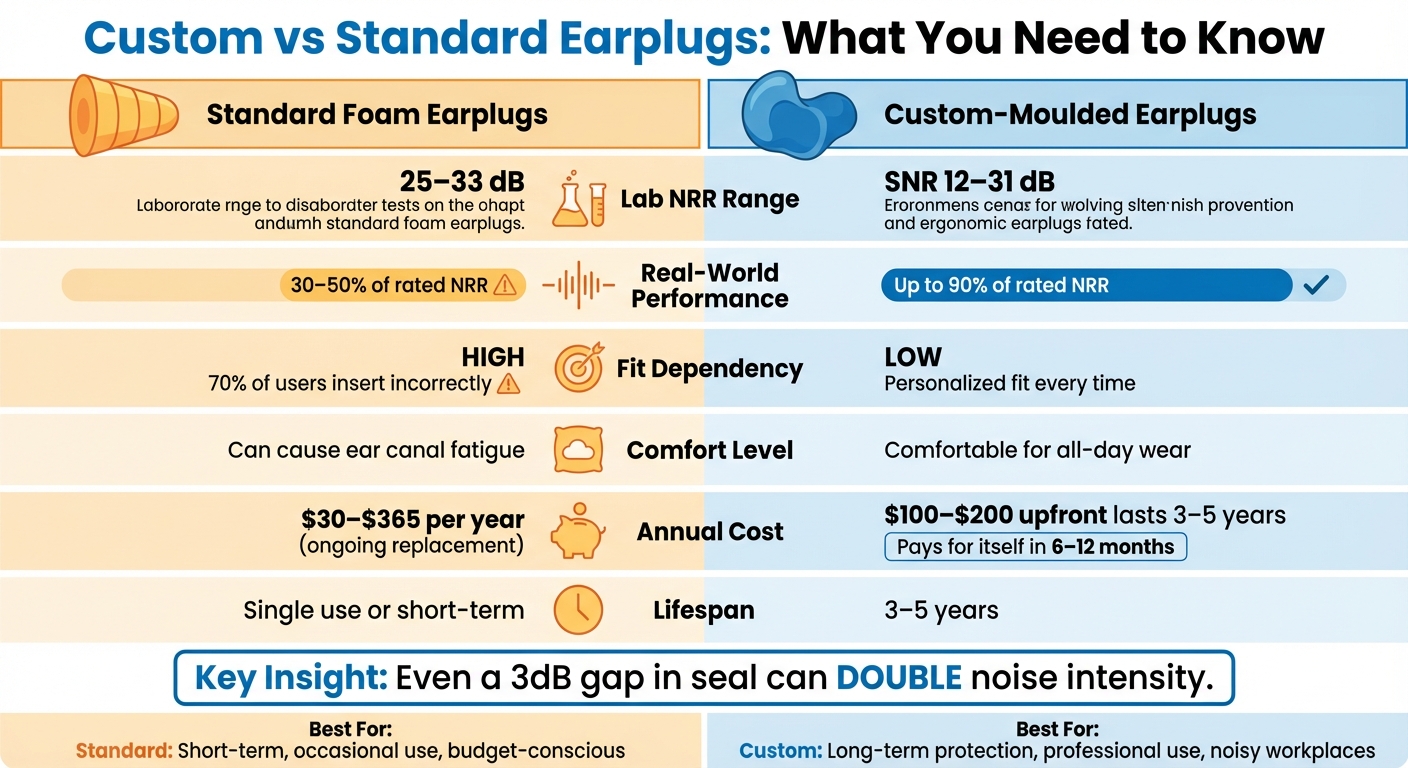
Custom vs Standard Earplugs: NRR Performance and Cost Comparison
$2 vs $20 vs $200 Earplugs for Concerts – Are Expensive Ones Worth It?
sbb-itb-80b2a19
What is Noise Reduction Rating (NRR)?
The Noise Reduction Rating (NRR) indicates the decibel reduction a hearing protector can achieve under ideal conditions. Essentially, it reflects the maximum level of noise protection possible with a perfect fit. The U.S. Environmental Protection Agency (EPA) established NRR as the standard measure for hearing protector effectiveness under Regulation 40 CFR Part 211 Subpart B, making it the go-to benchmark for comparing products.
That said, there's often a gap between lab-tested ratings and what users experience in real life. For example, an earplug with an NRR of 30 dB might not deliver that level of protection outside a controlled environment.
How NRR is Measured
NRR is determined through laboratory tests following ANSI S3.19 standards. These tests use a KEMAR manikin in a sound-controlled lab, where professionals repeatedly insert earplugs (usually five times) to account for fit variability.
While this approach ensures consistent and repeatable results, it doesn’t reflect how people typically use earplugs in real-world settings - whether at work, concerts, or at home. Even small fit issues can drastically impact performance. For instance, a shallow insertion can leave a tiny "pinhole" air gap, causing a resonant peak around 1,300 Hz. This can make sound pressure at the eardrum 12 dB louder than if no earplug were worn.
These controlled tests highlight why actual protection levels often fall short of the NRR printed on packaging.
Derating for Everyday Use
Since real-life use rarely matches lab conditions, the listed NRR often needs adjustment. OSHA suggests halving the lab-rated NRR to estimate real-world performance. If your earplugs have an NRR of 30 dB, you should expect closer to 15 dB of noise reduction in everyday situations.
This adjustment accounts for common issues like improper insertion, movement from talking or chewing, and natural differences in ear canal shapes. To stay protected, it’s wise to assume you’ll get only half the listed NRR and choose earplugs accordingly based on your noise exposure.
Grasping these concepts is key when comparing the NRR performance of standard versus custom-moulded earplugs.
Standard Earplugs: NRR and Performance
Standard earplugs come in various types, including foam, pre-moulded silicone, and universal-fit designs. They are widely available, budget-friendly, and made to accommodate different ear canal shapes.
Lab-Tested NRR for Standard Earplugs
In controlled lab settings, standard earplugs typically achieve a Noise Reduction Rating (NRR) between 22 and 33 dB. Most mid-range options fall within the 27–29 dB range, while lower-rated models start at 22 dB.
"The higher the NRR number associated with a hearing protector, the greater the potential for noise reduction." - Cooper Safety
However, real-world protection is often less than the NRR suggests. For example, an earplug rated at 33 dB provides roughly 13 dB of actual noise reduction, calculated using the formula (NRR - 7) / 2.
Performance Issues in Daily Use
The difference between lab-tested ratings and everyday performance mainly comes down to fit and seal quality. Standard earplugs rely heavily on being inserted correctly and forming a tight seal, which isn't always easy to achieve. Studies indicate that disposable earplugs often provide only 12–15 dB of real-world protection. Factors like shallow insertion, ear movement, and variations in ear canal size can reduce their effectiveness by as much as 50%.
For instance, at a 100 dB rock concert, earplugs with a 33 dB rating might only lower the noise level to about 87 dB. This is still above the 85 dB threshold where prolonged exposure requires hearing protection under OSHA guidelines.
Up next, we’ll explore how custom-moulded earplugs tackle these performance limitations.
Custom-Moulded Earplugs: NRR and Benefits
Custom-moulded earplugs are crafted from medical-grade silicone, using impressions taken from the individual’s ears. This tailored approach creates a snug fit that matches the unique shape of the ear canal, offering excellent noise reduction and comfort.
Lab-Tested NRR for Custom Earplugs
In laboratory settings, custom earplugs demonstrate impressive Single Number Ratings (SNR), ranging from 12 to 31 dB. Many high-quality options also meet Class 5 safety certification standards under the Australian and New Zealand guidelines (AS/NZS 1270:2002). Thanks to their precise fit, these earplugs deliver consistent noise protection, even in real-world scenarios where conditions can vary.
Performance and Comfort in Daily Use
Beyond their lab-tested capabilities, custom earplugs excel in daily environments. They stay securely in place, even during physical activity, making them ideal for industries like mining, aviation, motorsport, and food production. Users often find them so comfortable they’re barely noticeable, even after hours of wear. Plus, the durable silicone material retains its shape and effectiveness over time, unlike disposable foam plugs that can wear out with frequent use.
Custom vs Standard Earplugs: NRR Comparison
When it comes to noise reduction, the debate between standard and custom earplugs often boils down to performance and practicality. Standard foam earplugs work by compressing and expanding to fit the ear canal. However, this mechanism can lead to inconsistent sealing. In fact, approximately 70% of users insert foam earplugs incorrectly, achieving only 30–50% of their rated Noise Reduction Rating (NRR). On the other hand, custom-moulded earplugs are crafted to match the unique shape of your ear, providing a reliable seal and delivering up to 90% of their rated protection by eliminating common fitting errors.
Cost is another factor to consider. Foam earplugs are cheaper upfront, costing between $30 and $365 annually due to frequent replacements. Custom earplugs, with an initial cost of $100–$200, can last 3–5 years, making them a cost-effective solution that often pays for itself within 6–12 months. Beyond the financial aspect, comfort is a significant advantage of custom earplugs. While foam earplugs can cause discomfort and ear canal fatigue during prolonged use, custom options are designed for all-day wear, offering a snug yet pressure-free fit.
Comparison Table
Here’s a side-by-side look at how the two types of earplugs compare:
| Metric | Standard Foam Earplugs | Custom-Moulded Earplugs |
|---|---|---|
| Lab NRR Range | 25–33 dB | SNR 12 to 31 dB |
| Actual Attenuation | 30–50% of rated NRR | Up to 90% of rated protection |
| Fit Dependency | High (user-dependent) | Low; consistent seal |
| Comfort | Can cause ear canal fatigue | Designed for extended wear |
| Cost Factors | Low upfront; $30–$365 annually | $100–$200 upfront; pays for itself in 6–12 months |
This comparison makes it clear why many professionals opt for custom earplugs. They offer dependable noise protection, greater comfort, and long-term value. At ACS Custom, we specialise in tailor-made hearing protection designed to perform reliably in daily use, ensuring you get the most out of your investment.
Factors Affecting NRR Performance in Daily Use
Lab ratings might provide a baseline, but they don't always reflect what happens in real life. Noise reduction in your day-to-day use depends on how well earplugs perform outside controlled testing environments. One of the biggest influences? How they fit and seal.
Fit and Seal Quality
The effectiveness of earplugs hinges on how well they seal your ear canal. Even the smallest gap can make a huge difference - just a 3dB increase can double the intensity of the noise you’re exposed to. This is where custom earplugs stand out.
Foam earplugs rely on being compressed, inserted, and then expanding to create a seal. But this process depends heavily on proper technique. For example, skipping the "roll-pull-hold" method can leave the seal incomplete. On the other hand, custom-moulded earplugs are crafted to fit the unique shape of your ears, ensuring a snug fit every time. One user, Aravinda, shared their experience:
"I often find myself checking to see if they've fallen out as they are so comfortable and they don't ruin sound quality"
This tailored fit not only provides excellent noise isolation but also maintains sound clarity, avoiding the muffled sensation often associated with foam earplugs. Another user, Matt, who works in a noisy environment, highlighted the benefits:
"The plugs are comfortable and I can hear the radios clearer than I ever have. All the damaging noise levels are a lot quieter."
Material Quality and Durability
Material choice plays a big role in both comfort and long-term performance. For instance, ACS Custom's custom earplugs are made from medical-grade soft silicone. This material is durable, comfortable, and environmentally friendly, ensuring the seal remains effective even with daily wear.
In contrast, standard foam earplugs are designed for short-term use. They degrade quickly with repeated use, making them less reliable over time. High-quality silicone earplugs, however, can meet Class 5 certification under Australian standards (AS/NZS1270:2002) and achieve up to SNR 31 under European standards (BS EN352-2). These certifications highlight how material quality directly impacts both safety and real-world effectiveness, reinforcing the importance of investing in better ear protection.
Conclusion: Choosing the Right Earplugs for Your Needs
Selecting earplugs isn’t just about chasing the highest Noise Reduction Rating (NRR) - it’s about finding protection that aligns with your specific needs. While standard foam earplugs may suffice for occasional or short-term use, they often lack the consistency, comfort, and reliable fit required for long-term or professional use.
For those working in high-noise environments - whether it’s mining, aviation, music, or other industries where hearing protection is critical - custom-moulded earplugs stand out. They offer a secure, personalised fit that ensures an effective seal throughout the day. As Josh, a long-time user, shared:
"Amazing sound quality and wearability (Pro series). Well worth the investment for anyone wearing ear protection for extended periods".
Custom earplugs go beyond simply blocking noise. If you need to maintain clear communication or preserve sound fidelity, options like the Pro series with acoustic filters deliver protection without the muffled sensation often associated with generic foam plugs. This is thanks to the tailored seal, which reduces noise effectively while maintaining sound clarity. Michael, a music teacher and violinist, highlighted this benefit:
"As a music teacher and violinist in orchestras I've been searching for a comfortable set of earplugs that don't make me sound like I'm under water! These pro15 fit the bill".
Additionally, compliance with safety standards is a cornerstone of effective hearing protection. For workplaces with extreme noise levels, look for earplugs that meet Class 5 certification under AS/NZS 1270:2002 or feature Single Number Ratings (SNR) up to 31, ensuring they meet your specific requirements. Custom-moulded earplugs, crafted from medical-grade soft silicone, not only meet these standards but also provide durability that far outlasts disposable alternatives.
FAQs
How do I estimate real-world noise reduction from an earplug’s NRR?
To estimate noise reduction in everyday settings, start by applying a 50% reduction to the Noise Reduction Rating (NRR) to better reflect typical conditions of use. Then, subtract 7 dB from this adjusted NRR. This step accounts for the gap between controlled lab results and actual performance, giving you a more realistic idea of how well the earplugs will work in real-world environments.
What’s the easiest way to tell if my foam earplugs are fitted properly?
The simplest way to see if your foam earplugs are fitted correctly is to take them out after they've had about a minute to expand in your ear. If they feel secure, stay in position, and don't cause any discomfort or leave gaps, you've got them fitted properly.
How do I choose the right NRR/SNR for my noise level without overblocking sound?
To pick the right NRR (Noise Reduction Rating) or SNR (Single Number Rating), think about the noise levels you’re exposed to and aim for a balance between protection and awareness. Select a rating suited to your environment - if noise levels exceed 85 dBA, ensure harmful sounds are reduced without completely blocking out important ones. For a more personalised option, custom earplugs can provide a snug fit, delivering effective protection while minimising the risk of overblocking sounds you need to hear in everyday situations.
Partnering for Your Hearing Health: earLAB & ACS Custom
At earLAB, we are proud to support the ACS Custom community by providing the clinical expertise necessary to protect and enhance your listening experience. Whether you are a musician, an audiophile, or an industry professional, your hearing health is our priority. Our Melbourne-based clinics offer a full suite of specialised services, including professional ear impression taking for a perfect ACS fit, safe microsuction earwax removal to ensure clear sound delivery, and comprehensive hearing tests to monitor your auditory health. As an independent clinic, we also provide expert hearing aid fittings and rehabilitation, offering unbiased advice on the latest technology tailored to your lifestyle. Book your appointment at locations to ensure your ears—and your ACS devices—are performing at their absolute best.
Related Blog Posts
- Foam vs Silicone vs Custom Earplugs: Full Comparison
- Custom vs Universal Earplugs: Which Is Right for You?
- Best Earplugs for Sleeping: Complete Buyer's Guide
- Custom Ear Protection FAQs: Everything You Need to Know


